Facts
The applicant, Narayan Singh Bundela, Deputy Chief Engineer, Construction Base, Central Railway, was accused of demanding ₹1,00,000 as illegal gratification from complainant Abhishek Pyasi for processing and facilitating approximately ₹1 crore in pending dues payable to M/s Vikas Stone Crushing Company.
Source reference: para. 6; p. 3The CBI organised a trap on 4 June 2026 at Hotel Paradise, Sagar, during which the applicant allegedly accepted the tainted currency notes; the notes were subsequently recovered from the pocket of his trousers.
Source reference: para. 6; p. 3Crime No. RC0092026A0003 was registered by the CBI, ACB, Jabalpur, for an offence under Section 7 of the Prevention of Corruption Act, and the applicant remained in judicial custody from 7 June 2026.
Source reference: p. 1; para. 6He filed his first application under Section 483 of the Bharatiya Nagarik Suraksha Sanhita, 2023, contending that the relevant bills were not pending before him, that the initial conversation did not disclose any demand, that the investigation was complete, and that further custody was unnecessary.
Source reference: para. 4The CBI opposed bail on the grounds that the applicant had been caught accepting the bribe, but confirmed that he had no criminal antecedents.
Source reference: para. 5Issues
Whether the applicant should be released on bail under Section 483 of the Bharatiya Nagarik Suraksha Sanhita, 2023, despite the allegation that he demanded and accepted ₹1,00,000 as illegal gratification under Section 7 of the Prevention of Corruption Act.
Source reference: paras. 4–9Whether the circumstances of the case—including completion of investigation, absence of criminal antecedents, lack of flight risk, and absence of a demonstrated likelihood of witness tampering—justified continued incarceration pending trial.
Source reference: paras. 7–9Law Applied
The Court exercised its jurisdiction under Section 483 of the Bharatiya Nagarik Suraksha Sanhita, 2023, governing the grant of bail by the High Court or Court of Session.
Source reference: p. 1The alleged offence was under Section 7 of the Prevention of Corruption Act, concerning demand, acceptance, or obtaining of undue advantage by a public servant.
Source reference: paras. 1 and 6In assessing bail, the Court considered the prima-facie nature of the allegations, the period and necessity of custody, the likelihood of the accused fleeing from justice, the possibility of tampering with evidence or influencing witnesses, the existence of criminal antecedents, and the expected duration of trial.
Source reference: paras. 6–9The applicant relied upon Vihan Kumar v. State of Haryana, (2025) 5 SCC 799, and Mihir Rajesh Shah v. State of Maharashtra, (2026) 1 SCC 500, in support of bail where the alleged offence is punishable with imprisonment up to seven years.
Source reference: para. 4Bail was made subject to conditions requiring attendance, abstention from similar offences, non-interference with witnesses or evidence, and compliance with the provisions corresponding to Section 309 of the CrPC and Section 346 of the BNSS.
Source reference: para. 10Reasoning
The Court found that the applicant’s submissions—particularly that the relevant bills were not pending before him and that the initial conversation did not clearly establish a demand—had prima-facie substance, although their ultimate truth would have to be determined at trial.
Source reference: para. 6The alleged recovery of tainted currency and the prosecution’s case concerning demand and acceptance were therefore not finally adjudicated at the bail stage.
Source reference: no citationSince the final report had been submitted, further custodial interrogation was not required.
Source reference: para. 4The Court also noted that the applicant had no criminal antecedents, held a responsible public position, had dependent family members, and was not shown to present a flight risk or a substantial likelihood of influencing witnesses or tampering with evidence.
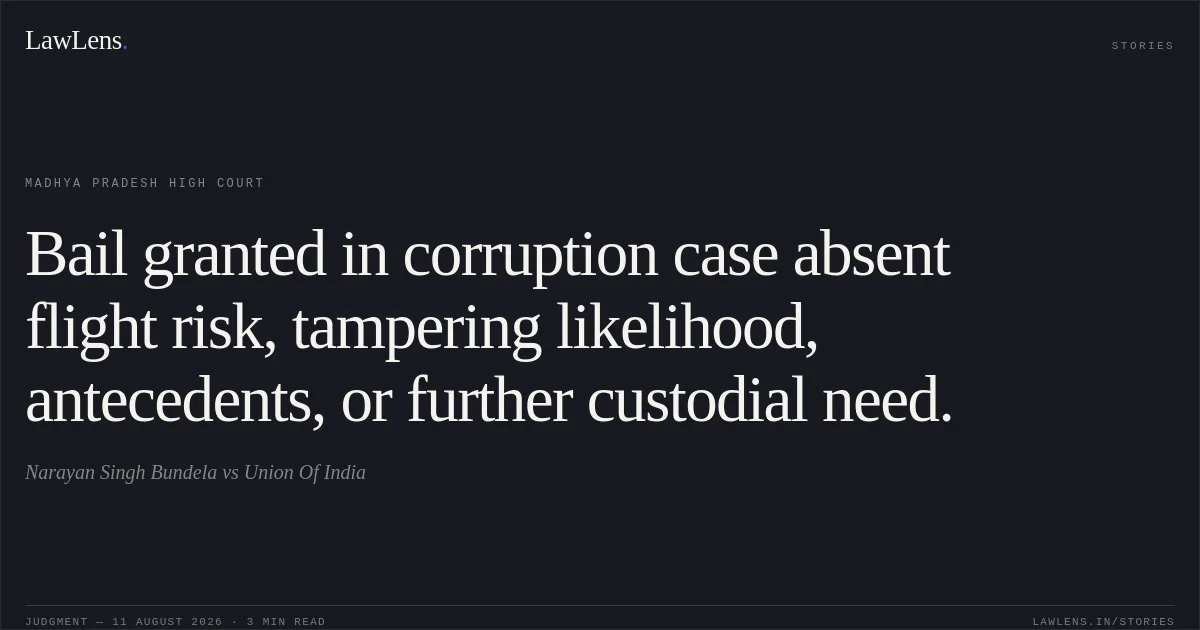
Source reference: para. 8Balancing these factors against the seriousness of the allegation, and considering that the trial would take time, the Court found no compelling reason for continued incarceration, while expressly reserving the merits for determination during trial.
Source reference: paras. 8–9Holding
The High Court allowed the bail application and directed that Narayan Singh Bundela be released in Crime No. RC0092026A0003 upon furnishing a personal bond of ₹1,00,000 with one surety of the same amount to the satisfaction of the trial Court.
Bail was granted subject to conditions requiring his presence at each hearing, prohibiting involvement in similar offences, inducement or intimidation of persons acquainted with the facts, and tampering with evidence or witnesses; he was also required to ensure compliance with the provisions concerning examination of witnesses in attendance.
Source reference: para. 10The order was made effective until the conclusion of trial, subject to cancellation of bail by the trial Court upon breach of the conditions.
Source reference: paras. 11–12Acts & Sections Cited
4 provisions across 3 statutes referred to in this judgment. Each provision opens on LawLens.
Bharatiya Nagarik Suraksha Sanhita, 20232
Prevention of Corruption Act, 19881
Code of Criminal Procedure, 19731
Original Court PDF
Narayan Singh BundelavsUnion Of India
Click to open original judgment
Original judgment, available to read, download and summarize on LawLens.in