Facts
The petitioners, government surveyors, were accused of demanding a bribe in connection with surveying the complainant’s land pursuant to a civil court order.
Source reference: paras. 1, 3; pp. 3–5The complainant alleged that the demand of ₹10 lakhs was negotiated down to ₹5 lakhs.
Source reference: paras. 1, 3; pp. 3–5On 21 August 2026, the petitioners were apprehended in a trap while receiving ₹2 lakhs in tainted currency.
Source reference: paras. 1, 3, 6–7; pp. 3–5They were arrested and remanded to judicial custody.
Source reference: paras. 1, 3, 6–7; pp. 3–5Their bail application before the Trial Court was rejected on 1 September 2026, after which they sought regular bail under Section 483 of the BNSS, 2023.
Source reference: paras. 1, 3, 6–7; pp. 3–5The alleged offence was under Section 7(a) of the Prevention of Corruption Act, 1988.
Source reference: paras. 1, 3, 6–7; pp. 3–5Issues
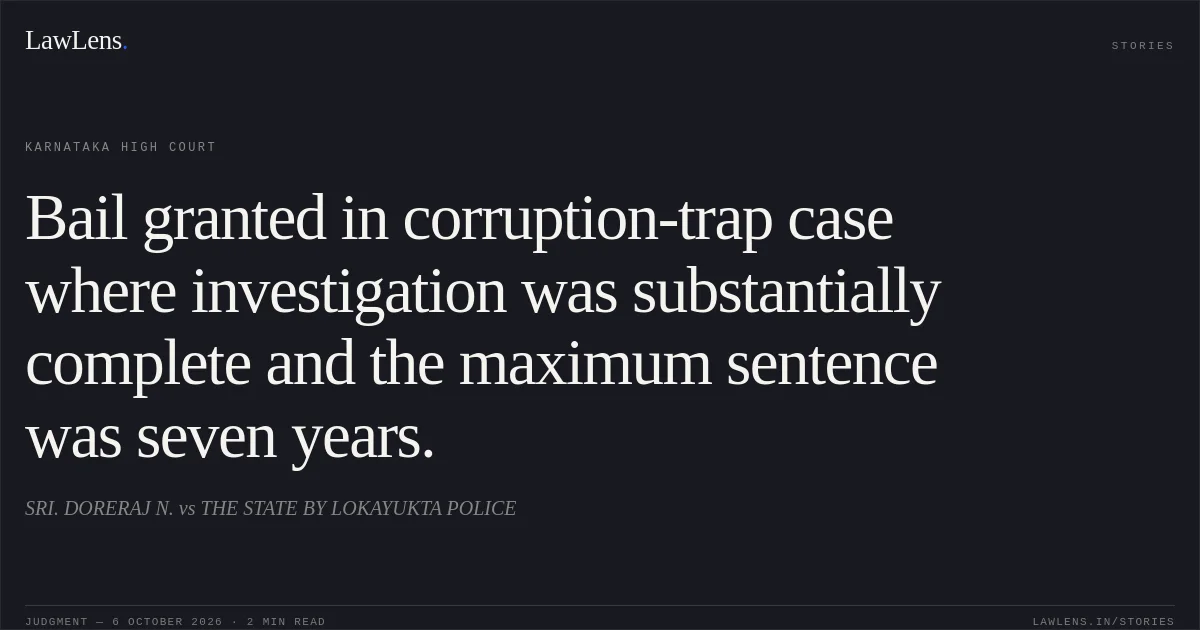
Whether the petitioners should be enlarged on regular bail while facing prosecution under Section 7(a) of the Prevention of Corruption Act, 1988.
Source reference: paras. 1, 4–7; pp. 3–6Law Applied
The petitions were brought under Section 483 of the Bharatiya Nagarik Suraksha Sanhita, 2023, which provides for the High Court’s power to grant bail.
Source reference: paras. 1, 4, 7; pp. 3, 5–6The alleged offence was punishable under Section 7(a) of the Prevention of Corruption Act, 1988, for which the Court noted a maximum punishment of seven years’ imprisonment.
Source reference: paras. 1, 4, 7; pp. 3, 5–6In assessing bail, the Court considered the circumstances of the alleged trap, the stage of investigation, the petitioners’ custody and criminal antecedents, and the applicable punishment.
Source reference: paras. 1, 4, 7; pp. 3, 5–6No judicial precedent was cited.
Source reference: paras. 1, 4, 7; pp. 3, 5–6Reasoning
The Court considered the prosecution’s allegation that the petitioners had been caught receiving ₹2 lakhs in a trap, but also noted that in a trap case the major part of the investigation is ordinarily completed on the day of the trap, apart from awaiting the FSL report.
Source reference: paras. 5–7; pp. 4–6The petitioners had been in custody since 21 August 2026; the alleged offence carried a maximum sentence of seven years; and the prosecution did not dispute that they had no criminal antecedents.
Source reference: paras. 5–7; pp. 4–6On those circumstances, the Court found that bail was warranted, subject to conditions addressing attendance, witness interference, further offending and travel.
Source reference: paras. 5–7; pp. 4–6Holding
The High Court allowed both petitions and ordered the petitioners’ release on bail in Crime No. 7/2026.
Each petitioner was required to execute a personal bond of ₹1,00,000 with two sureties for the like sum, and to comply with conditions including regular attendance before the Trial Court, non-interference with prosecution witnesses, refraining from similar offences, and not leaving the Trial Court’s jurisdiction without permission until disposal of the case.
Source reference: para. 8; pp. 6–7Acts & Sections Cited
3 provisions across 3 statutes referred to in this judgment. Each provision opens on LawLens.
Code of Criminal Procedure, 19731
Bharatiya Nagarik Suraksha Sanhita, 20231
Prevention of Corruption Act, 19881
Original Court PDF
SRI. DORERAJ N.vsTHE STATE BY LOKAYUKTA POLICE
Click to open original judgment
Original judgment, available to read, download and summarize on LawLens.in