Facts
The Applicant was accused of being an active Maoist involved in anti-government activities, including propagating Maoist ideology, organizing meetings in forest areas, and establishing a training camp in April 2004
Source reference: para. 5He was charged under Sections 121, 121A, 124A, and 153B of the IPC and Sections 10/20 of the Unlawful Activities (Prevention) Act (UAPA) in connection with an FIR from 2004
Source reference: para. 3The Applicant was apprehended in 2021, approximately fifteen years after the alleged incidents, following the issuance of a bailable warrant
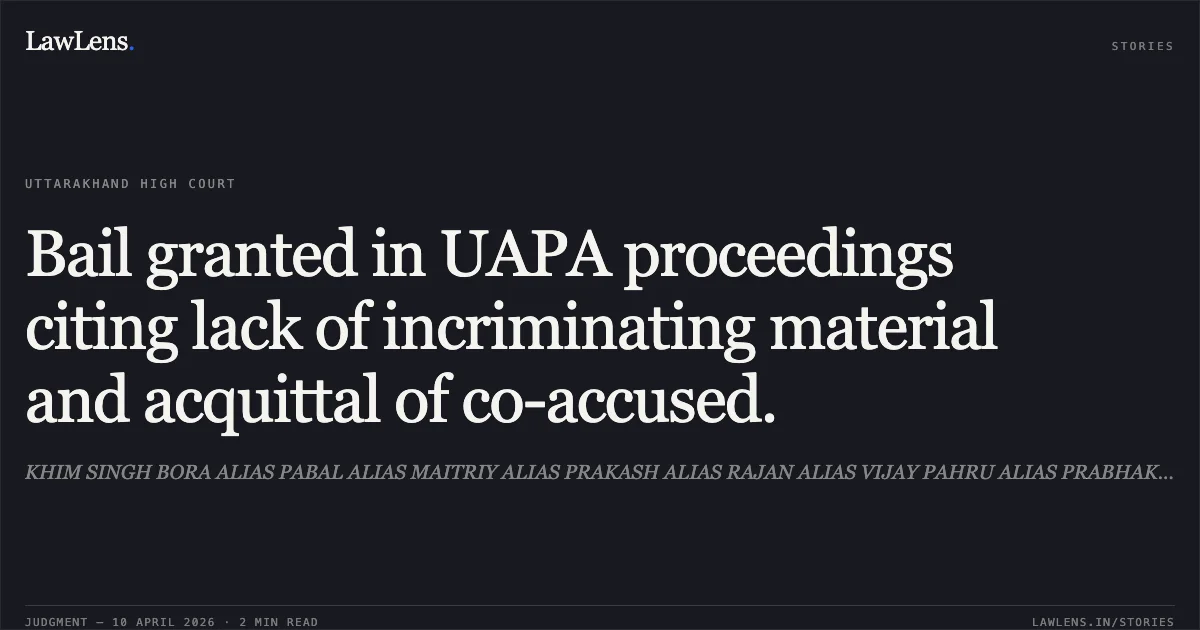
Source reference: para. 6The Applicant moved for bail on the grounds that he was not named in the FIR, no incriminating material was recovered from him, and all co-accused persons had already been acquitted of the charges—an acquittal that was subsequently upheld by the High Court
Source reference: para. 6The State opposed the bail, arguing the Applicant was a primary instigator who had absconded for over a decade and might flee again as the trial reached its final stages
Source reference: para. 7Issues
Whether the Applicant is entitled to the grant of bail in light of the acquittal of co-accused, the lack of recovered incriminating material, and the duration of his judicial custody
Source reference: para. 6, 8Law Applied
The court considered the offences defined under Sections 121 (waging war against the Government), 121A (conspiracy to wage war), 124A (sedition), and 153B (imputations prejudicial to national integration) of the Indian Penal Code
Source reference: para. 3It further applied the provisions of Sections 10 and 20 of the Unlawful Activities (Prevention) Act regarding membership and activities of unlawful associations
Source reference: para. 3The Court relied on the discretionary power to grant bail where the grounds urged by the Applicant are found to be "well founded" despite the gravity of the charges
Source reference: para. 8Reasoning
The Court balanced the State's concerns regarding the Applicant's history of absconding with the evidentiary gaps highlighted by the defense.
Source reference: para. 6It noted the defense's argument that the Applicant was not named in the FIR and that there was a total absence of recovery of any incriminating materials to link him to the alleged Maoist activities
Source reference: para. 6A significant factor in the Court's reasoning was the procedural history of the case, specifically that co-accused persons had already been acquitted of the same charges and the High Court had already rejected the State’s appeal against those acquittals
Source reference: para. 6Consequently, the Court found that the Applicant had made out a sufficient case for bail at this stage, without expressing a final opinion on the merits of the trial
Source reference: para. 8Holding
The Court allowed the Bail Application
It held that the Applicant be released on bail subject to executing a personal bond and furnishing two reliable sureties
Source reference: para. 10The release was made subject to specific conditions: the Applicant must surrender his passport, maintain peace and tranquility, and refrain from threatening or inducing any person acquainted with the facts of the case
Source reference: para. 10The Court further noted that any breach of these conditions would allow the prosecution to move for cancellation of bail
Source reference: para. 10(iv)Acts & Sections Cited
3 provisions across 2 statutes referred to in this judgment. Each provision opens on LawLens.
Indian Penal Code, 18601
Unlawful Activities (Prevention) Act, 19672
Original Court PDF
KHIM SINGH BORA ALIAS PABAL ALIAS MAITRIY ALIAS PRAKASH ALIAS RAJAN ALIAS VIJAY PAHRU ALIAS PRABHAKvsSTATE OF UTTARAKHAND
Click to open original judgment
Original judgment, available to read, download and summarize on LawLens.in