Facts
On November 2, 2025, police recovered 3 kilograms of cannabis (ganja) from the possession of co-accused Aasha Soni.
Source reference: para 2Following her arrest, a memorandum statement was recorded under Section 27 of the Evidence Act, wherein she alleged that the applicant, Prem Soni, supplied the contraband to her and provided a motorcycle to another co-accused, Vidyadhar Giri, for transport.
Source reference: para 2The applicant was arrested on February 18, 2026, for offenses under the NDPS Act.
Source reference: para 3The applicant moved for regular bail, arguing that no contraband was seized from his direct possession, his implication rested solely on inadmissible memorandum statements, and similarly situated co-accused persons had already been granted bail.
Source reference: para 3The State opposed the bail, citing the gravity of the offense and the applicant's role as the source of the drugs.
Source reference: para 4Issues
Whether the applicant is entitled to grant of regular bail under Section 483 of the Bhartiya Nagarik Suraksha Sanhita, 2023, in light of the fact that the seized quantity was non-commercial and his implication was based on a co-accused's statement.
Source reference: para 1, 6Law Applied
The Court considered Section 483 of the Bhartiya Nagarik Suraksha Sanhita, 2023 (BNSS), which governs the power of the High Court to grant bail.
Source reference: para 1It applied Sections 20(B) and 29 of the Narcotic Drugs and Psychotropic Substances (NDPS) Act, 1985, regarding the possession and conspiracy of contraband.
Source reference: para 1The Court also referenced the evidentiary value of memorandum statements under Section 27 of the Evidence Act and the judicial principle of parity in bail matters.
Source reference: para 3, 6Reasoning
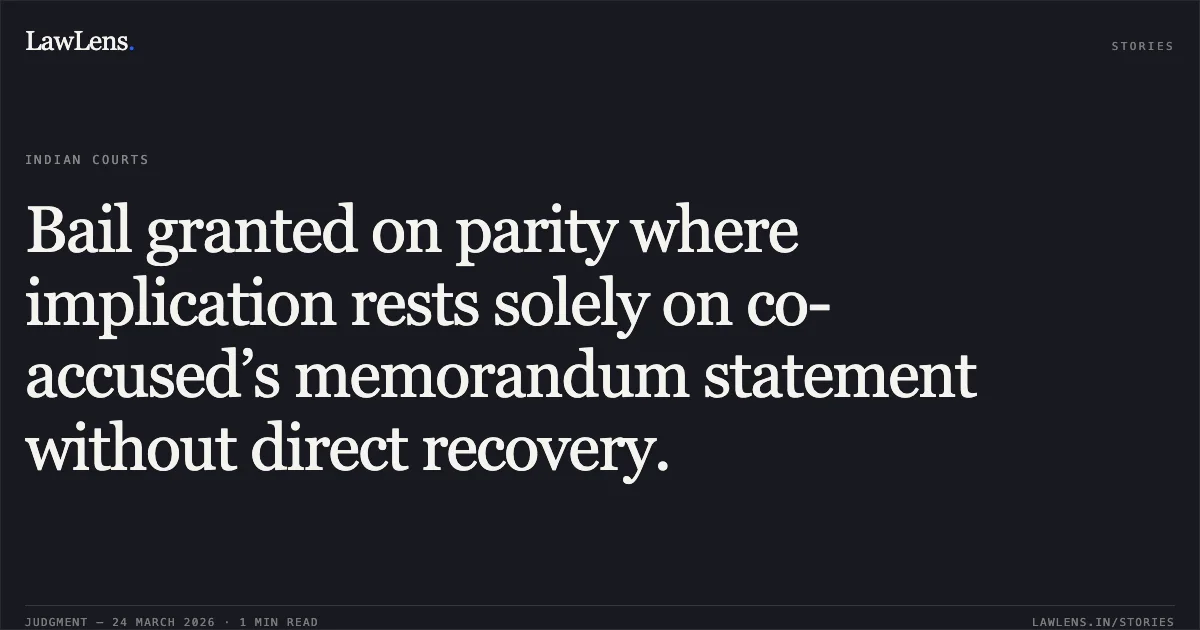
The Court observed that while the applicant was named as the source of the contraband in the memorandum statements of co-accused Aasha Soni and Vidyadhar Giri, no prohibited substances were recovered from the applicant’s actual possession.
Source reference: para 3, 6Crucially, the Court noted that the 3 kilograms of ganja seized is less than the "commercial quantity," which significantly impacts the statutory rigors of bail under the NDPS Act.
Source reference: para 6The Court further reasoned that the applicant has no prior criminal antecedents and has been in custody since February 18, 2026.
Source reference: para 6Finally, applying the principle of parity, the Court found that since the primary co-accused (from whom the drugs were actually seized) had already been granted bail by the High Court in January 2026, the applicant was similarly entitled to relief, especially as the trial was expected to take a considerable amount of time.
Source reference: para 3, 6Holding
The Court held that the lack of direct recovery, the non-commercial quantity of the seized drug, the absence of criminal history, and the principle of parity favored the grant of bail.
The High Court allowed the bail application and ordered the release of the applicant on a personal bond with two local sureties.
Source reference: para 7The release was made subject to several conditions, including that the applicant shall not seek unnecessary adjournments, must remain present for all trial dates (specifically for framing of charges and recording of statements under Section 351 BNSS), and must not abuse the liberty of bail.
Source reference: para 7Acts & Sections Cited
7 provisions across 3 statutes referred to in this judgment. Each provision opens on LawLens.
Bharatiya Nyaya Sanhita, 20232
Bharatiya Nagarik Suraksha Sanhita, 20233
Narcotic Drugs and Psychotropic Substances Act, 19852
Original Court PDF
PREM SONI @ PARMESHWARvsSTATE OF CHHATTISGARH
Click to open original judgment
Original judgment, available to read, download and summarize on LawLens.in