Facts
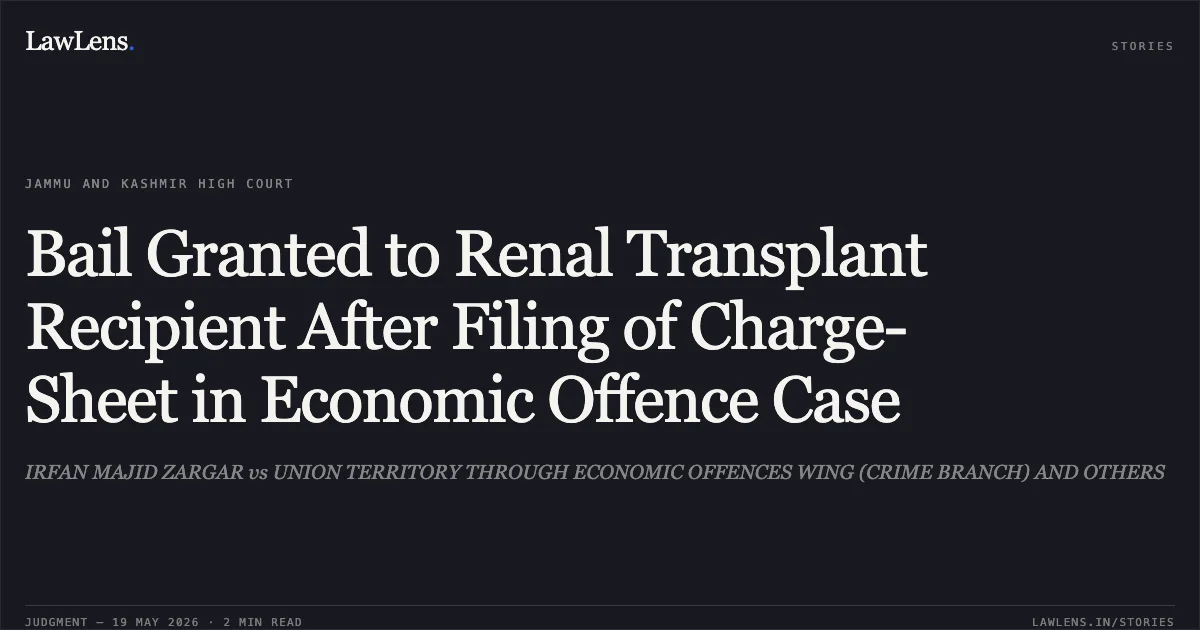
The petitioner, a 42-year-old former Branch Head of HDFC Bank, Shopian, was arrested on February 13, 2026, in Case FIR No. 30/2025
Source reference: p. 1-2He is accused of orchestrating a financial scam involving approx. ₹5.86 crore, including forging cheques of M/S Freshmen Foods Pvt. Ltd., issuing fake Fixed Deposit receipts, and making fictitious entries to mask a physical cash shortfall
Source reference: p. 2-3, 5-6The petitioner sought bail under Section 483 of the Bharatiya Nagarik Suraksha Sanhita (BNSS), citing his status as a kidney transplant recipient (2015) requiring a sterile environment and medication, the completion of the investigation, and the fact that co-accused persons had already been granted bail
Source reference: p. 3-5The respondent opposed bail, labeling the petitioner the "principal architect" of the fraud
Source reference: p. 5Issues
1. Whether the petitioner is entitled to bail under Section 483 of the BNSS considering the completion of the investigation and the principle of parity with co-accused
Source reference: p. 2, 82. Whether the petitioner’s medical condition as a renal transplant patient warrants the grant of bail under the mandate of Article 21 of the Constitution of India
Source reference: p. 4, 9-10Law Applied
The Court primarily applied Section 483 of the Bharatiya Nagarik Suraksha Sanhita, 2023 regarding bail
Source reference: p. 1the principle that "bail is the rule and jail is the exception" as established in Dataram Singh v. State of Uttar Pradesh
Source reference: p. 8doctrine from Satender Kumar Antil v. CBI, which mandates that unnecessary incarceration should be avoided after the filing of a charge-sheet
Source reference: p. 7Sanjay Chandra v. CBI, which held that bail in economic offences should not be withheld as a form of pre-trial punishment
Source reference: p. 8-9Right to Life under Article 21 of the Constitution concerning the petitioner's medical necessity
Source reference: p. 4, 10Reasoning
The Court reasoned that since the investigation is complete and the charge-sheet has been filed, custodial interrogation is no longer necessary
Source reference: p. 7It dismissed the prosecution's apprehension regarding evidence tampering, noting that all documentary and electronic evidence is already in judicial custody
Source reference: p. 7-8The Court observed that six co-accused had been granted bail by the trial court, and the petitioner was entitled to similar treatment under the principle of parity
Source reference: p. 8The Court evaluated the petitioner's medical records from Sir Ganga Ram Hospital, confirming his status as a kidney transplant patient. It determined that the prison environment could not provide the required hygiene, renal diet, and medical supervision necessary to prevent organ failure or infection, thereby necessitating bail on humanitarian and constitutional grounds
Source reference: p. 10Holding
The Court answered the issues in the affirmative, holding that the petitioner’s medical condition and the completion of the investigation outweighed the severity of the economic allegations
The bail application was allowed, and the petitioner was ordered to be released on a personal bond of ₹1,00,000 with two sureties, subject to conditions including non-interference with witnesses, surrendering his passport, and not leaving the UT of J&K without permission
Source reference: p. 10-11Acts & Sections Cited
7 provisions across 3 statutes referred to in this judgment. Each provision opens on LawLens.
Bharatiya Nagarik Suraksha Sanhita, 20231
Bharatiya Nyaya Sanhita, 20235
Information Technology Act, 20001
Original Court PDF
IRFAN MAJID ZARGARvsUNION TERRITORY THROUGH ECONOMIC OFFENCES WING (CRIME BRANCH) AND OTHERS
Click to open original judgment
Original judgment, available to read, download and summarize on LawLens.in