01Facts
The appellants preferred a criminal appeal under Section 14-A(2) of the Scheduled Castes and the Scheduled Tribes (Prevention of Atrocities) Act, 1989, challenging the order dated 4 January 2025 by which the Special Court (SC & ST), Cuttack refused them bail in Khuntuni P.S. Case No. 186 of 2024.
p. 1The prosecution alleged that, during a Ganesh immersion procession, the accused abused members of the Scheduled Caste community by referring to their caste, assaulted them with sharp weapons, caused injuries to Sidhartha Behera and Sanjay Behera, and murdered Suryakanta Samal.
p. 1The offences alleged were under Sections 126(2), 296, 117(2), 118(2), 109, 103 and 3(5) of the Bharatiya Nyaya Sanhita, read with Sections 3(1)(r), 3(1)(s), 2(v) and 2(va) of the SC/ST Act.
p. 1The appellants contended that the eyewitness evidence was inconsistent, that some witnesses had exonerated them, and that the specific allegation of stabbing was directed against co-accused Deepak Behera.
p. 2Appellant No. 1 had been in custody since 11 September 2024 and Appellant No. 2 since 24 December 2024.
pp. 2–3The prosecution and the informant opposed bail, relying on the eyewitness evidence, the post-mortem report, the homicidal death of the deceased, and the alleged similarity of the appellants’ case with that of co-accused Santosh Behera, whose bail application had been rejected.
pp. 3–402Issues
i.Whether the appellants were entitled to bail under Section 14-A(2) of the SC/ST Act, having regard to the evidence collected against them and the seriousness of the alleged offences.
pp. 1, 4–5ii.Whether the inconsistencies in the eyewitness testimony, the absence of a specific allegation of stabbing against the appellants, their period of custody, and the stage of trial justified setting aside the order refusing bail.
pp. 2–5iii.Whether release of the appellants on bail was likely to result in absconding or tampering with prosecution evidence.
p. 503Law Applied
The Court applied Section 14-A(2) of the Scheduled Castes and the Scheduled Tribes (Prevention of Atrocities) Act, 1989, which provides an appellate remedy against an order granting or refusing bail passed by a Special Court under the Act.
p. 1The Court also considered the offences alleged under the Bharatiya Nyaya Sanhita and the relevant provisions of the SC/ST Act.
p. 1In determining bail, the Court applied the established principles that an accused is presumed innocent until proven guilty, that bail is not an adjudication of guilt or acquittal, and that securing the accused’s presence at trial is a primary consideration.
pp. 5–6It further considered the likelihood of the accused absconding, threatening witnesses, or tampering with evidence, together with the nature of the accusation, the material collected, the period of custody, and the likely duration of the trial.
pp. 5–604Reasoning
The Court distinguished the appellants’ alleged role from that of co-accused Deepak Behera and Santosh Behera, against whom the principal allegation of stabbing the deceased and injuring Sidhartha Behera appeared to be directed.
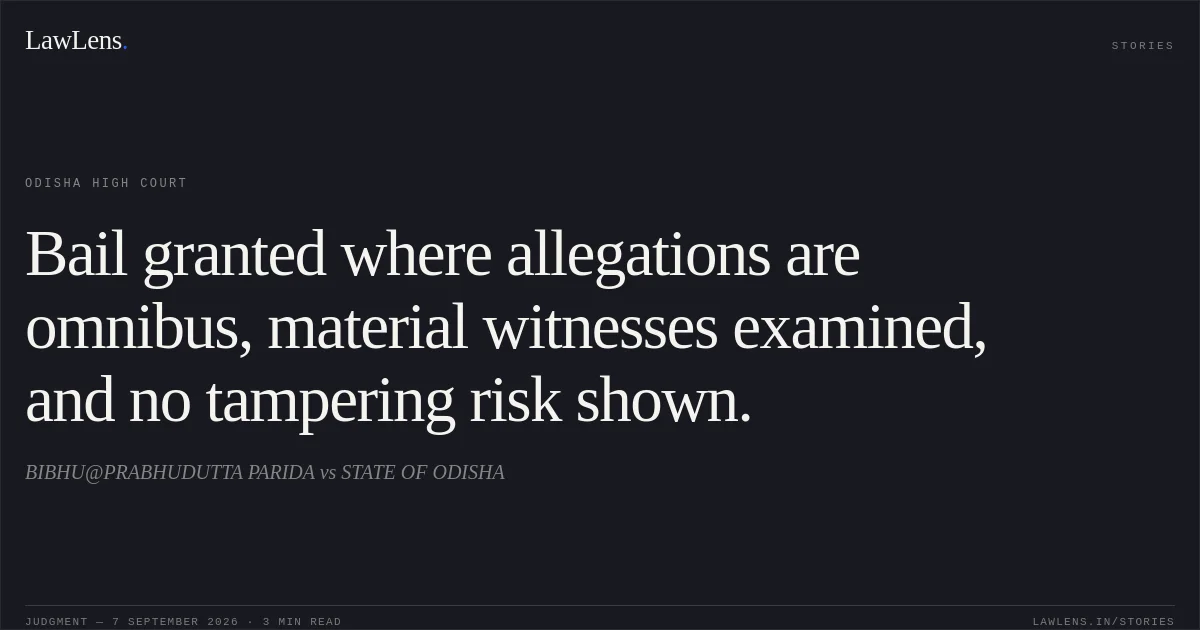
p. 4Although the post-mortem report established that the deceased died from haemorrhage and shock caused by an abdominal injury, and identified one stab wound as fatal in the ordinary course of nature, the Court found that the allegations against the present appellants were omnibus and lacked a specific attribution of the fatal stabbing.
pp. 4–5The Court also took into account the discrepancies in the testimony of the witnesses, the fact that the material witnesses had already been examined, and the appellants’ substantial periods of custody.
pp. 2–3, 5Since there was no material indicating that the appellants would abscond or threaten or tamper with witnesses, and the trial was unlikely to conclude shortly, the balance favoured release on bail.
p. 505Holding
The Court allowed the criminal appeal and set aside the Special Court’s order dated 4 January 2025 refusing bail.
p. 6The appellants were directed to be released on bail on terms and conditions to be fixed by the concerned court, expressly excluding cash surety.
p. 6The Court clarified that its order was based on the bail considerations arising from the materials presently available and did not express any opinion on the merits of the prosecution case.
p. 5Original Court PDF
BIBHU@PRABHUDUTTA PARIDAvsSTATE OF ODISHA
Click to open original judgment
Original judgment, available to read, download and summarize on LawLens.in