Facts
The deceased, Ratan Kumar Jha, died in a railway incident on 5 February 2018. After his cremation, his family allegedly found a suicide note in an almirah naming the petitioner, Sujit Kumar Das, the Bank Manager, and Rajeev Kumar Jha, a sweeper, as persons who had pressured and blackmailed the deceased to undertake illegal banking activities and caused him financial loss.
Source reference: p. 2–3On the basis of the informant’s written application dated 6 February 2018, Kishanganj P.S. Case No. 85 of 2018 was registered under Section 306 of the IPC.
Source reference: p. 3The petitioner’s application under Section 227 of the Cr.P.C. for discharge was rejected by the Sessions Judge, Kishanganj, on 21 December 2018.
Source reference: p. 3The petitioner challenged that order before the High Court, contending that the suicide note did not disclose abetment, had not been subjected to forensic examination, and that the deceased’s death might have resulted from a railway accident rather than suicide.
Source reference: p. 3–4Issues
Whether the order rejecting the petitioner’s application for discharge under Section 227 of the Cr.P.C. was illegal or warranted interference by the High Court.
Source reference: p. 1–2, 5Whether the alleged absence of active or direct instigation, the non-forensic examination of the suicide note, and the possibility that the death was accidental justified quashing the proceedings at that stage.
Source reference: p. 3–5Whether the suicide note naming the petitioner was sufficient to raise grave suspicion for the purpose of framing a charge under Section 306 of the IPC.
Source reference: p. 4Law Applied
The Court considered Section 227 of the Cr.P.C., which permits discharge where, upon consideration of the record and documents, there is insufficient ground for proceeding, and Section 306 of the IPC, which criminalises abetment of suicide read with Section 107 of the IPC.
Source reference: p. 3–4The Court referred to Gurcharan Singh v. State of Punjab, (2017) 1 SCC 433, relied upon by the petitioner for the principle that abetment requires the requisite active or direct conduct constituting instigation, and to Sajjan Kumar v. Central Bureau of Investigation, (2010) 9 SCC 368, relied upon by the State for the principle that, at the stage of framing charge, the court examines whether the material raises a grave suspicion and does not conduct a detailed evaluation or trial on disputed facts.
Source reference: p. 3–4Reasoning
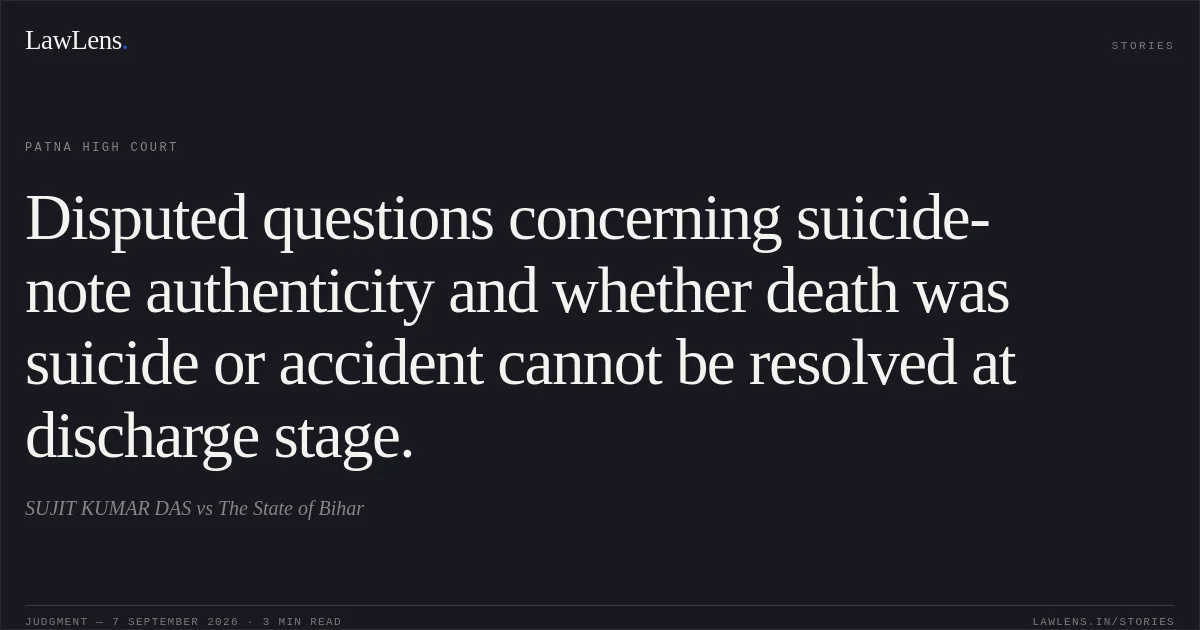
The High Court held that the petitioner’s objections concerning the authenticity of the suicide note, the absence of forensic examination, and whether the death was a suicide or a railway accident involved disputed questions of fact that could not be conclusively determined in the present proceeding.
Source reference: p. 5Since the deceased’s note allegedly named the petitioner and attributed pressure and blackmail to him, the material was sufficient at the threshold to raise grave suspicion relevant to framing a charge.
Source reference: p. 4The Court therefore declined to undertake a detailed assessment of the evidentiary value of the note or determine whether the alleged conduct ultimately satisfied the ingredients of abetment under Sections 107 and 306 of the IPC.
Source reference: p. 4–5The Sessions Judge’s rejection of the Section 227 application was consequently not found to be illegal or arbitrary warranting interference.
Source reference: p. 5Holding
The High Court answered the issues against the petitioner. It held that the disputed questions regarding the genuineness of the suicide note and the actual manner of the deceased’s death could not be decided at that stage, and that the available material disclosed sufficient ground to proceed.
The petition challenging the order dated 21 December 2018 was dismissed as devoid of merit, with no interference with the trial court’s order.
Source reference: p. 5Acts & Sections Cited
3 provisions across 2 statutes referred to in this judgment. Each provision opens on LawLens.
Code of Criminal Procedure, 19731
Indian Penal Code, 18602
Original Court PDF
SUJIT KUMAR DASvsThe State of Bihar
Click to open original judgment
Original judgment, available to read, download and summarize on LawLens.in