01Facts
Opposite parties 1 and 2 instituted Title Suit No. 105 of 2026 before the Civil Judge (Senior Division), 1st Court, Baruipur, seeking, inter alia, declaration and partition.
¶ 2(a)–(c) · p. 2They sought ex parte interim relief under Order XXXIX Rules 1 and 2 of the Code of Civil Procedure, 1908 (“CPC”).
¶ 2(a)–(c) · p. 2On 21 February 2026, the Trial Court, observing that the caveat noted on its file related to a different property and Dag number, directed the parties to maintain status quo regarding the nature, character and possession of the suit properties.
¶ 2(a)–(c) · p. 2The petitioners thereafter sought recall or vacation of the ex parte injunction, contending that their caveat, allegedly numbered 1897 of 2025, had not been noted because the Sheristadar had mistakenly recorded another caveat relating to a different property.
¶ 2(d) · p. 2They asserted that the order had therefore been passed in breach of their statutory right to notice and hearing under Section 148A CPC.
¶ 2(d) · p. 2After the record was put up on 6 April 2026, the Trial Court, by order dated 23 April 2026, rejected the petitioners’ application for recall or vacation of the injunction and extended the interim order until the next date.
¶ 2(g) · p. 3The petitioners challenged that order under Article 227 of the Constitution.
¶ 3–5 · pp. 3–6The opposite parties objected to maintainability on the ground that the application was substantively one under Order XXXIX Rule 4 CPC and that the impugned order was appealable under Order XLIII Rule 1(r) CPC.
¶ 3–5 · pp. 3–602Issues
i.Whether an application seeking recall or vacation of an injunction on the ground that the Court failed to act upon a lodged caveat falls within the scope of Order XXXIX Rule 4 CPC and is therefore appealable under Order XLIII Rule 1(r) CPC?
¶ 9–16 · pp. 9–11ii.Whether the High Court should exercise its supervisory jurisdiction under Article 227 of the Constitution when an efficacious appellate remedy under the CPC is available?
¶ 24–25 · pp. 13–14iii.Whether the petitioners’ caveat was validly lodged and whether the injunction order was liable to be recalled for breach of Section 148A CPC?
¶ 28–29 · pp. 14–1503Law Applied
The Court applied Section 148A CPC, which confers upon a caveator the right to notice and an opportunity of hearing before an interim order is passed, subject to the statutory requirements governing caveats.
It construed Order XXXIX Rule 4 CPC broadly, holding that an application by “any party dissatisfied with” an injunction may seek its discharge, variation or setting aside on both substantive and procedural grounds.
¶ 10–16 · pp. 9–11Such an order is appealable under Order XLIII Rule 1(r) CPC.
The Court relied on S. Sundaram Pillai v. V.R. Pattabiraman, (1985) 1 SCC 591, for the principle that a proviso cannot be interpreted to restrict or nullify the substantive provision.
¶ 15 · pp. 10–11The Court relied on A. Venkatasubbiah Naidu v. S. Chellappan, (2000) 7 SCC 695, and Virudhunagar Hindu Nadargal Dharma Paribalana Sabai v. Tuticorin Educational Society, (2019) 9 SCC 538, for the principle that Article 227 should ordinarily not be invoked where an appellate remedy under the CPC exists, particularly in civil-court proceedings.
¶ 25, 33 · pp. 13–16The Court distinguished the procedural-review principles in Grindlays Bank Ltd. v. Central Government Industrial Tribunal, 1980 Supp SCC 420, and Kapra Mazdoor Ekta Union v. Birla Cotton Spinning and Weaving Mills Ltd., (2005) 13 SCC 777, holding that the express remedy under Order XXXIX Rule 4 CPC covered the grievance.
¶ 17–20 · pp. 11–13It also considered Sukumar Roy v. Pratul Kumar Roy, MANU/WB/0430/1985, but held that the decision did not require the recall remedy to be pursued under Section 151 CPC rather than Order XXXIX Rule 4 CPC.
¶ 25–27 · pp. 13–15Provisions in the judgment · 4 · Linked ones open on LawLens
Code of Civil Procedure, 1908 Section 151Section 104Section 39Section 43
04Reasoning
The Court held that the substance of the petitioners’ application, rather than its caption as one for “recall,” was determinative.
¶ 13–16 · pp. 10–11Since the petitioners sought to set aside or vacate an existing injunction, their application fell within the wide language of Order XXXIX Rule 4 CPC, even though the alleged defect concerned the Trial Court’s failure to act upon the caveat rather than the merits of the injunction.
¶ 13–16 · pp. 10–11The Court rejected the argument that procedural invalidity placed the application outside Order XXXIX Rule 4, explaining that the provision covers all grounds on which a party is dissatisfied with an injunction.
¶ 20–24 · pp. 12–13It further held that the availability of an appeal under Order XLIII Rule 1(r) constituted a near-total bar to invoking Article 227 against the Trial Court’s order.
¶ 27–35 · pp. 14–16The Court therefore declined to examine whether the caveat had in fact been validly lodged, whether Section 148A CPC had been violated, or whether the injunction was otherwise liable to recall; those questions remained open before the appellate court.
¶ 27–35 · pp. 14–1605Holding
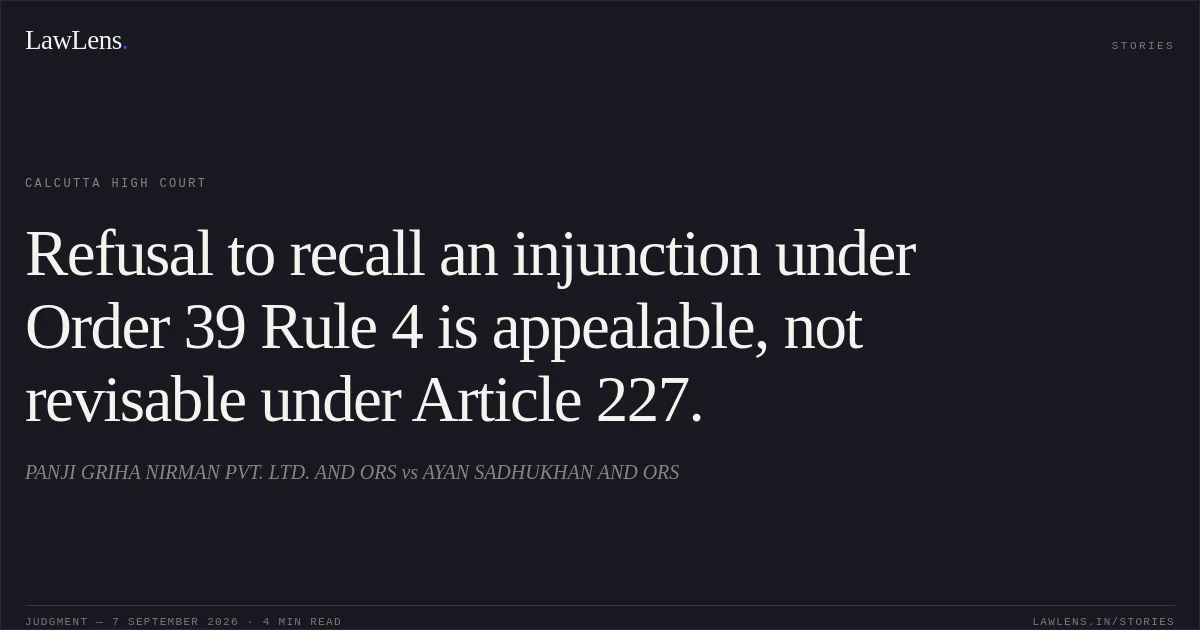
The High Court did not entertain the revisional application under Article 227 because the impugned order was appealable under Order XLIII Rule 1(r) CPC, being an order passed on an application falling within Order XXXIX Rule 4 CPC.
¶ 24, 35–37 · pp. 13–16The petitioners were granted liberty to prefer an appeal.
¶ 36 · p. 16If filed within one week, the delay would stand condoned and the appeal would be treated as within limitation; alternatively, they could seek exclusion of the period during which the revision remained pending.
¶ 36 · p. 16The appellate court was requested to decide the appeal expeditiously, preferably within a fortnight.
¶ 36 · p. 16The High Court expressly left open all questions concerning the validity of the caveat, the alleged breach of Section 148A CPC, and the merits of recalling or vacating the injunction.
¶ 36 · p. 16Original Court PDF
PANJI GRIHA NIRMAN PVT. LTD. AND ORSvsAYAN SADHUKHAN AND ORS
Click to open original judgment
Original judgment, available to read, download and summarize on LawLens.in