Facts
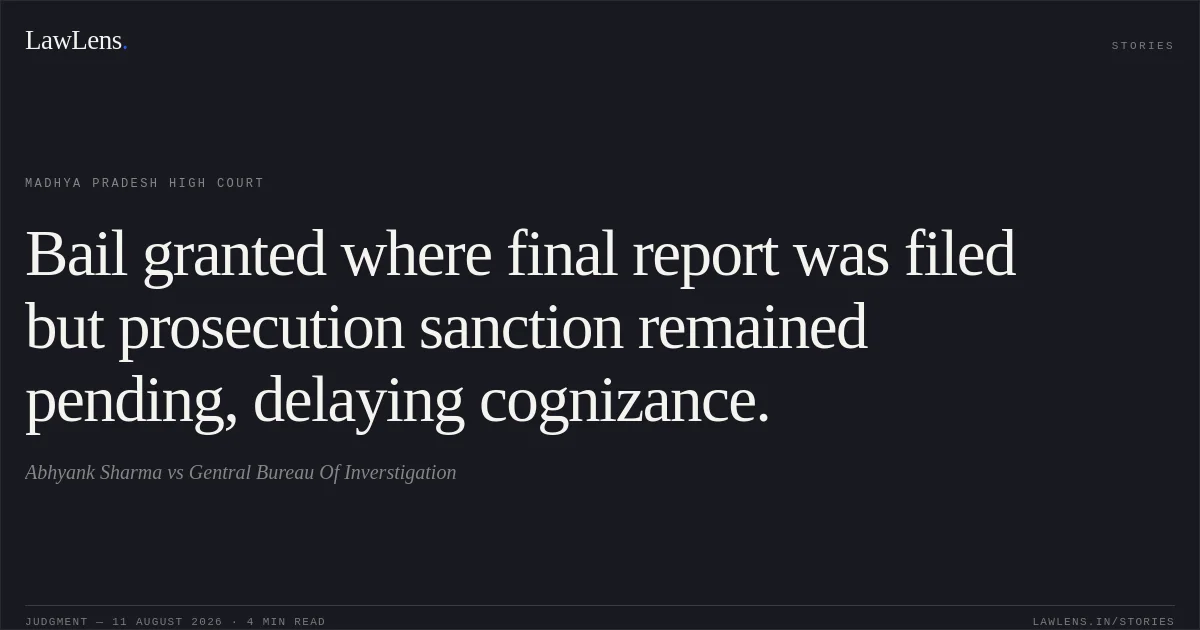
The applicant, Abhyank Sharma, a Manager in the Central Bank of India, was accused of demanding and accepting illegal gratification in connection with the proposed Kiosk Banking Service.
Source reference: para. 1, 6The CBI registered Crime No. RC0092026A0004 under Section 7 of the Prevention of Corruption Act, 1988, after verifying the complainant’s allegations and recording the conversation relating to the alleged demand.
Source reference: para. 1, 6A trap was laid, during which the applicant allegedly received bribe money concealed in a yellow envelope; the tainted currency notes were recovered from the rear pocket of his jeans.
Source reference: para. 6The applicant was arrested and remained in judicial custody from 12 June 2026.
Source reference: para. 1The CBI completed the investigation and submitted its final report, but sanction for prosecution from the competent authority was still awaited.
Source reference: para. 6The applicant filed his first bail application under Section 483 of the Bharatiya Nagarik Suraksha Sanhita, 2023, contending that he lacked authority to grant the relevant permission, had opposed the complainant’s proposal, and had been falsely implicated.
Source reference: para. 4The CBI opposed bail on the basis of the recorded demand, voice verification, and recovery of the tainted currency, but confirmed that the applicant had no criminal antecedents.
Source reference: para. 5Issues
Whether the applicant should be released on bail under Section 483 of the Bharatiya Nagarik Suraksha Sanhita, 2023, notwithstanding the allegations of demand and acceptance of bribe under Section 7 of the Prevention of Corruption Act, 1988.
Source reference: paras. 1, 5–8Whether the pendency of sanction for prosecution, submission of the final report, the applicant’s period of custody, and the anticipated delay in commencement of trial justified grant of bail.
Source reference: paras. 4, 6–8Whether the prosecution’s apprehension of witness influence or evidence tampering constituted a sufficient ground to continue the applicant’s incarceration.
Source reference: paras. 5, 7–8Law Applied
The Court applied Section 483 of the Bharatiya Nagarik Suraksha Sanhita, 2023, governing the High Court’s power to grant bail, and considered the accusation under Section 7 of the Prevention of Corruption Act, 1988, concerning demand and acceptance of illegal gratification.
Source reference: para. 1The Court applied the established bail principle that pre-trial detention should not operate as punishment and that bail must be assessed with reference to the nature of the accusation, the material collected, the likelihood of absconding, the possibility of tampering with evidence or influencing witnesses, criminal antecedents, and the likely duration of trial.
Source reference: para. 4The applicant relied on Sanjay Chandra v. Central Bureau of Investigation, (2012) 1 SCC 40, Vihan Kumar v. State of Haryana, (2025) 5 SCC 799, and Mihir Rajesh Shah v. State of Maharashtra, (2026) 1 SCC 500.
Source reference: para. 4The Court also considered that cognizance and trial would be deferred pending sanction for prosecution.
Source reference: para. 6Bail conditions were imposed to secure the applicant’s attendance, prevent repetition of the offence, and prohibit inducement, threats, witness intimidation, or tampering with evidence.
Source reference: para. 9Reasoning
The Court acknowledged that the prosecution material, including the recorded conversation, voice comparison, and recovery of tainted currency, prima facie connected the applicant with the alleged offence; however, it held that the applicant’s defence regarding his lack of authority and alleged ignorance of the concealed bribe could not be rejected as manifestly baseless at the bail stage.
Source reference: paras. 4–6The Court expressly left the veracity of the prosecution evidence and the applicant’s complicity to be determined at trial.
Source reference: para. 6Since the investigation was complete and the final report had been filed, custodial interrogation was no longer necessary.
Source reference: paras. 4, 6Further, sanction for prosecution remained pending, resulting in deferment of cognizance and trial and indicating that the proceedings would take time.
Source reference: paras. 4, 6The applicant had no criminal antecedents, was a government-bank employee with family responsibilities, and there was no substantial likelihood of his absconding, repeating the offence, tampering with evidence, or influencing witnesses.
Source reference: para. 7Balancing these considerations against the seriousness of the allegations, the Court found no compelling reason for continued incarceration.
Source reference: paras. 7–8Holding
The High Court allowed the bail application.
The High Court directed that Abhyank Sharma be released in connection with Crime No. RC0092026A0004 upon furnishing a personal bond of Rs. 1,00,000 with one surety of the same amount to the satisfaction of the trial Court.
Source reference: paras. 8–9The bail was made subject to conditions requiring his presence on every directed hearing date, abstention from similar offences, non-inducement or intimidation of persons acquainted with the case, non-tampering with evidence, and compliance with the provisions concerning examination of witnesses in attendance.
Source reference: para. 9The order was made effective until conclusion of the trial, subject to cancellation of bail by the trial Court in the event of breach of the conditions.
Source reference: paras. 10–11Acts & Sections Cited
4 provisions across 3 statutes referred to in this judgment. Each provision opens on LawLens.
Bharatiya Nagarik Suraksha Sanhita, 20232
Prevention of Corruption Act, 19881
Code of Criminal Procedure, 19731
Original Court PDF
Abhyank SharmavsGentral Bureau Of Inverstigation
Click to open original judgment
Original judgment, available to read, download and summarize on LawLens.in