Facts
The applicant, Sunil, was arrested on May 22, 2025, in connection with Crime No. 141/2024 registered at Police Station Raoti, District Ratlam, for alleged offenses under Sections 363, 366-A, 376(2)(n), and 368 of the IPC, and Sections 5L/6 of the POCSO Act.
Source reference: p. 1The prosecution alleged that the applicant kidnapped a 19-year-old victim (cited as a minor in the investigation) and subjected her to penetrative sexual assault.
Source reference: p. 2This is the applicant’s second bail application; the first was dismissed as withdrawn on December 11, 2025, with liberty to renew the prayer after the victim’s examination.
Source reference: p. 1Following that order, the victim (PW-1), her father (PW-2), and her paternal uncle (PW-4) were examined by the trial court.
Source reference: p. 1-2Issues
1. Whether the applicant is entitled to regular bail under Section 483 of the Bharatiya Nagarik Suraksha Sanhita (BNSS), 2023, in light of the testimony provided by material prosecution witnesses.
Source reference: p. 1-32. Whether the continued incarceration of the applicant is necessary given his socio-economic status and the current stage of the trial.
Source reference: p. 3Law Applied
The Court primarily applied Section 483 of the BNSS, 2023 (corresponding to Section 439 of the CrPC) governing the grant of bail by High Courts.
Source reference: p. 1It relied on the principle that bail is a matter of judicial discretion, influenced by the gravity of the offense, the likelihood of the accused fleeing from justice, and the potential for tampering with evidence.
Source reference: p. 2-3The Court also referenced Section 346 of the BNSS (formerly Section 309 of the CrPC) regarding the requirement for due compliance in the examination of witnesses in attendance.
Source reference: p. 4Reasoning
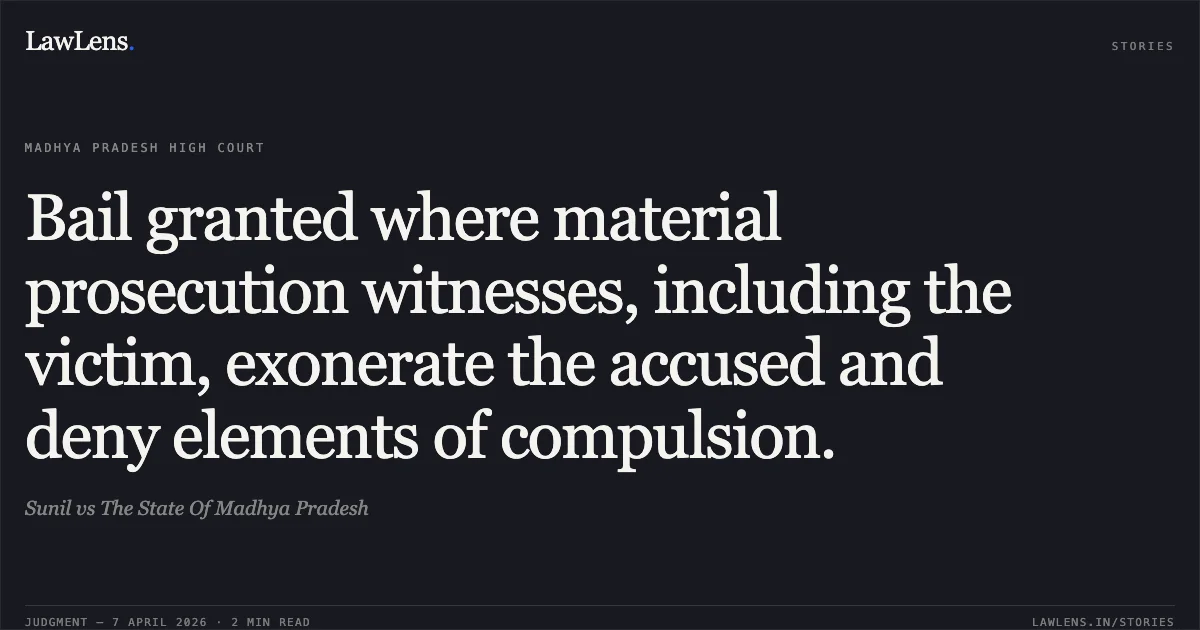
The Court noted that the material prosecution witnesses—the victim, her father, and her paternal uncle—had been examined and did not support the prosecution’s case.
Source reference: p. 2Specifically, they exonerated the applicant, stated the victim was an adult at the time of the incident, and denied any element of enticement, force, or compulsion.
Source reference: p. 2-3The Court reasoned that since these material witnesses have already testified, the risk of the applicant tampering with evidence or influencing the remaining witnesses is minimal.
Source reference: p. 2-3Furthermore, the Court observed that the applicant is a 22-year-old labourer with no reported criminal antecedents, suggesting a low likelihood of recidivism or flight from justice.
Source reference: p. 2-3The Court concluded that the contentions regarding the doubtful determination of the victim's age and the lack of compulsion possessed prima facie merit, making continued incarceration unnecessary as the trial would take time to conclude.
Source reference: p. 3Holding
The Court allowed the application and ordered the applicant’s release on bail upon furnishing a personal bond of Rs. 50,000 with one surety of like amount.
The holding is subject to five conditions: (1) mandatory appearance at all hearings; (2) no involvement in similar offenses; (3) no inducement or threats to persons acquainted with the facts; (4) no tampering with evidence; and (5) compliance with Section 346 of the BNSS regarding witness examination.
Source reference: p. 4The Court clarified that these observations are limited to the bail application and do not reflect on the merits of the final trial.
Source reference: p. 3Acts & Sections Cited
8 provisions across 4 statutes referred to in this judgment. Each provision opens on LawLens.
Bharatiya Nagarik Suraksha Sanhita, 20232
Indian Penal Code, 18603
Code of Criminal Procedure, 19731
Original Court PDF
SunilvsThe State Of Madhya Pradesh
Click to open original judgment
Original judgment, available to read, download and summarize on LawLens.in