Facts
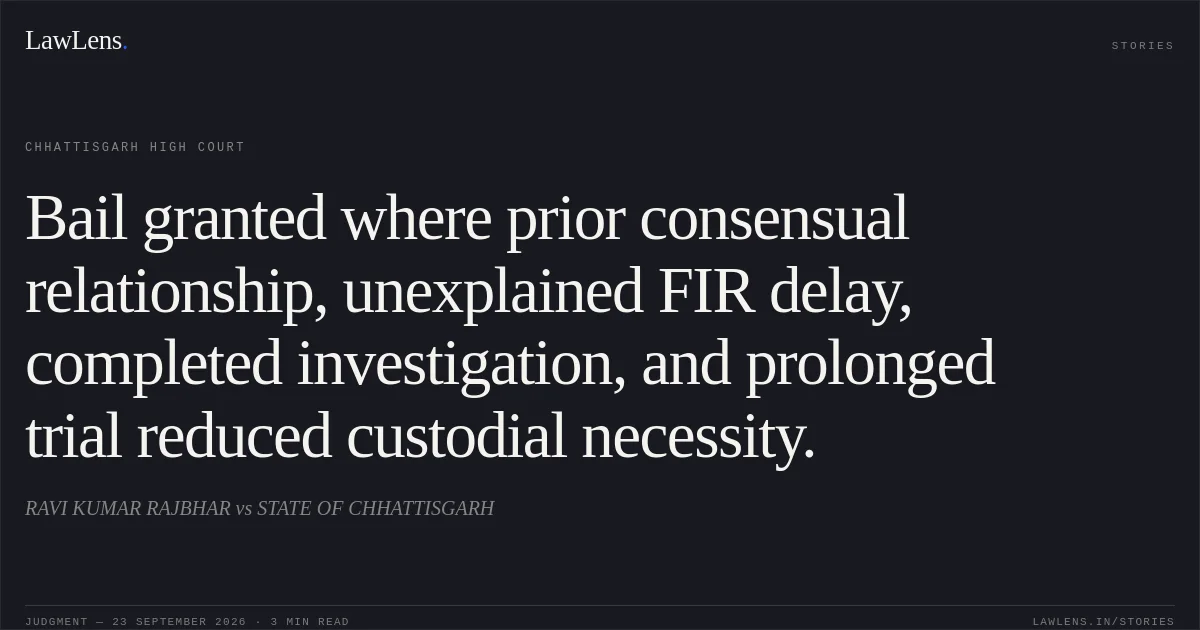
The appellant challenged the order dated 2 July 2026 by which the Special Judge under the SC/ST Act, Bastar, rejected his application for regular bail under Section 483 of the Bharatiya Nagarik Suraksha Sanhita, 2023 (“BNSS”) in connection with Crime No. 174/2026 registered at Police Station Kotwali, Jagdalpur.
Source reference: para. 1The prosecution alleged that between 21 and 22 August 2025, the appellant sexually assaulted the 26-year-old prosecutrix in a hotel room at Jagdalpur and recorded video clips of the incident.
Source reference: para. 1–2The FIR was lodged on 24 January 2026; during investigation, the prosecutrix’s statement and social-status certificate were obtained, and the appellant was arrested.
Source reference: para. 1–2The appellant contended that he and the prosecutrix had been in a relationship since meeting through social media in 2023, that the relationship was consensual, and that the prosecutrix had voluntarily accompanied him to the hotel.
Source reference: para. 3He relied upon the eight-month delay in lodging the FIR, completion of investigation, filing of the charge-sheet, and his custody since 14 June 2026.
Source reference: para. 3The State opposed bail, asserting that the appellant knew the prosecutrix belonged to a Scheduled Tribe and that the allegations constituted serious offences under Sections 64(1) and 64(2)(m) of the Bharatiya Nyaya Sanhita, 2023 (“BNS”) and Section 3(ll)(v) of the SC/ST Act.
Source reference: para. 4The prosecutrix appeared through video conferencing and objected to the grant of bail.
Source reference: para. 5Issues
Whether the appellant was entitled to regular bail under Section 483 of the BNSS despite the allegations under Sections 64(1) and 64(2)(m) of the BNS and Section 3(ll)(v) of the SC/ST Act?
Source reference: paras. 1, 6–7Whether the alleged consensual relationship, the parties’ asserted love affair, the eight-month delay in lodging the FIR, completion of investigation, filing of the charge-sheet, and the appellant’s period of custody justified interference with the rejection of bail?
Source reference: paras. 3, 7What conditions were necessary to secure the appellant’s presence and prevent misuse of bail during trial?
Source reference: para. 8Law Applied
The Court exercised appellate jurisdiction under Section 14-A(2) of the Scheduled Castes and Scheduled Tribes (Prevention of Atrocities) Act, 1989, against the order rejecting bail.
Source reference: para. 1It considered the appellant’s entitlement to regular bail under Section 483 of the BNSS, while taking into account the nature and seriousness of the alleged offences under Sections 64(1) and 64(2)(m) of the BNS and Section 3(ll)(v) of the SC/ST Act.
Source reference: paras. 1, 4The governing bail considerations applied by the Court included the apparent circumstances of the relationship, the unexplained delay in reporting, completion of investigation and filing of the charge-sheet, the period of custody, the likely duration of trial, and the need to impose conditions ensuring the accused’s attendance and preventing obstruction of proceedings.
Source reference: para. 7–8Reasoning
The Court considered the defence claim that the appellant and the prosecutrix had been in a relationship since 2023 and that she had voluntarily accompanied him to the hotel.
Source reference: para. 7It further attached significance to the eight-month delay in lodging the FIR, which, according to the Court, had not been satisfactorily explained.
Source reference: para. 7Without expressing any opinion on the merits of the prosecution case, the Court also noted that investigation had concluded, the charge-sheet had been filed, and the appellant had remained in custody since 14 June 2026, making prolonged pre-trial detention relevant because the trial was likely to take time.
Source reference: para. 7Balancing these factors against the seriousness of the allegations and the prosecutrix’s objection, the Court found it appropriate to grant bail, subject to stringent conditions relating to attendance, adjournments, personal appearance at material stages, and consequences for misuse of liberty.
Source reference: paras. 5, 7–8Holding
The appeal was allowed and the order dated 2 July 2026 rejecting bail was set aside.
The appellant, Ravi Kumar Rajbhar, was directed to be released on bail upon furnishing a personal bond with two sureties in the like amount to the satisfaction of the trial court.
Source reference: para. 8The conditions required him not to seek adjournments when witnesses were present, to remain present on every date either personally or through counsel, to appear personally during opening of the case, framing of charge, and recording of his statement under Section 351 of the BNSS, and permitted the trial court to take action in accordance with law in the event of absence, non-compliance, or misuse of bail.
Source reference: para. 8(i)–(iv)The trial court was requested to endeavour to conclude the trial expeditiously.
Source reference: para. 9Acts & Sections Cited
7 provisions across 3 statutes referred to in this judgment. Each provision opens on LawLens.
Scheduled Castes and the Scheduled Tribes (Prevention of Atrocities) Act, 19891
Bharatiya Nagarik Suraksha Sanhita, 20233
Bharatiya Nyaya Sanhita, 20233
Original Court PDF
RAVI KUMAR RAJBHARvsSTATE OF CHHATTISGARH
Click to open original judgment
Original judgment, available to read, download and summarize on LawLens.in