Facts
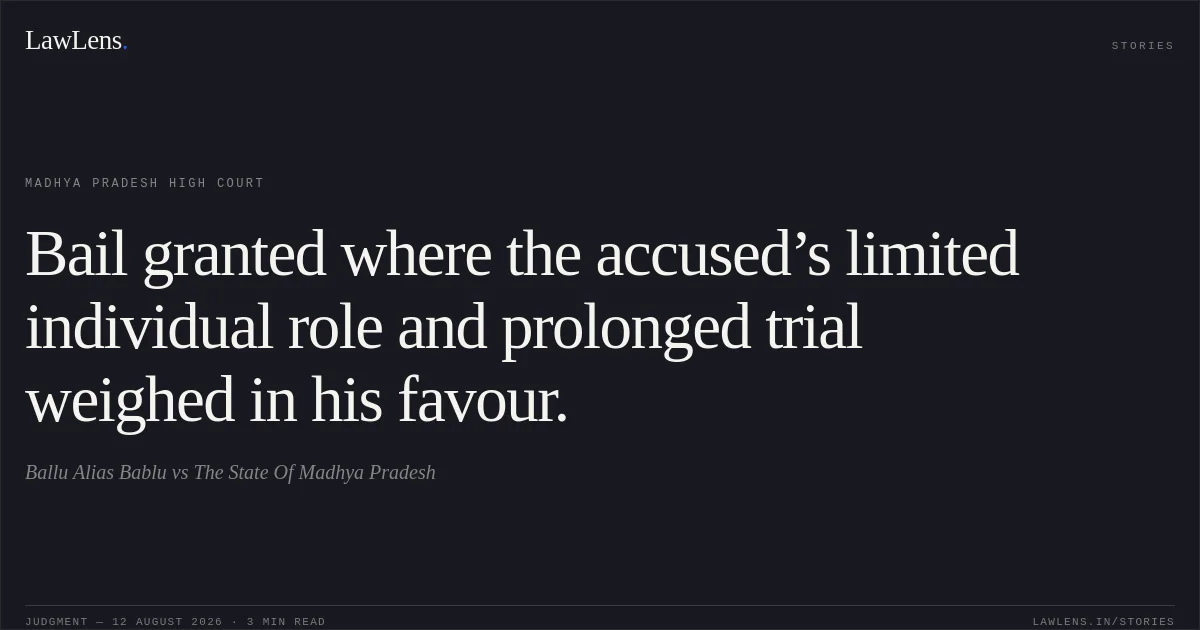
The appellant filed a first criminal appeal under Section 14-A(2) of the Scheduled Castes and Scheduled Tribes (Prevention of Atrocities) Act, 1989, challenging the order dated 31 July 2026 by which the Special Judge (Atrocities), Sheopur, dismissed his bail application under Section 483 of the Bharatiya Nagarik Suraksha Sanhita, 2023.
Source reference: para. 1The appellant had been arrested on 5 June 2026 in Crime No. 107/2026 registered at Police Station Vijaypur, District Sheopur, for offences under various provisions of the Bharatiya Nyaya Sanhita, 2023, and Sections 3(1)(r), 3(1)(s), 3(1)(f), 3(1)(g), and 3(2)(v) of the SC/ST Act.
Source reference: para. 3The prosecution case arose from a land dispute and altercation in which caste-based abuses and assaults with sticks and an axe were allegedly committed.
Source reference: para. 4The appellant contended that the incident was a free fight, that his individual role was limited to allegedly causing an injury to Morvati with a lathi, and that the more serious allegation under Section 109(2) of the BNS related to an injury allegedly caused by co-accused Makhan.
Source reference: para. 4Issues
Whether the appellant was entitled to bail under Section 14-A(2) of the SC/ST Act read with Section 483 of the BNSS, notwithstanding the allegations under the BNS and the SC/ST Act.
Source reference: paras. 1, 3–7Whether the circumstances of the case, including the appellant’s custody, the alleged individual role, and the likelihood of delay in conclusion of trial, justified setting aside the rejection of bail.
Source reference: paras. 4, 6–7Law Applied
The Court applied Section 14-A(2) of the SC/ST Act, which permits an appeal against an order granting or refusing bail by a Special Court or Exclusive Special Court.
Source reference: para. 1Section 15-A of the SC/ST Act concerning notice to and participation of the victim, which the State stated had been complied with.
Source reference: paras. 5–6Section 483 of the BNSS governing the High Court’s power to grant bail.
Source reference: para. 1The governing bail principle applied was that bail may be granted after considering the allegations, the accused’s specific role, the period of custody, the likelihood of the trial taking time, the possibility of absconding or tampering with evidence, and the need to impose appropriate conditions.
Source reference: para. 7Reasoning
After perusing the case diary and hearing both sides, the Court took into account that the appellant had been in custody since 5 June 2026, that the prosecution arose from an alleged land-dispute altercation, and that the appellant’s attributed role was confined to allegedly causing an injury to Morvati with a lathi, while the allegation relating to the enhanced offence under Section 109(2) of the BNS was attributed to co-accused Makhan.
Source reference: paras. 3–6Without expressing any opinion on the merits, the Court considered that the trial was likely to take considerable time and found it appropriate to grant bail subject to safeguards designed to secure the appellant’s presence, cooperation, and non-interference with the proceedings.
Source reference: para. 7The Court therefore interfered with the Special Court’s order refusing bail.
Source reference: para. 7Holding
The appeal was allowed, and the order dated 31 July 2026 rejecting bail was set aside.
The appellant was directed to be released on bail upon furnishing a personal bond of ₹50,000 with one solvent surety in the same amount to the satisfaction of the trial Court.
Source reference: para. 7The bail was made subject to conditions requiring compliance with the bond, cooperation with the investigation or trial, abstention from inducement, threats or promises to witnesses, non-commission of a similar offence, avoidance of unnecessary adjournments, and obtaining prior permission before leaving India.
Source reference: para. 8In addition, the appellant was directed to mark his presence at the concerned police station on the first Sunday of every month between 10:30 a.m. and 2:00 p.m. for one year.
Source reference: para. 8Acts & Sections Cited
11 provisions across 3 statutes referred to in this judgment. Each provision opens on LawLens.
Scheduled Castes and the Scheduled Tribes (Prevention of Atrocities) Act, 19891
Bharatiya Nyaya Sanhita, 20238
Indian Penal Code, 18602
Original Court PDF
Ballu Alias BabluvsThe State Of Madhya Pradesh
Click to open original judgment
Original judgment, available to read, download and summarize on LawLens.in