Facts
The appellant was arrested on 7 September 2025 following an anti-Naxal search operation in the forest area of Village Rengabeda-Paralnar, District Narayanpur.
Source reference: para. 2The prosecution alleged that a BGL launcher and two BGL cells were recovered from his possession, and that he was associated with the Maoist organisation and intended to use the recovered articles against police personnel.
Source reference: para. 2Crime No. 12/2025 was registered for offences under Sections 191(2), 191(3) and 190 of the Bharatiya Nyaya Sanhita, 2023, Section 25 of the Arms Act, and Sections 16, 18, 20, 38(2) and 39(2) of the Explosive Substances Act, 1908.
Source reference: para. 1After investigation, the matter proceeded before the Special Judge under the NIA Act, District Kondagaon.
Source reference: paras. 3, 6, 10The prosecution cited 23 witnesses, of whom 7 had been examined when the bail appeal was heard.
Source reference: paras. 3, 6, 10The Special Court rejected the appellant’s bail application under Section 483 of the Bharatiya Nagarik Suraksha Sanhita, 2023, by order dated 3 July 2026.
Source reference: para. 1The appellant challenged that order under Section 21(4) of the National Investigation Agency Act, 2008.
Source reference: para. 1Issues
Whether, in view of the alleged recovery of the BGL launcher and BGL cells, the gravity of the offences, and the evidence recorded during trial, the appellant was entitled to bail under Section 483 of the Bharatiya Nagarik Suraksha Sanhita, 2023.
Source reference: paras. 4–10Whether the High Court should interfere, in appeal under Section 21(4) of the National Investigation Agency Act, 2008, with the Special Court’s order rejecting bail.
Source reference: paras. 1, 8–10Whether the appellant’s objections concerning the alleged memorandum statement, absence of a scientific report, lack of mens rea, and the evidentiary deficiencies raised questions requiring determination at the bail stage.
Source reference: paras. 4, 9Law Applied
The Court exercised appellate jurisdiction under Section 21(4) of the National Investigation Agency Act, 2008, against the order of the Special Court, and considered the bail application under Section 483 of the Bharatiya Nagarik Suraksha Sanhita, 2023.
Source reference: para. 1The governing bail principles required consideration of the nature and gravity of the alleged offences, the material connecting the accused with the offences, the stage of the trial, and the possibility of interference with the proceedings.
Source reference: no citationAt the bail stage, the Court does not undertake a detailed appreciation of evidence or conclusively determine the admissibility and evidentiary value of disputed material; such questions ordinarily remain for trial.
Source reference: para. 9The substantive allegations arose under Sections 191(2), 191(3) and 190 of the Bharatiya Nyaya Sanhita, 2023, Section 25 of the Arms Act, and Sections 16, 18, 20, 38(2) and 39(2) of the Explosive Substances Act, 1908.
Source reference: para. 1Reasoning
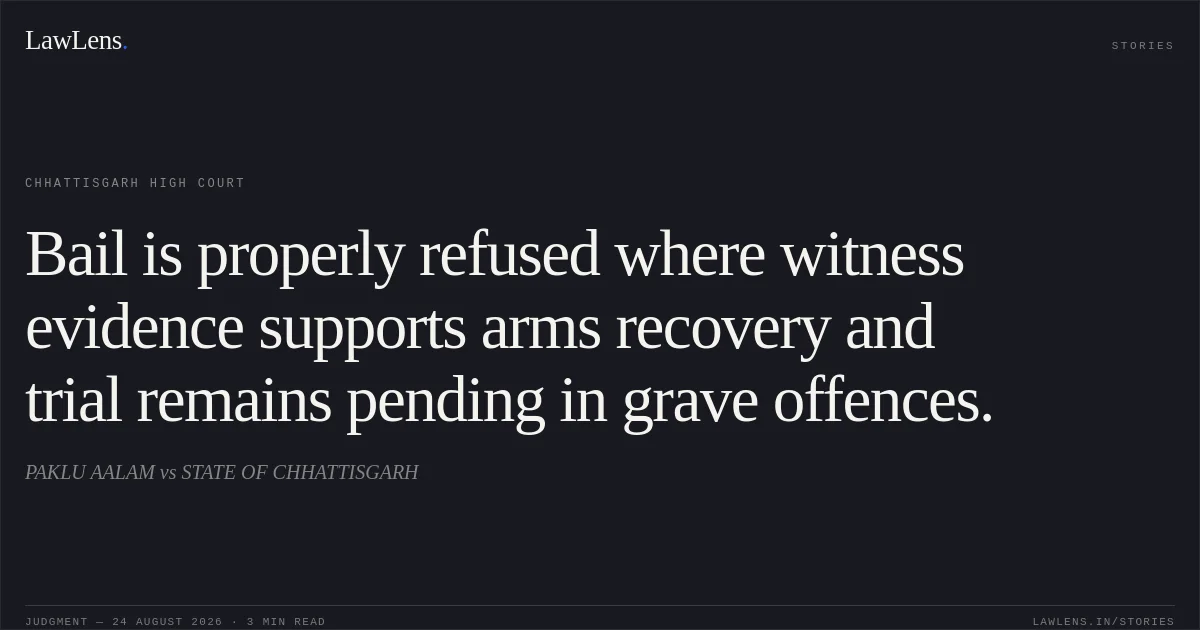
The High Court found that the prosecution case was, at that stage, supported by the evidence of witnesses examined during trial, particularly the evidence concerning the appellant’s apprehension and the recovery of the BGL launcher and BGL cells from his possession.
Source reference: para. 9The alleged association with the Maoist organisation and intended use of arms and explosive materials against the police party made the allegations grave and serious.
Source reference: para. 9Although the appellant challenged the memorandum statement, the absence of a scientific report, and the alleged lack of mens rea, the Court held that these contentions involved appreciation of merits and evidentiary value that could not be conclusively decided in the bail proceedings.
Source reference: para. 9Since only 7 of the 23 prosecution witnesses had been examined and the remaining evidence was pending, the Court considered the trial to be at an intermediate stage and found no sufficient basis to disturb the Special Court’s discretionary refusal of bail.
Source reference: para. 10Holding
The High Court answered the issues against the appellant.
It held that the gravity of the alleged offences, the material relating to the recovery and the evidence recorded so far, and the pending stage of the trial justified denial of bail.
Source reference: paras. 9–10The appeal under Section 21(4) of the National Investigation Agency Act, 2008, was accordingly dismissed, and the Special Court’s order dated 3 July 2026 was affirmed.
Source reference: paras. 9–10However, recognising that the appellant had remained in custody since 7 September 2025, the High Court directed the Trial Court to make all endeavours to conclude the trial expeditiously, preferably within six months from receipt of the order, while remaining uninfluenced by the observations made in the bail proceedings.
Source reference: para. 11Acts & Sections Cited
10 provisions across 5 statutes referred to in this judgment. Each provision opens on LawLens.
National Investigation Agency Act, 20081
Bharatiya Nagarik Suraksha Sanhita, 20231
Bharatiya Nyaya Sanhita, 20232
Arms Act, 19591
Explosive Substances Act, 19085
Original Court PDF
PAKLU AALAMvsSTATE OF CHHATTISGARH
Click to open original judgment
Original judgment, available to read, download and summarize on LawLens.in