01Facts
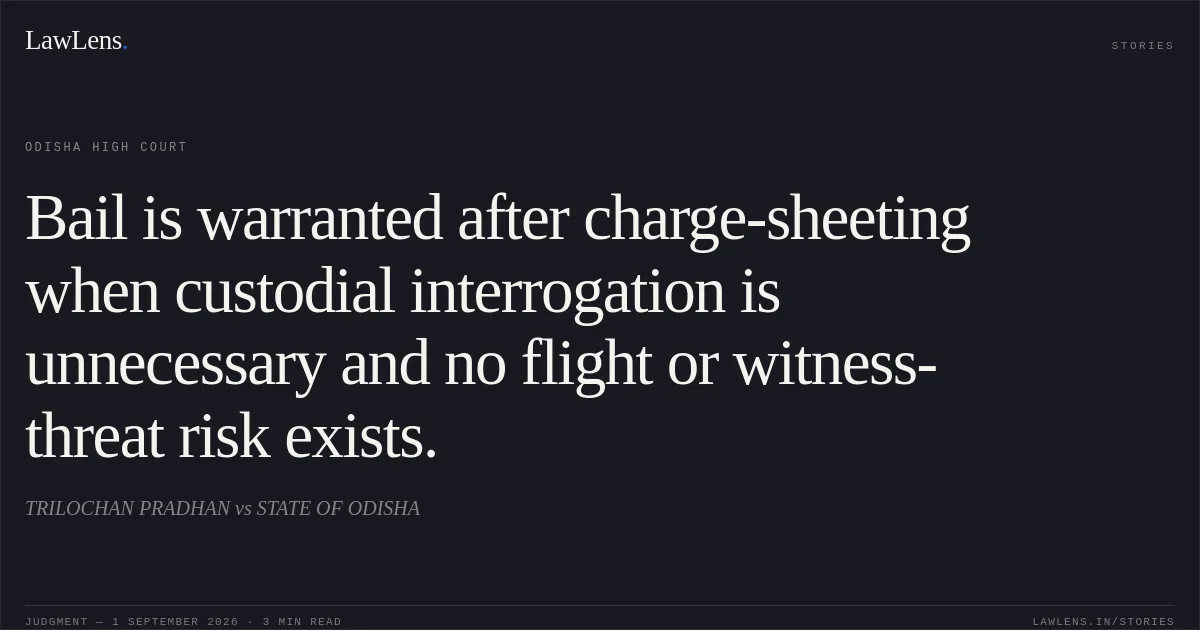
The petitioner sought bail under Section 483 of the Bharatiya Nagarik Suraksha Sanhita, 2023 (“BNSS”) in Talcher P.S. Case No. 506 of 2026, corresponding to G.R. Case No. 864 of 2026, involving alleged offences under Sections 318(4), 319(2), 336(2), 336(3), 338, 340(2) and 61(2) of the Bharatiya Nyaya Sanhita, 2023 (“BNS”).
p. 1 · ¶ 1The prosecution allegation was that the petitioner impersonated a co-sharer and forged documents and signatures to procure execution of a sale deed in favour of his son and relatives, thereby attempting to cheat the informant and appropriate land valued at approximately ₹9.96 lakh under the Government rate.
p. 1 · ¶ 1 · p. 2 · ¶ 3The petitioner had been in custody since 1 May 2026, and the charge-sheet had been filed by the time of consideration of the bail application.
p. 3 · ¶ 4The informant also alleged that the petitioner had a criminal antecedent which had not been disclosed in the bail application; the petitioner’s counsel stated that bail would be withheld if such antecedent was found.
p. 3 · ¶ 302Issues
i.Whether the petitioner should be released on bail under Section 483 of the BNSS despite the allegations of impersonation, forgery, cheating and attempted grabbing of the informant’s land.
pp. 1–5 · ¶ 1, 4–5ii.Whether the petitioner’s period of custody, filing of the charge-sheet, absence of dispossession, age, and the absence of apparent risk of absconding or influencing witnesses justified grant of bail.
pp. 3–5 · ¶ 4–5iii.Whether the bail order should be subject to verification of the petitioner’s alleged criminal antecedent.
pp. 3, 5–6 · ¶ 3, 5–603Law Applied
The Court exercised its jurisdiction under Section 483 of the BNSS to consider the petitioner’s entitlement to bail.
p. 1 · ¶ 1It applied the settled principles that bail is generally the rule and custody is the exception, that an accused enjoys the presumption of innocence until conviction, and that grant of bail does not amount to acquittal but secures the accused’s appearance at trial.
p. 4 · ¶ 4The Court also considered the principles stated by the Supreme Court in Satender Kumar Antil v. Central Bureau of Investigation, (2022) 10 SCC 51, particularly in the context of pre-trial detention and bail.
p. 5 · ¶ 5The alleged offences were noted to be triable by a Magistrate, and the Court treated the filing of the charge-sheet as reducing the need for further custodial interrogation.
pp. 3–5 · ¶ 4–5Provisions in the judgment · 1 · Linked ones open on LawLens
Bharatiya Nagarik Suraksha Sanhita, 2023 Section 483
04Reasoning
Although the allegations against the petitioner concerned serious acts of impersonation, forgery and attempted fraudulent transfer of land, the Court noted that the accusations remained subject to proof at trial.
p. 4 · ¶ 4The petitioner had remained in custody since 1 May 2026, the charge-sheet had already been filed, and therefore no further custodial interrogation appeared necessary.
p. 3 · ¶ 4The informant had not been dispossessed of the property, and the Court found no material indicating that the petitioner would abscond or threaten, induce or influence witnesses if released.
pp. 3–5 · ¶ 3–5Having regard to the petitioner’s age of approximately 63 years, the period of pre-trial detention, the presumption of innocence, and the fact that the offences were triable by a Magistrate, the Court concluded that continued incarceration was not justified at that stage.
pp. 3–5 · ¶ 4–5However, because of the allegation regarding a prior criminal case and the petitioner’s counsel’s undertaking, the benefit of bail was made conditional upon verification of the petitioner’s criminal antecedents.
pp. 3, 5–6 · ¶ 3, 5–605Holding
The High Court allowed the bail application and directed that the petitioner be released on furnishing bail bonds of ₹50,000 with two solvent sureties for the like amount to the satisfaction of the court concerned.
p. 5 · ¶ 6The release was subject to conditions that he cooperate with further investigation, if any, and refrain from threatening, inducing, influencing or coercing any witness, including members of the informant’s family.
p. 5 · ¶ 6The Court clarified that the order would not benefit the petitioner if verification disclosed any criminal antecedent or his implication in another criminal case.
p. 6 · ¶ 6The BLAPL was accordingly disposed of, without expressing any opinion on the merits of the prosecution case.
pp. 5–6 · ¶ 5–7Original Court PDF
TRILOCHAN PRADHANvsSTATE OF ODISHA
Click to open original judgment
Original judgment, available to read, download and summarize on LawLens.in