Facts
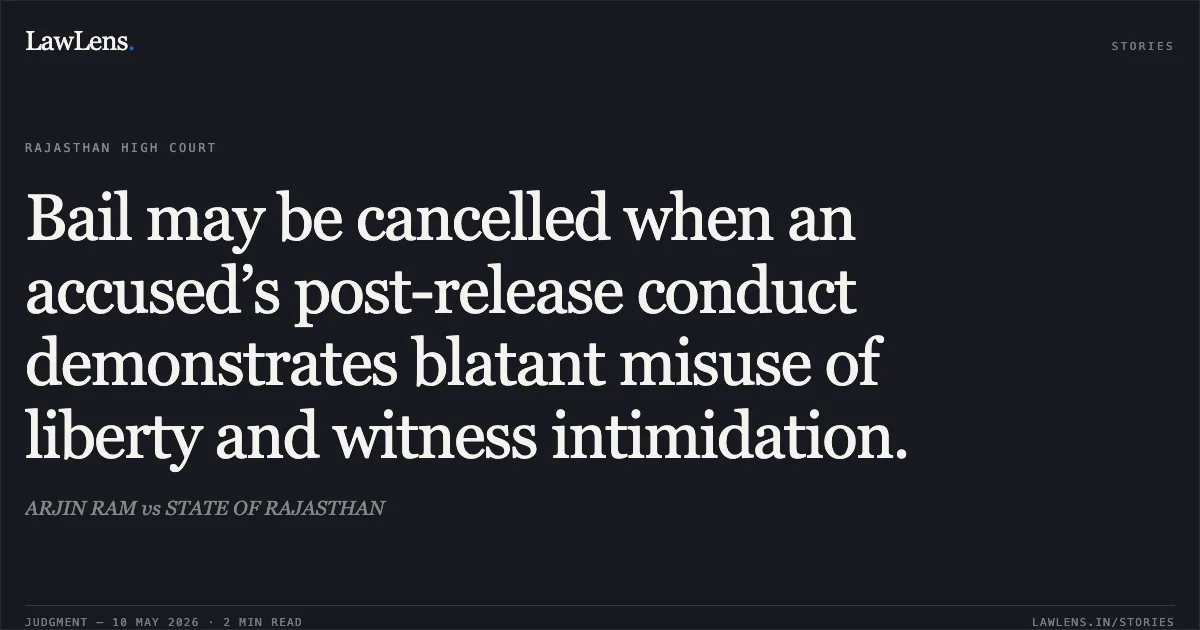
The petitioner (complainant) filed an application under Section 483(3) of the BNSS, 2023, seeking to cancel the bail granted to Respondent No. 2 (Sukhdev Ram) on July 7, 2025.
Source reference: para 1Respondent No. 2 was originally accused in FIR No. 397/2024 involving extortion, threats, and vandalism of the petitioner’s business.
Source reference: para 2After his release on bail, the respondent allegedly violated bail conditions by issuing fresh death threats, demanding "monthly ransom," and threatening to open fire at the petitioner's premises.
Source reference: para 2.1These post-release actions led to the registration of two new FIRs: No. 342/2025 and No. 29/2026.
Source reference: para 2.2Despite being served notice, Respondent No. 2 failed to appear before the Court.
Source reference: para 4Issues
1. Whether the post-release conduct of the accused, involving the commission of fresh offenses and intimidation of the complainant, constitutes a sufficient "supervening circumstance" to warrant the cancellation of bail under Section 483(3) of the BNSS, 2023.
Source reference: paras 5, 7, 24Law Applied
The Court primarily applied Section 483(3) of the BNSS, 2023 (corresponding to Section 439(2) of the CrPC), which empowers the High Court to cancel bail if liberty is abused or trial integrity is compromised.
Source reference: para 5The Court relied on the principle that bail is a "conditional liberty" predicated on good behavior and non-interference with justice.
Source reference: para 6It further applied the precedent of Neeru Yadav v. State of Uttar Pradesh (AIR 2015 SC 3703), which establishes that criminal antecedents and post-grant conduct are decisive factors in bail matters.
Source reference: para 10, 15The Court cited Harshadhipati v. State of Rajasthan (SBCRLBC No. 66/2023), emphasizing that acts reflecting dominance or glorification of crime post-release undermine judicial sanctity.
Source reference: para 11Reasoning
The Court reasoned that while bail cancellation is not a routine exercise, it becomes a duty when the accused subverts the administration of justice.
Source reference: para 5In this instance, the Court found a "continuum of criminality" evidenced by the registration of subsequent FIRs for similar offenses of extortion and threat after the respondent was enlarged on bail.
Source reference: para 2.2, 7The Court determined that the respondent’s specific threat to fire rounds in the petitioner’s premises was a "brazen disregard for law" that created a palpable environment of fear, rendering a fair trial impossible.
Source reference: para 21, 22By applying the Neeru Yadav standard, the Court noted that the respondent's actions proved he was likely to repeat offenses and influence witnesses, thereby violating the implicit conditions of his liberty.
Source reference: para 16, 21The Court concluded that the respondent had transformed his legal liberty into an "instrument of oppression".
Source reference: para 26Holding
The Court allowed the application and set aside the bail order dated July 7, 2025.
The Court held that the respondent’s repeated acts of intimidation and fresh criminal activity constituted substantial supervening circumstances that outweighed his right to individual liberty.
Source reference: para 24, 25Respondent No. 2 was directed to surrender forthwith before the Trial Court, with an order for the Trial Court to take coercive steps if he fails to do so.
Source reference: para 27The Court clarified that these observations are limited to the bail cancellation and do not reflect on the merits of the pending trial.
Source reference: para 28Acts & Sections Cited
1 provisions across 1 statute referred to in this judgment. Each provision opens on LawLens.
Bharatiya Nagarik Suraksha Sanhita, 20231
Original Court PDF
ARJIN RAMvsSTATE OF RAJASTHAN
Click to open original judgment
Original judgment, available to read, download and summarize on LawLens.in