Facts
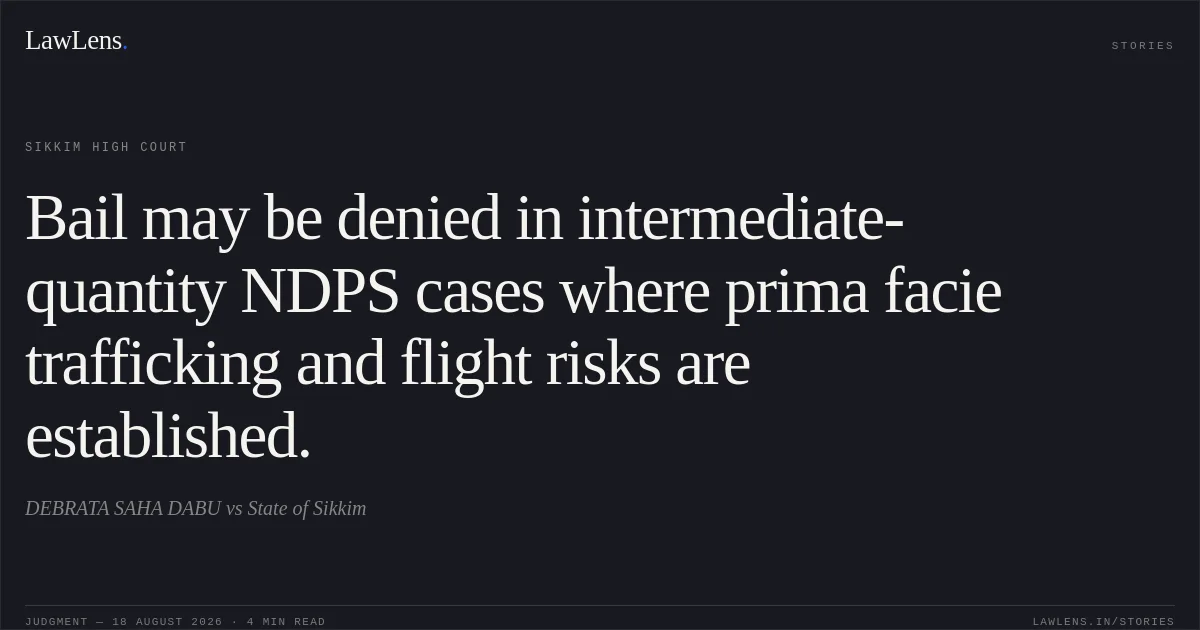
The applicant, accused no. 3, was prosecuted under Section 22(b) of the Narcotic Drugs and Psychotropic Substances Act, 1985 (NDPS Act), and Sections 111 and 3(5) of the Bharatiya Nyaya Sanhita, 2023 (BNS), concerning the seizure of 57.39 grams of heroin from a vehicle on 6 March 2026.
Source reference: para. 3The prosecution alleged that accused no. 2 had procured the heroin from the applicant, who supplied it from Siliguri, and that call-detail records, bank statements and a UPI payment of ₹82,500 supported the alleged transaction.
Source reference: para. 4It further alleged that ₹15,06,050 had been transferred by accused no. 2 to the applicant between January 2024 and the date of the alleged offence.
Source reference: para. 4The charge sheet alleged a prima facie case under Section 22(b) of the NDPS Act and Sections 111/3(5) of the BNS.
Source reference: para. 5The applicant appeared before the Magistrate after execution of a bailable warrant and the case was committed to the Special Court, NDPS Act.
Source reference: paras. 6–7His bail application before the Special Judge was rejected on grounds including the prima facie case, the seriousness of the allegations, the quantity of heroin, the possibility of absconding, and the fact that charges had not yet been framed.
Source reference: para. 9Issues
Whether the applicant should be released on bail under Section 483 of the Bharatiya Nagarik Suraksha Sanhita, 2023, considering the constitutional presumption in favour of personal liberty and the conventional bail factors.
Source reference: paras. 2, 14, 17–19Whether the restrictions under Section 37 of the NDPS Act applied to the applicant’s alleged offence under Section 22(b), and, if not, whether the seriousness of the NDPS allegations nevertheless justified continued custody.
Source reference: para. 15Whether the applicant was entitled to bail on the ground of parity with accused no. 1, who had been granted bail on medical and caregiving grounds.
Source reference: paras. 11, 20Law Applied
The Court applied Section 483 of the BNSS, which empowers the High Court or Court of Session to release an accused in custody on bail.
Source reference: para. 12It applied the constitutional principles under Articles 21 and 22, including the principle that “bail is the rule, jail is the exception,” while recognising that custody may be justified where its necessity substantially outweighs the accused’s liberty.
Source reference: para. 2The Court relied on the bail considerations identified in Prasanta Kumar Sarkar v. Ashish Chatterjee, including the existence of a prima facie case, the nature and gravity of the accusation, the severity of punishment, the risk of absconding, the likelihood of repetition, the possibility of influencing witnesses and the danger of frustration of justice.
Source reference: para. 14Section 37 of the NDPS Act was held inapplicable because the case did not involve Sections 19, 24 or 27-A, or a commercial quantity of narcotic substance; however, the Court held that the societal harm and seriousness associated with drug trafficking remained relevant to the general bail assessment.
Source reference: para. 15The Court also relied on Union of India v. Mohd. Nawas Khan and Union of India v. Themboi @ Themboi Singson regarding the wider societal impact of narcotics offences.
Source reference: para. 16Reasoning
Although Section 37 of the NDPS Act did not impose its stringent twin conditions, the Court assessed the application under Section 483 of the BNSS together with the ordinary bail factors and the nature of NDPS offences.
Source reference: paras. 14–16The applicant had been in custody for approximately two months and fifteen days, but the charge sheet reserved liberty to file a supplementary charge sheet, charges had not been framed, and no prosecution witness had been examined.
Source reference: para. 19(i)–(iii)Nevertheless, the alleged offence carried punishment of up to ten years’ rigorous imprisonment, and the prosecution material—particularly the CDRs, bank records and UPI transaction—provided prima facie support for the allegation that the applicant was a supplier in an organised drug-trafficking network.
Source reference: para. 19(iv), (vii)–(ix)The Court considered the allegations especially grave because the drugs were allegedly supplied for circulation in Sikkim, where substance abuse was recognised as a significant social concern.
Source reference: paras. 16, 19(vii)–(viii)It also accepted that the risks of absconding, influencing witnesses and repeating the offence could not be ruled out, particularly as the applicant had appeared only after execution of a bailable warrant and was alleged to have been involved in similar activities.
Source reference: para. 19(vi), (x)–(xi)The grant of bail to accused no. 1 did not establish parity because that order rested on the accused’s father’s serious medical condition and his role as the sole earning member and caregiver—circumstances not shown in the applicant’s case.
Source reference: paras. 11, 20Holding
The High Court held that, notwithstanding the inapplicability of Section 37 of the NDPS Act and the applicant’s constitutional claim to personal liberty, the gravity of the allegations, the prima facie material indicating his role as a supplier, and the risks of absconding, witness influence and repetition outweighed the case for release on bail.
The applicant was not entitled to parity with accused no. 1.
Source reference: paras. 11, 20The bail application under Section 483 of the BNSS was therefore rejected.
Source reference: para. 22Copies of the order were directed to be forwarded to the Special Judge, NDPS, Namchi, the Jail Superintendent, Boomtar, Namchi, and the applicant’s counsel.
Source reference: para. 23Acts & Sections Cited
11 provisions across 4 statutes referred to in this judgment. Each provision opens on LawLens.
Bharatiya Nagarik Suraksha Sanhita, 20232
Narcotic Drugs and Psychotropic Substances Act, 19854
Bharatiya Nyaya Sanhita, 20234
Bharatiya Sakshya Adhiniyam, 20231
Original Court PDF
DEBRATA SAHA DABUvsState of Sikkim
Click to open original judgment
Original judgment, available to read, download and summarize on LawLens.in