Facts
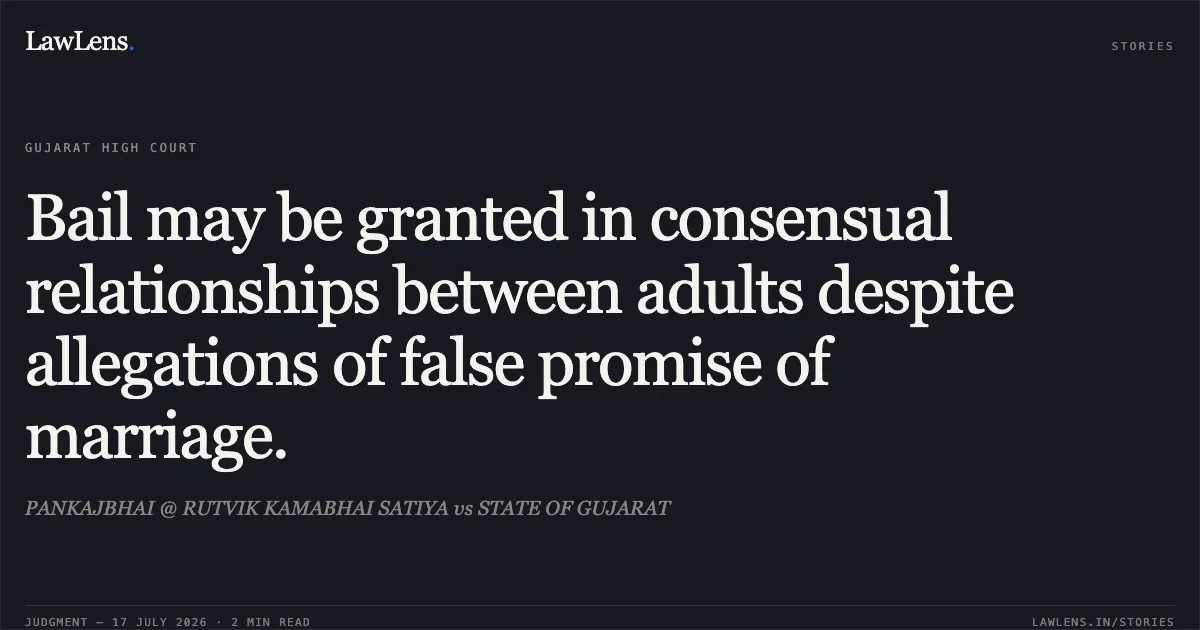
The appellant moved the High Court under Section 14-A of the Scheduled Caste and Scheduled Tribe (Prevention of Atrocities) Act, 1989, challenging a Sessions Court order dated 15.04.2026 that denied him regular bail.
Source reference: p.1The appellant, a 25-year-old, was accused of offenses under Section 69 of the Bharatiya Nyaya Sanhita, 2023 (sexual intercourse on a false promise of marriage) and relevant sections of the Atrocity Act.
Source reference: p.2The prosecution alleged he exploited the victim, a major from the SC/ST community, under the pretext of marriage.
Source reference: p.2The appellant contended the relationship was consensual, born of a mutual love affair while working together, and noted an unexplained 18-day delay in filing the FIR.
Source reference: p.2The charge-sheet has been filed and the appellant has been in custody since 25.02.2026.
Source reference: p.2Issues
1. Whether the appellant is entitled to regular bail under Section 483 of the Bharatiya Nagarik Suraksha Sanhita, 2023, considering the nature of the allegations and the filing of the charge-sheet.
Source reference: p.22. Whether the bar under Section 18 of the Atrocity Act applies in the current circumstances.
Source reference: p.3, para. 7Law Applied
The court primarily applied Section 483 of the Bharatiya Nagarik Suraksha Sanhita, 2023 (BNSS) regarding regular bail and Section 69 of the Bharatiya Nyaya Sanhita (BNS).
Source reference: p.1-2The court relied on the principle that "bail is the rule and jail is an exception" as established in Sanjay Chandra v. Central Bureau of Investigation.
Source reference: p.3, para. 7Regarding the Scheduled Caste and Scheduled Tribe (Prevention of Atrocities) Act, the court applied the precedent from Hitesh Verma v. State of Uttarakhand, holding that the statutory bar of Section 18 was not applicable in this context.
Source reference: p.3, para. 7The court also identified eight classic factors for bail, including the gravity of the offense, danger of absconding, and the likelihood of tampering with evidence.
Source reference: p.3, para. 6Reasoning
The court analyzed the facts by noting that both the appellant and the victim were majors and that the relationship appeared prima facie to be voluntary and consensual, with marriage being denied later due to family interference.
Source reference: p.2-3, para. 5The court observed that since the investigation was complete and the charge-sheet had already been filed, further custodial interrogation or recovery was unnecessary.
Source reference: p.2, para. 3Applying the factors for judicial discretion, the court reasoned that keeping the appellant in custody would amount to "pre-trial conviction".
Source reference: p.3, para. 7It determined that the potential for tampering with evidence could be mitigated through stringent bail conditions rather than continued incarceration.
Source reference: p.3-4Holding
The court allowed the appeal and quashed the lower court’s order dated 15.04.2026.
It held that the appellant was entitled to regular bail subject to executing a personal bond of Rs. 25,000 and one surety.
Source reference: p.4, para. 8Specific conditions were imposed, including surrendering his passport, marking presence at the police station once a month for six months, and a strict prohibition against contacting the victim or witnesses.
Source reference: p.4, para. 8The court clarified that these observations are prima facie and shall not influence the final trial.
Source reference: p.5, para. 10Acts & Sections Cited
4 provisions across 3 statutes referred to in this judgment. Each provision opens on LawLens.
Scheduled Castes and the Scheduled Tribes (Prevention of Atrocities) Act, 19892
Bharatiya Nagarik Suraksha Sanhita, 20231
Bharatiya Nyaya Sanhita, 20231
Original Court PDF
PANKAJBHAI @ RUTVIK KAMABHAI SATIYAvsSTATE OF GUJARAT
Click to open original judgment
Original judgment, available to read, download and summarize on LawLens.in