Facts
The appellant, arrayed as A.8, appealed under Section 14-A(2) of the Scheduled Castes and Scheduled Tribes (Prevention of Atrocities) Act, 1989, against the Sessions Court’s order refusing bail.
Source reference: p. 2The case arose from an attack in which Kanal died and Harith was injured; the prosecution alleged that the appellant and others attacked them with stones and wooden logs.
Source reference: pp. 4–5The appellant was not named in the FIR, was added as A.8 in the final report, and had no specific overt act attributed to him.
Source reference: pp. 3, 5–6The investigation was complete and the final report had been filed; the appellant had been in custody since 20 July 2026.
Source reference: pp. 3, 5–6Harith, the injured victim, stated that he had no objection to bail.
Source reference: p. 4Issues
Whether the trial court’s refusal to grant bail to the appellant should be set aside, having regard to his alleged role and the circumstances of the case.
Source reference: pp. 2–3, 5–6Whether the appellant should be released on bail subject to conditions.
Source reference: pp. 6–7Law Applied
Section 14-A(2) of the SC/ST (Prevention of Atrocities) Act, 1989, provides the appellate basis invoked to challenge the order refusing bail.
Source reference: p. 2The prosecution’s altered charges included Sections 191(2), 191(3), 126(2), 296(b), 115(2), 118(1), 103(1) and 137(2) of the Bharatiya Nyaya Sanhita, 2023, read with Section 3(2)(v) of the SC/ST Act.
Source reference: pp. 3–5The judgment cited no precedent and did not set out a broader bail doctrine; it determined the appeal on the circumstances recorded in the case.
Source reference: pp. 5–6Reasoning
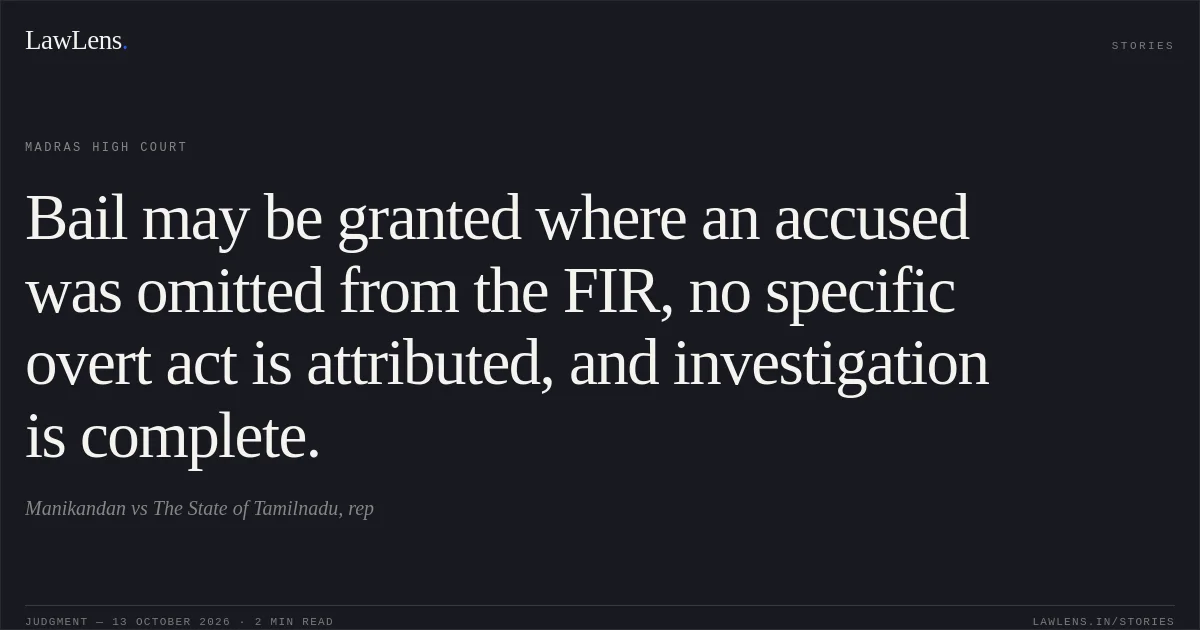
The Court considered that the appellant had not been named in the FIR, no specific overt act was attributed to him, the investigation was complete, and the final report had been filed.
Source reference: pp. 4–6It also noted his period of custody and that the injured victim did not oppose bail.
Source reference: pp. 4–6On these circumstances, the Court concluded that bail was appropriate, subject to stringent conditions.
Source reference: p. 6Holding
The Court allowed the appeal, set aside the Sessions Court’s order dated 7 September 2026, and directed that the appellant be released on bail.
Conditions included execution of a bond for ₹20,000 with two sureties for like sums, submission of identity and address proof, filing an undertaking not to engage in future offences, and daily reporting to the trial court at 10:30 a.m. until further orders, except on days when his appearance was required there.
Source reference: pp. 6–7The police were permitted to seek cancellation of bail upon breach of any condition.
Source reference: pp. 6–7Acts & Sections Cited
9 provisions across 2 statutes referred to in this judgment. Each provision opens on LawLens.
Bharatiya Nyaya Sanhita, 20238
Scheduled Castes and the Scheduled Tribes (Prevention of Atrocities) Act, 19891
Original Court PDF
ManikandanvsThe State of Tamilnadu, rep
Click to open original judgment
Original judgment, available to read, download and summarize on LawLens.in


