Facts
An FIR was registered against unknown persons at Old Goa Police Station, Goa, under Sections 302 and 201 of the Indian Penal Code, 1860 (“IPC”), concerning the murder and disposal of the body of Chandrika @ Gabbar Sahani.
Source reference: paras. 2–3; pp. 1–3The petitioner was identified and arrested on 29 August 2023, and was subsequently arraigned as Accused No. 1 in the chargesheet filed on 23 November 2023.
Source reference: paras. 2–3; pp. 1–3He was facing trial for offences under Sections 342, 302 and 201 read with Section 120-B IPC before the District and Sessions Court, North Goa.
Source reference: paras. 2–3; pp. 1–3The prosecution alleged that, arising from a family/property dispute, the petitioner and the co-accused conspired to eliminate the deceased.
Source reference: para. 3; p. 2The petitioner allegedly lured the deceased to his rented residence, wrongfully confined and assaulted him, and thereafter, with the assistance of the co-accused, tied the victim’s body to a stone and disposed of it in the Gaundalim river.
Source reference: para. 3; p. 2The petitioner’s second bail application was rejected by the Bombay High Court at Goa on 8 April 2026.
Source reference: paras. 1, 4; pp. 1, 3Before the Supreme Court, he claimed bail principally on the ground of parity with co-accused who had been granted bail, and also relied on prolonged incarceration and the alleged lack of progress in the trial.
Source reference: paras. 1, 4; pp. 1, 3At the time of hearing, only one of the prosecution’s proposed sixty-two witnesses had been examined.
Source reference: para. 7; p. 4Issues
Whether the petitioner was entitled to bail on the ground of parity because co-accused persons, allegedly assigned similar roles, had been granted bail?
Source reference: paras. 4–5, 8–11; pp. 3–5Whether the petitioner’s incarceration of nearly three years, coupled with the anticipated delay in conclusion of the trial, entitled him to bail notwithstanding the gravity of the alleged offences and concerns regarding witness influence or evidence tampering?
Source reference: paras. 7, 12–14; pp. 4–6Law Applied
The Court considered the prosecution’s allegations under Sections 342, 302 and 201 read with Section 120-B IPC, relating respectively to wrongful confinement, murder, causing disappearance of evidence and criminal conspiracy.
Source reference: para. 2; p. 2It applied the principle that the grant of bail to one accused does not automatically entitle another accused to bail; parity must be determined by comparing the specific role and degree of participation attributed to each accused, and cannot be treated as a mechanical or mathematical formula.
Source reference: para. 9; p. 4In this regard, the Court relied on Ramesh Bhavan Rathod v. Vishanbhai Hirabhai Makwana, (2021) 6 SCC 230, Sagar v. State of U.P., 2025 SCC OnLine SC 2584, and Rekha Sengar v. State of M.P., (2021) 3 SCC 729.
Source reference: para. 10; p. 4The Court further recognised the accused’s constitutional right to a speedy trial, but held that prolonged incarceration or the possibility of trial delay does not, by itself, mandate release on bail where the offence is grave and there is a risk of witnesses being influenced or evidence being tampered with.
Source reference: para. 12; p. 5Reasoning
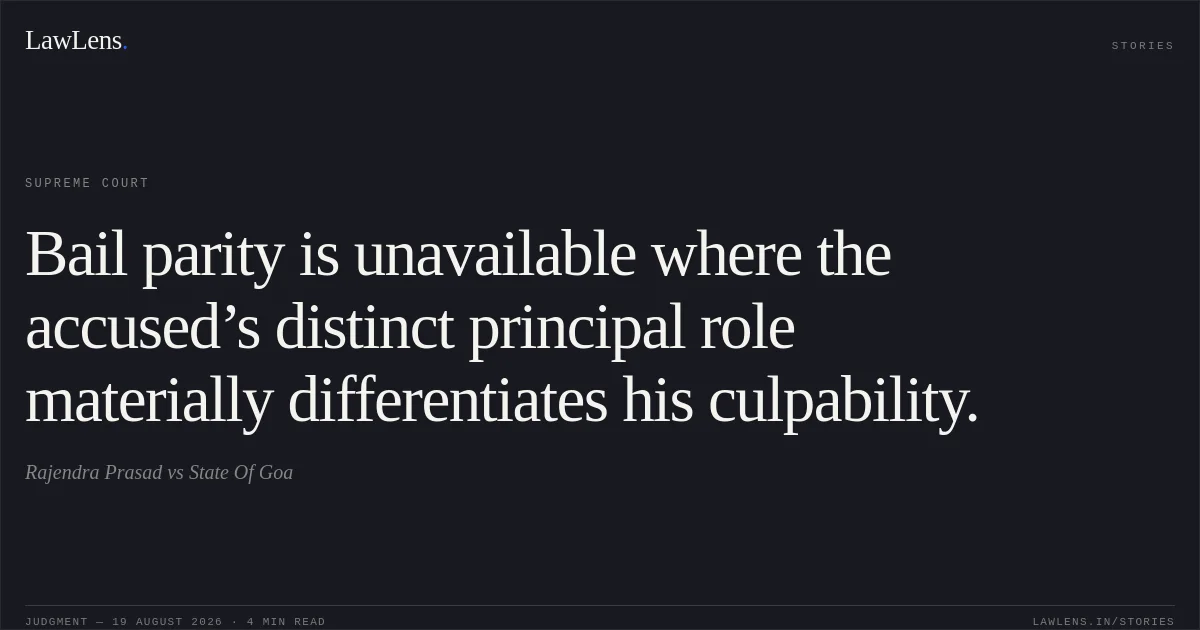
The Court rejected the petitioner’s parity argument because, on a prima facie assessment, he was alleged to be the principal architect of the conspiracy and to have played a distinct and more specific role in executing the plan, whereas the co-accused were treated as facilitators.
Source reference: para. 11; pp. 4–5Therefore, the mere fact that two co-accused had been granted bail did not establish comparable circumstances or require identical treatment.
Source reference: para. 11; pp. 4–5The Court also declined to grant bail solely on the basis of the petitioner’s nearly three-year incarceration.
Source reference: paras. 7, 12–13; pp. 4–6Although the right to a speedy trial was acknowledged, the Court noted that the investigation had been completed within three months, the trial had commenced, and the case involved serious allegations based on circumstantial evidence, including the anticipated testimony of vulnerable employee-witnesses and associates who were known to the petitioner.
Source reference: paras. 7, 12–13; pp. 4–6These considerations justified refusing bail at that stage, while also requiring expedited recording of crucial evidence.
Source reference: paras. 12–13; pp. 5–6Holding
The Supreme Court dismissed the petitioner’s challenge to the rejection of bail and held that he could not claim bail on the ground of parity because his alleged role was materially distinct and more serious.
The Court directed the Sessions Court to make a sincere endeavour to record, out of turn, the testimony of eight specified sensitive witnesses within one year from communication of the order, without preventing it from examining other witnesses in the meantime.
Source reference: para. 13; p. 6If those witnesses were examined earlier, or if their examination was not completed within one year, the petitioner was granted liberty to approach the appropriate forum afresh for bail, subject to his cooperation and provided that any delay was not attributable to him.
Source reference: para. 14; p. 6The Court clarified that its prima facie observations were confined to the bail proceedings and would not affect the merits of the pending trial.
Source reference: para. 15; p. 6The special leave petition was accordingly disposed of on these terms.
Source reference: para. 16; p. 7Acts & Sections Cited
3 provisions across 1 statute referred to in this judgment. Each provision opens on LawLens.
Indian Penal Code, 18603
Original Court PDF
Rajendra PrasadvsState Of Goa
Click to open original judgment
Original judgment, available to read, download and summarize on LawLens.in