Facts
The three revision petitions arose from Sarai P.S. Case No. 204 of 2025, registered under Sections 103(1) and 3(5) of the Bharatiya Nyaya Sanhita.
Source reference: para. 3–8The petitioners, assessed as children in conflict with law (CICL), were accused of involvement in the death of the informant’s son.
Source reference: para. 3–8The Juvenile Justice Board (JJB) rejected their bail applications; the appellate court affirmed those rejections.
Source reference: para. 3–8The petitioners challenged the respective appellate and JJB orders before the High Court.
Source reference: para. 3–8They argued that there was no eyewitness, the post-mortem report did not ascertain the cause of death, and no statutory ground for denying bail was established.
Source reference: para. 9Issues
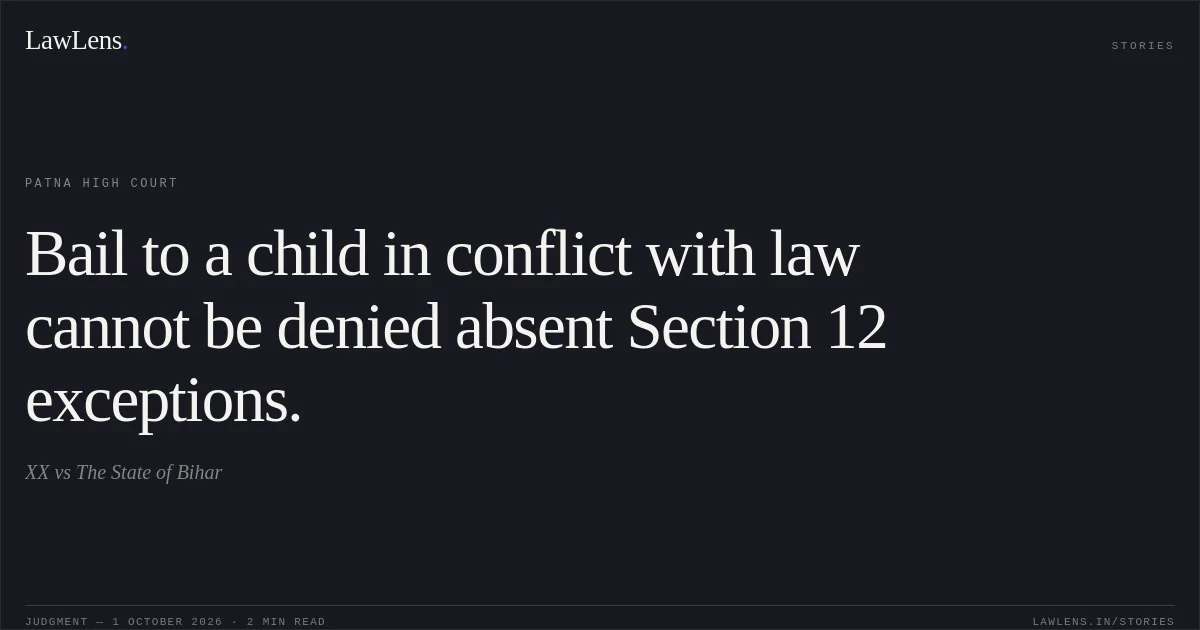
1. Whether the concurrent orders refusing bail to the petitioners could be sustained under Section 12 of the Juvenile Justice (Care and Protection of Children) Act, 2015.
Source reference: para. 12, 152. Whether the record established that releasing the petitioners would bring them into association with known criminals, expose them to moral, physical or psychological danger, or defeat the ends of justice.
Source reference: para. 12, 15Law Applied
Section 12 of the Juvenile Justice Act, 2015 requires a child alleged to be in conflict with law to be released on bail, with or without surety or under the supervision of a probation officer or fit person, unless reasonable grounds exist to believe that release would bring the child into association with a known criminal, expose the child to moral, physical or psychological danger, or defeat the ends of justice.
Source reference: para. 12The Act’s child-centred principles also require decisions to serve the child’s best interests and development, treat institutional care as a measure of last resort, and promote the child’s restoration and reunification with family where consistent with the child’s best interests.
Source reference: para. 13–14The judgment cites no judicial precedent.
Source reference: no citationReasoning
The High Court found no eyewitness to the occurrence and observed that the petitioners had been named on the basis of suspicion; the post-mortem report did not support the prosecution’s alleged cause of death.
Source reference: para. 15It also found no cogent material showing that release would trigger any of the exceptions in Section 12.
Source reference: para. 15Applying the Act’s rehabilitative and child-centred principles, the Court concluded that the lower courts had erred in refusing bail and that institutionalisation was not justified on the record.
Source reference: para. 14–15Holding
The Court allowed all three revision petitions.
It set aside the appellate orders dated 12 January 2026 and 10 March 2026 and the corresponding JJB orders dated 17 September 2025 and 27 January 2026.
Source reference: para. 16, 18The petitioners were directed to be released on bail on bonds of ₹10,000 each, with two sureties of like amount, subject to conditions including that one bailor be a parent, the other be a relative without criminal antecedents who undertakes to care for the petitioner, and that the petitioners attend each date fixed by the Board.
Source reference: para. 17Acts & Sections Cited
4 provisions across 2 statutes referred to in this judgment. Each provision opens on LawLens.
Bharatiya Nyaya Sanhita, 20232
Juvenile Justice (Care and Protection of Children) Act, 2015.2
Original Court PDF
XXvsThe State of Bihar
Click to open original judgment
Original judgment, available to read, download and summarize on LawLens.in