Facts
The juvenile appellant was accused, on the basis of a written report by a seventeen-year-old girl, of enticing her away on a promise of marriage, establishing a physical relationship with her, and subsequently refusing to marry her.
Source reference: p.2, para. 2The Children Court-cum-Additional Sessions Judge, Araria rejected his bail application on 30 October 2025, principally relying on the Social Investigation Report to conclude that the appellant’s parents had engaged him in labour instead of educating him and, therefore, could not be trusted to care for or reform him.
Source reference: p.1, para. 1; p.19, para. 28The appellant challenged that order, contending that bail under Section 12 of the Juvenile Justice (Care and Protection of Children) Act, 2015 (“J.J. Act”) is the rule, that his family had no criminal antecedents, and that poverty—not parental neglect—had prevented his education.
Source reference: pp.2–4, paras. 4–7The State and the informant opposed bail on the grounds of the seriousness of the allegation, the appellant’s maturity, and the possibility of moral, physical, or psychological danger upon release.
Source reference: p.4, para. 8Issues
1. Whether bail to a child in conflict with law can be denied under Section 12 of the J.J. Act on the basis of the seriousness of the alleged offence or the juvenile’s age.
Source reference: pp.4–18, paras. 9–272. Whether the Social Investigation Report disclosed any statutory ground under the proviso to Section 12(1)—association with known criminals, exposure to moral, physical, or psychological danger, or defeat of the ends of justice—justifying denial of bail.
Source reference: pp.5–8, paras. 10–13; pp.19–20, paras. 28–313. Whether the Children Court was justified in treating the appellant’s engagement in labour, arising from his family’s poverty, as a basis to distrust his parents and deny bail.
Source reference: pp.19–20, paras. 28–29Law Applied
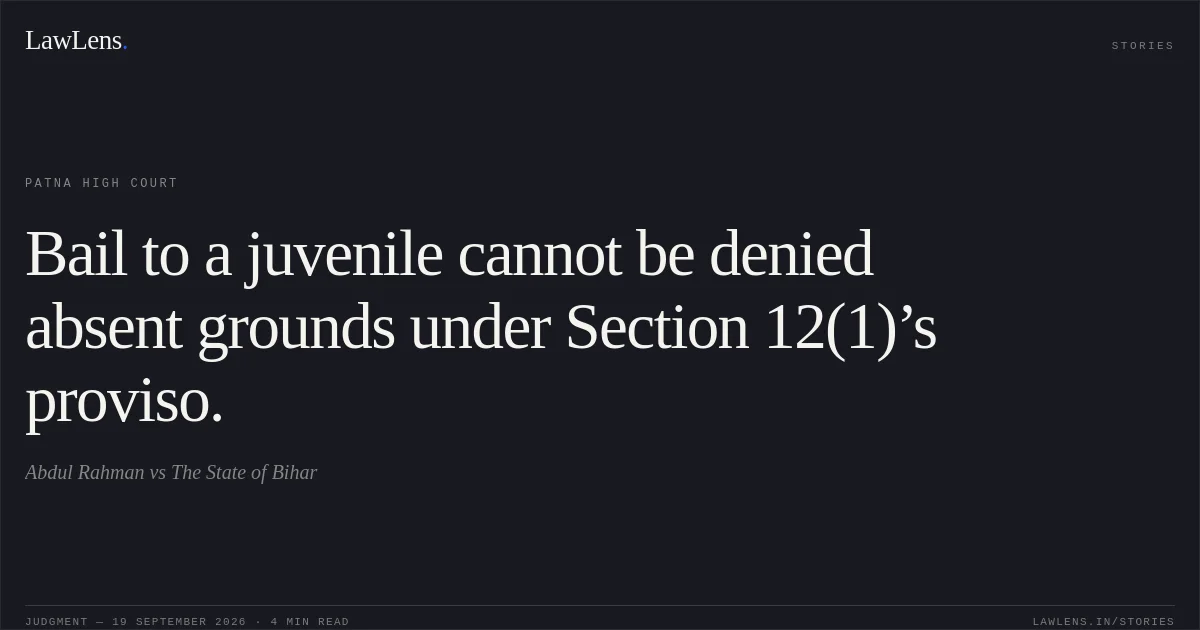
Section 12(1) of the J.J. Act mandates release of a child in conflict with law on bail, with or without surety, or under the supervision of a probation officer or the care of a fit person; bail may be denied only where there are reasonable grounds to believe that release would bring the child into association with known criminals, expose the child to moral, physical, or psychological danger, or defeat the ends of justice, with reasons recorded in writing.
Source reference: pp.4–6, paras. 9–10The Court relied on Juvenile in Conflict with Law v. State of Rajasthan, 2024 SCC OnLine SC 5297, and Re-Exploitation of Children in Orphanages in the State of T.N. v. Union of India, (2020) 14 SCC 327, for the proposition that bail is mandatory unless the Section 12(1) proviso is specifically established.
Source reference: pp.6–8, paras. 11–12It further relied on authorities holding that the nature or gravity of the offence is not, by itself, relevant under Section 12, including XYZ v. State of Maharashtra, 2023 SCC OnLine Bom 2790; Radhika (Juvenile) v. State of U.P., 2019 SCC OnLine All 4911; Vishvas v. State of Punjab, MANU/PH/0067/2021; and Gau v. State of Rajasthan, 2025 SCC OnLine Raj 2526.
Source reference: pp.7–14, paras. 13–18The Court also applied Sections 3(v), 3(vii), 3(xii), and 3(xiii) of the J.J. Act, embodying family responsibility, mobilisation of family and community resources, institutionalisation as a last resort, and restoration of the child to the family.
Source reference: pp.12–16, paras. 19–24The Court additionally treated the Social Investigation Report as important material for assessing the child’s socio-economic circumstances and rehabilitation needs.
Source reference: pp.18–19, para. 27(6)Reasoning
The High Court held that the Children Court had not identified any material showing that the appellant would associate with known criminals, suffer moral, physical, or psychological danger, or that his release would defeat the ends of justice.
Source reference: p.20, para. 31The allegation’s heinous or serious nature could not independently justify denial of bail, as Section 12 applies uniformly to children in conflict with law.
Source reference: p.20, para. 30; p.18, paras. 27(1)–27(5)The Court interpreted the Social Investigation Report in its socio-economic context: the appellant’s parents were illiterate daily-wage labourers, and their failure to provide education was attributable to poverty rather than lack of affection, irresponsibility, or inability to care for the child.
Source reference: pp.19–20, para. 29Since the J.J. Act prefers family-based care and treats institutionalisation as a last resort, the parents’ poverty was not a legally sufficient reason to reject bail; instead, governmental and community resources were required to support the family’s rehabilitative role.
Source reference: pp.15–16, paras. 22–25; p.20, para. 29Holding
The appeal was allowed and the Children Court’s order dated 30 October 2025 was set aside.
The appellant was directed to be released on bail on furnishing a bond of Rs. 10,000, together with an affidavit-undertaking by his father to supervise his habits, prevent contact with criminals, ensure his developmental needs, secure his attendance before the Court, and facilitate vocational training.
Source reference: p.21, para. 32The District Magistrate, Purnea, was directed to examine eligibility for a pucca house, ration card, free grain, employment, and other governmental benefits for the family; the Secretary, DLSA, Purnea, was directed to assist in that process.
Source reference: pp.21–22, paras. 32–33The Court thus held that, in the absence of a specific and fact-based finding under the proviso to Section 12(1), the juvenile was entitled to bail.
Source reference: no citationActs & Sections Cited
5 provisions across 1 statute referred to in this judgment. Each provision opens on LawLens.
Juvenile Justice (Care and Protection of Children) Act, 2015.5
Original Court PDF
Abdul RahmanvsThe State of Bihar
Click to open original judgment
Original judgment, available to read, download and summarize on LawLens.in