01Facts
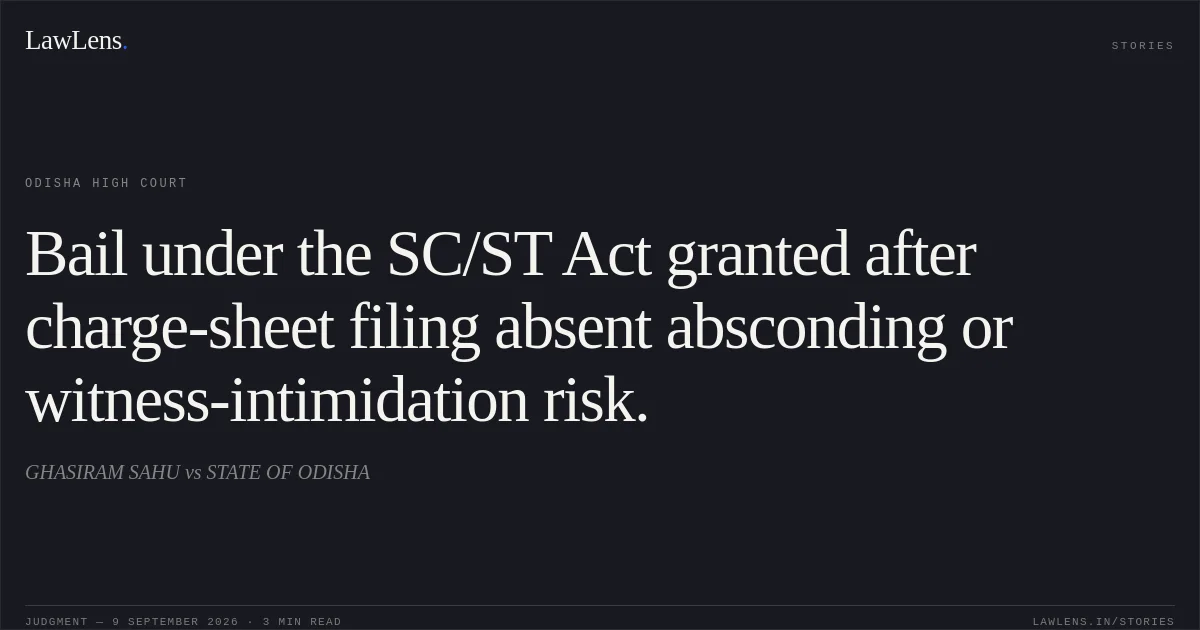
The appellants challenged, under Section 14-A(2) of the Scheduled Castes and the Scheduled Tribes (Prevention of Atrocities) Act, 1989, the order dated 5 February 2026 by which the Special Court, Sonepur, refused to grant them bail in Dunguripali P.S. Case No. 20 of 2026.
p. 1They were accused of offences under Sections 296, 115(2), 351(2), 109, 118(2), 74 and 3(5) of the Bharatiya Nyaya Sanhita, read with Sections 3(1)(r), 3(1)(s) and 3(2)(v) of the SC/ST (Prevention of Atrocities) Act.
pp. 1–2The prosecution allegation was that the appellants, along with co-accused persons, attacked Swantantra Bahuk, Sujata Bahuk, Bidesh Bahuk and Barsarani Pande @ Bahuk, who belonged to the Scheduled Caste community, with deadly weapons and attempted to endanger their lives by taking advantage of their caste.
p. 2The appellants had been in custody since 7 January 2026, and the charge-sheet had been filed by the time of consideration of the appeal.
p. 3The informant/victim did not appear despite notice.
p. 202Issues
i.1. Whether the appellants were entitled to bail under Section 14-A(2) of the SC/ST (Prevention of Atrocities) Act, notwithstanding the allegations of a caste-based attack involving deadly weapons?
pp. 1–3ii.2. Whether the circumstances of the case, including the appellants’ period of detention, filing of the charge-sheet, nature and number of injuries, and absence of material indicating absconding or witness intimidation, justified setting aside the refusal of bail?
p. 303Law Applied
The Court applied Section 14-A(2) of the SC/ST (Prevention of Atrocities) Act, 1989, which provides the statutory basis for an appeal against an order refusing bail in proceedings under the Act.
p. 1It considered the offences alleged under the Bharatiya Nyaya Sanhita and Sections 3(1)(r), 3(1)(s) and 3(2)(v) of the SC/ST Act.
pp. 1–2The Court further relied on established bail principles, including consideration of the nature and gravity of the accusations, the period of pre-trial detention, filing of the charge-sheet, the circumstances and injuries on record, the presumption of innocence, and the likelihood of absconding or interfering with witnesses.
p. 3Provisions in the judgment · 1 · Linked ones open on LawLens
Scheduled Castes and the Scheduled Tribes (Prevention of Atrocities) Act, 1989 Section 3
04Reasoning
The Court acknowledged the serious allegations against the appellants but assessed them alongside the circumstances relevant to bail.
p. 3It noted that the appellants had remained in custody since 7 January 2026 and that the charge-sheet had already been submitted, reducing the need for continued custodial detention.
p. 3The Court also considered the nature and number of injuries sustained by the injured persons, the appellants’ inherent entitlement to be presumed innocent until proven guilty, and the absence of material suggesting that they would abscond or threaten, induce or influence witnesses if released.
p. 3Without expressing any opinion on the merits of the prosecution case, the Court therefore found it appropriate to grant bail.
p. 305Holding
The appeal was allowed and the order dated 5 February 2026 refusing bail was set aside.
p. 3The appellants were directed to be released on bail on such terms and conditions, excluding cash surety, as the court having seisin over the matter considered appropriate.
p. 3The bail was subject to conditions that the appellants would not engage in criminal activities, would not induce, influence or coerce witnesses, and would not contact the injured persons or their family members.
pp. 3–4An urgent certified copy of the order was directed to be issued, with electronic communication to the concerned court and jail authorities.
p. 4Original Court PDF
GHASIRAM SAHUvsSTATE OF ODISHA
Click to open original judgment
Original judgment, available to read, download and summarize on LawLens.in