Facts
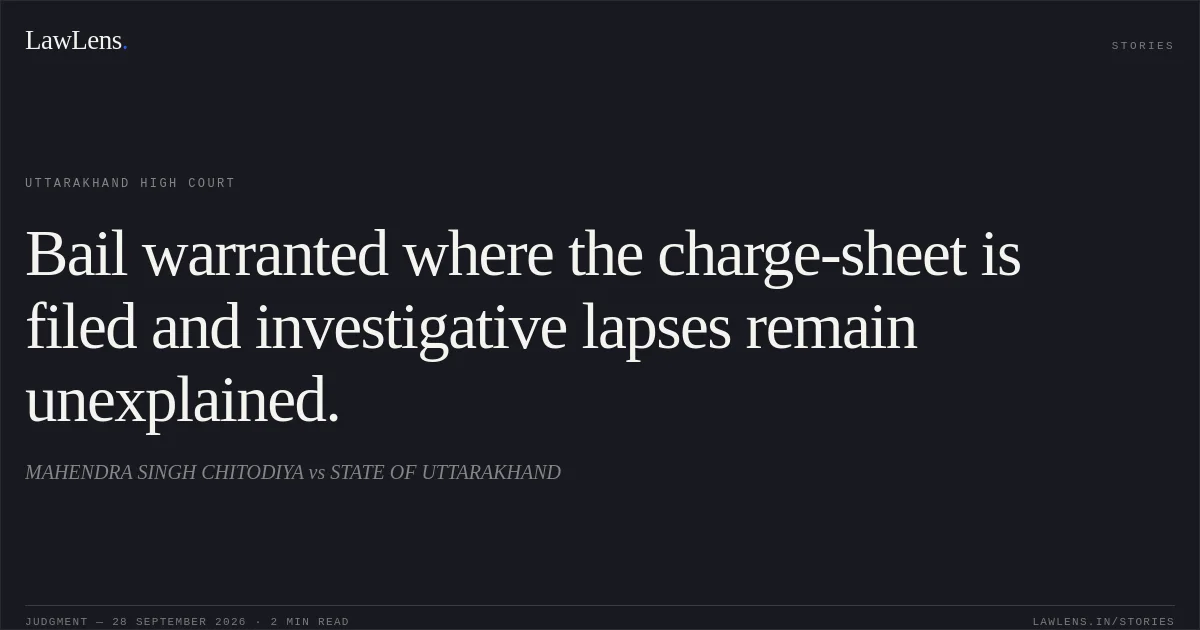
The informant’s son died by hanging on 13 April 2026.
Source reference: no citationNo FIR was lodged, inquest conducted, or post-mortem performed at the time; the body was cremated.
Source reference: no citationOn 24 May 2026, the informant reported that his son had been a victim of cyber fraud, alleging that this came to light after he examined the deceased’s mobile phone
Source reference: para. 5The FIR was initially registered against an unknown person under Section 318(4) of the Bharatiya Nyaya Sanhita, 2023 (BNS).
Source reference: no citationThe applicants, a father and son, were later charge-sheeted under Sections 61(2), 108, 308(2), and 318(4) of the BNS and arrested on 1 June 2026
Source reference: paras. 3–4, 6The applicants sought bail under Section 483 of the Bharatiya Nagarik Suraksha Sanhita, 2023 (BNSS), arguing that the case rested on weak evidence, including a transfer of ₹90,000, and that the charge-sheet had been filed
Source reference: paras. 6–7The State opposed bail, relying on electronic evidence, including alleged obscene images of the deceased, and the informant’s statement
Source reference: paras. 8–9Issues
1. Whether the applicants should be released on bail under Section 483 of the BNSS, given that the charge-sheet had been filed and further custodial interrogation was not required
Source reference: paras. 7, 102. Whether the circumstances surrounding the delayed FIR and the absence of an inquest or post-mortem were relevant to the bail determination
Source reference: paras. 9–10Law Applied
The application was considered under Section 483 of the BNSS, which provides the High Court with power to grant bail.
Source reference: no citationThe alleged offences were under Sections 61(2), 108, 308(2), and 318(4) of the BNS
Source reference: paras. 3–4The Court cited no precedent or further legal test.
Source reference: no citationIt made clear that its observations were not to influence the trial court’s independent consideration of the case on its merits
Source reference: para. 13Reasoning
The Court noted that the informant’s account raised questions about why no FIR was lodged and no post-mortem arranged when the death occurred.
Source reference: para. 10It observed that the investigating officer had not addressed these matters in the charge-sheet and described this as a prima facie lapse, while reserving the investigation’s ultimate significance for trial
Source reference: para. 10In deciding the bail application, the Court also took into account that the charge-sheet had been filed and further custodial interrogation was unnecessary.
Source reference: para. 10It therefore concluded that the applicants deserved bail, without determining the merits of the prosecution evidence
Source reference: para. 10Holding
The Court allowed the bail application
directed that both applicants be released on personal bonds with two reliable sureties each, to the satisfaction of the court concerned.
Source reference: paras. 11–12They must attend every trial date and not seek unnecessary adjournments
Source reference: paras. 11–12The trial court may proceed on the merits, uninfluenced by the High Court’s observations.
Source reference: para. 13Acts & Sections Cited
5 provisions across 2 statutes referred to in this judgment. Each provision opens on LawLens.
Bharatiya Nagarik Suraksha Sanhita, 20231
Bharatiya Nyaya Sanhita, 20234
Original Court PDF
MAHENDRA SINGH CHITODIYAvsSTATE OF UTTARAKHAND
Click to open original judgment
Original judgment, available to read, download and summarize on LawLens.in