Facts
The Plaintiff No. 2 (partnership firm) stored bicycle tube valves worth ₹9,93,000/- at the defendant’s (Central Warehousing Corporation) warehouse in Navi Mumbai for export
Source reference: p. 2The goods were insured by Plaintiff No. 1 (New India Assurance Co.). On June 7, 2002, a major fire broke out at the warehouse, destroying the goods
Source reference: p. 3The Fire Brigade attributed the fire to an electrical short circuit
Source reference: p. 11Plaintiff No. 1 settled the insurance claim with Plaintiff No. 2 for ₹8,53,329/- and, under the principle of subrogation, sued the defendant to recover this amount, alleging negligence in the defendant’s capacity as a bailee
Source reference: p. 3-4The Trial Court decreed the suit in favor of the plaintiffs. The defendant appealed, primarily contending that the fire was an "Act of God" and that the suit was defective for failing to implead their own insurer, United India Insurance Co.
Source reference: p. 5Issues
1. Whether the defendant, as a bailee, exercised the degree of care required under law to prevent the loss of goods
Source reference: p. 6, Issue 4-52. Whether the fire was an "Act of God" or resulted from the defendant's negligence
Source reference: p. 6, Issue 63. Whether the non-joinder of the defendant’s insurer (United India Insurance Co.) was fatal to the suit
Source reference: p. 5, Para 6Law Applied
Section 151 and 152 of the Indian Contract Act, 1872, which mandates that a bailee must take as much care of the goods bailed as a man of ordinary prudence would of his own goods, failing which they are liable for loss
Source reference: p. 9, 12Section 106 of the Indian Evidence Act, 1872, which places the burden of proof on the bailee to explain facts within their special knowledge, such as the cause of a fire in their premises
Source reference: p. 13Principle of subrogation under the law of insurance
Source reference: p. 4, 14Precedent in Laliteshwar Prasad Singh v. S.P. Srivastava regarding the duties of a First Appellate Court
Source reference: p. 16Reasoning
The High Court affirmed that once goods are damaged in a bailee's possession, there is an initial presumption of negligence
Source reference: p. 12The court found that the defendant failed to rebut this presumption because they did not examine the electrical engineer responsible for maintenance nor produced maintenance registers
Source reference: p. 8Despite claiming the fire was an "Act of God," the court noted the Fire Brigade report suggested a short circuit, and the defendant failed to show they took "round-the-clock" precautions for combustible materials like rubber tubes
Source reference: p. 11, 13Regarding the non-joinder of United India Insurance, the court held that the contract between the plaintiffs (based on subrogation) was independent of the contract between the defendant and its own insurer; hence, the latter was not a necessary party
Source reference: p. 14-15Holding
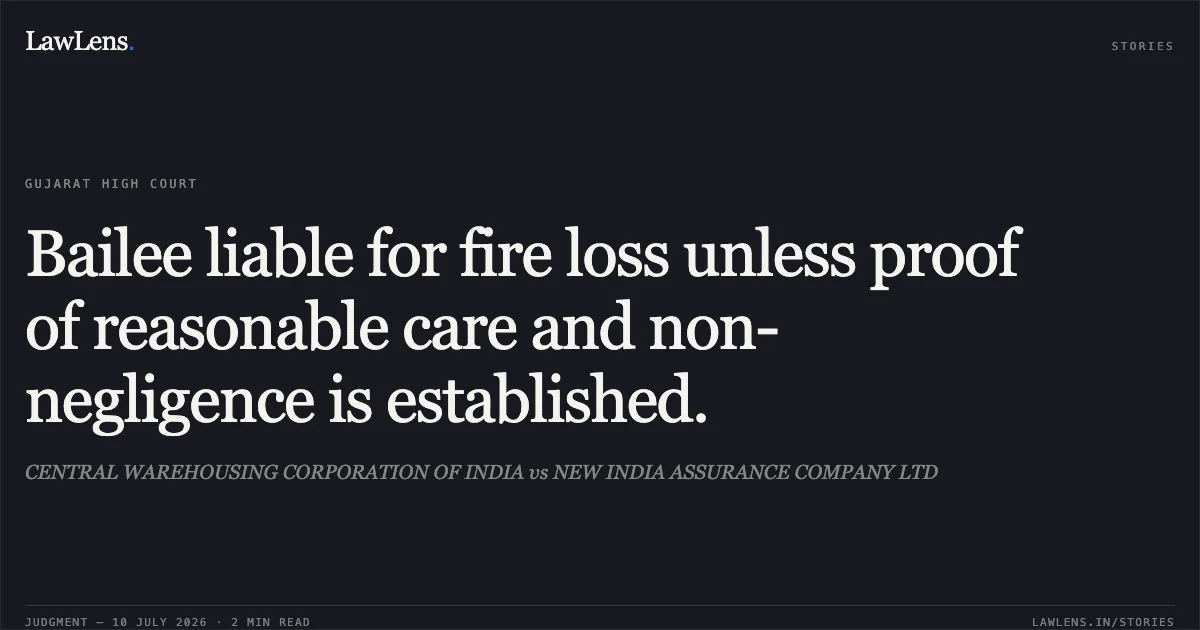
The court held that the defendant failed to prove it exercised ordinary prudence as a bailee and that the cause of action against the bailee is distinct from the bailee's claim against its own insurer
The High Court dismissed the appeal and upheld the Trial Court's decree directing the defendant to pay ₹8,55,329/- with 6% interest; the court ordered the disbursement of any deposited amounts to the New India Assurance Co.
Source reference: p. 1, 20Acts & Sections Cited
3 provisions across 2 statutes referred to in this judgment. Each provision opens on LawLens.
Code of Civil Procedure, 19081
Indian Contract Act, 18722
Original Court PDF
CENTRAL WAREHOUSING CORPORATION OF INDIAvsNEW INDIA ASSURANCE COMPANY LTD
Click to open original judgment
Original judgment, available to read, download and summarize on LawLens.in


