Facts
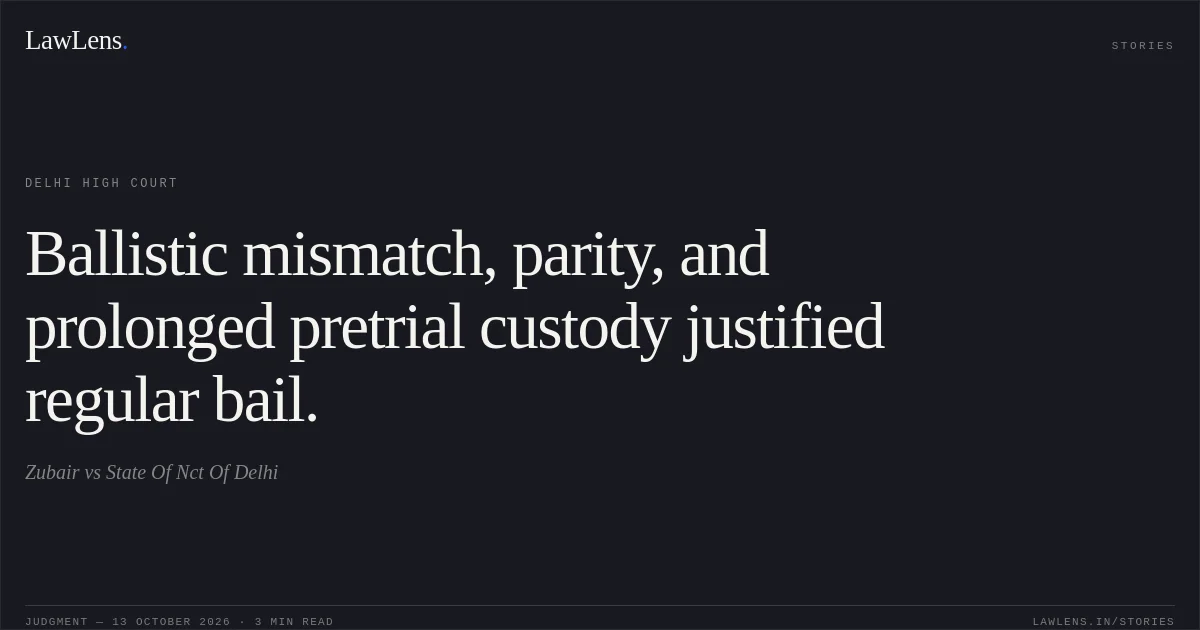
The petitioner sought regular bail under Section 483 of the Bharatiya Nagarik Suraksha Sanhita, 2023, in an FIR alleging that two persons stole a Remote Radio Unit from a telecom tower and one fired at an employee who attempted to apprehend them.
Source reference: p. 1The petitioner was not named in the FIR; co-accused later implicated him, and the injured witness identified him in a TIP.
Source reference: p. 1–2A pistol and cartridges were allegedly recovered at his instance, but the prosecution’s FSL ballistic report found that the evidence bullet did not match the test-fired bullets from the recovered pistol.
Source reference: p. 1–2The chargesheet had been filed, charges framed, and the co-accused had been granted bail.
Source reference: p. 2–5The petitioner had spent approximately eight months in judicial custody, while prosecution evidence had yet to be adduced.
Source reference: p. 2–5Issues
1. Whether the petitioner should be granted regular bail, having regard to the ballistic mismatch, the evidence of identification, and the alleged recovery.
Source reference: p. 2–3, 52. Whether parity with bailed co-accused, completion of investigation, and the petitioner’s period of custody supported release on bail.
Source reference: p. 3–5Law Applied
Section 483 of the Bharatiya Nagarik Suraksha Sanhita, 2023, empowers the High Court to grant regular bail.
Source reference: no citationUnder Mahipal v. Rajesh Kumar, as quoted in The State of Rajasthan v. Indraj Singh, bail requires a prima facie assessment and balancing relevant factors, including the nature of the offence, punishment, and the accused’s apparent involvement; a detailed determination of guilt is reserved for trial.
Source reference: p. 3Parity is a relevant, but not conclusive, consideration: where the applicant’s case is materially similar to that of bailed co-accused, consistency may favour bail, subject to an individual assessment (Sagar v. State of U.P.; Harbhajan Singh v. State).
Source reference: p. 3–4Bail is not punitive or preventive, and custody, completion of investigation, and the absence of a need for further custodial interrogation are relevant considerations (Satender Kumar Antil v. CBI).
Source reference: p. 4Article 21’s speedy-trial protection applies irrespective of the nature of the offence; prolonged pre-trial detention without reasonable trial progress may weigh in favour of bail (Arvind Dham v. ED).
Source reference: p. 5The Court also relied on the principle that, once a case for bail is made out, denial may impermissibly infringe Article 21 (Jalaluddin Khan v. Union of India).
Source reference: p. 6Reasoning
The Court considered the ballistic mismatch significant because it weakened the prima facie connection between the recovered pistol and the shooting, thereby diminishing the force of the alleged recovery as a distinguishing circumstance from the co-accused.
Source reference: p. 2–3Given that the co-accused had been granted bail, the Court found no material distinction at this stage that justified treating the petitioner differently.
Source reference: p. 3–4It also weighed the completed investigation and framed charges against the petitioner’s approximately eight months in custody and the fact that prosecution evidence had not yet been adduced.
Source reference: p. 4–6Applying the principles governing parity, pre-trial detention, and speedy trial, the Court concluded that continued custody was not warranted.
Source reference: p. 4–6Holding
The Court granted the petitioner regular bail on a personal bond of ₹25,000 with one surety for the like amount, subject to conditions including travel restrictions, disclosure of residence and contact details, reporting to the investigating officer and the local SHO, non-contact with prosecution witnesses, and attendance at each trial hearing.
The application and pending applications were disposed of; the Court clarified that its observations were limited to the bail decision and would not affect the trial.
Source reference: p. 8Acts & Sections Cited
8 provisions across 3 statutes referred to in this judgment. Each provision opens on LawLens.
Bharatiya Nagarik Suraksha Sanhita, 20231
Bharatiya Nyaya Sanhita, 20235
Arms Act, 19592
Original Court PDF
ZubairvsState Of Nct Of Delhi
Click to open original judgment
Original judgment, available to read, download and summarize on LawLens.in