Facts
The petitioner, Kamta Ninama, approached the High Court under Article 226 of the Constitution of India seeking a writ to direct Punjab National Bank to remove a debit freeze on their bank account (Account No. 99000400017044)
Source reference: para. 1In the alternative, the petitioner requested permission to operate the account subject to the retention of a disputed amount of ₹9,645/- pending investigation
Source reference: para. 1The petitioner contended that their case was identical to the precedent set in Malcolm Murayis & Ors. v. State Bank of India and Others (W.P. No. 1100 of 2024), where accounts were frozen by banks solely on the instructions of cyber cells without following proper legal procedures
Source reference: para. 2-3Issues
1. Whether the bank is justified in freezing the entire account of the petitioner based on an investigation into a specific disputed amount
Source reference: para. 1-22. Whether the investigating agencies complied with the mandatory procedural requirements under the law regarding the freezing of bank accounts
Source reference: para. 3-53. Whether the petitioner is entitled to operate the account after securing the disputed amount
Source reference: para. 5Law Applied
Article 226 of the Constitution of India regarding the High Court's power to issue writs for the enforcement of rights
Source reference: para. 1Section 102 of the Code of Criminal Procedure (Cr.P.C.), now governed by the relevant provisions of the Bharatiya Nagarik Suraksha Sanhita (BNSS), which requires investigating officers to report seizures/freezes to the competent Magistrate
Source reference: para. 3, 5the principle of mutatis mutandis from the precedent Malcolm Murayis & Ors. v. State Bank of India, which establishes that an entire account should not remain frozen indefinitely if the investigating agency fails to follow statutory procedures or respond to inquiries
Source reference: para. 3-4Reasoning
The Court observed that the petitioner's situation was functionally identical to the Malcolm Murayis case, where the Court found that cyber crime cells often freeze accounts via email without subsequent follow-up or compliance with Section 102 Cr.P.C.
Source reference: para. 3-4Justice Pranay Verma reasoned that the interests of justice would be served by balancing the needs of the criminal investigation with the petitioner's right to access their funds
Source reference: para. 5By directing the bank to segregate the "disputed amount" into a Fixed Deposit (FD), the Court ensured the potential "proceeds of crime" remained secured while allowing the petitioner to utilize the remainder of the account
Source reference: para. 5The Court emphasized that if the police agency fails to take legal action before a Magistrate within a three-month window, the petitioner’s right to the funds should be restored
Source reference: para. 5Holding
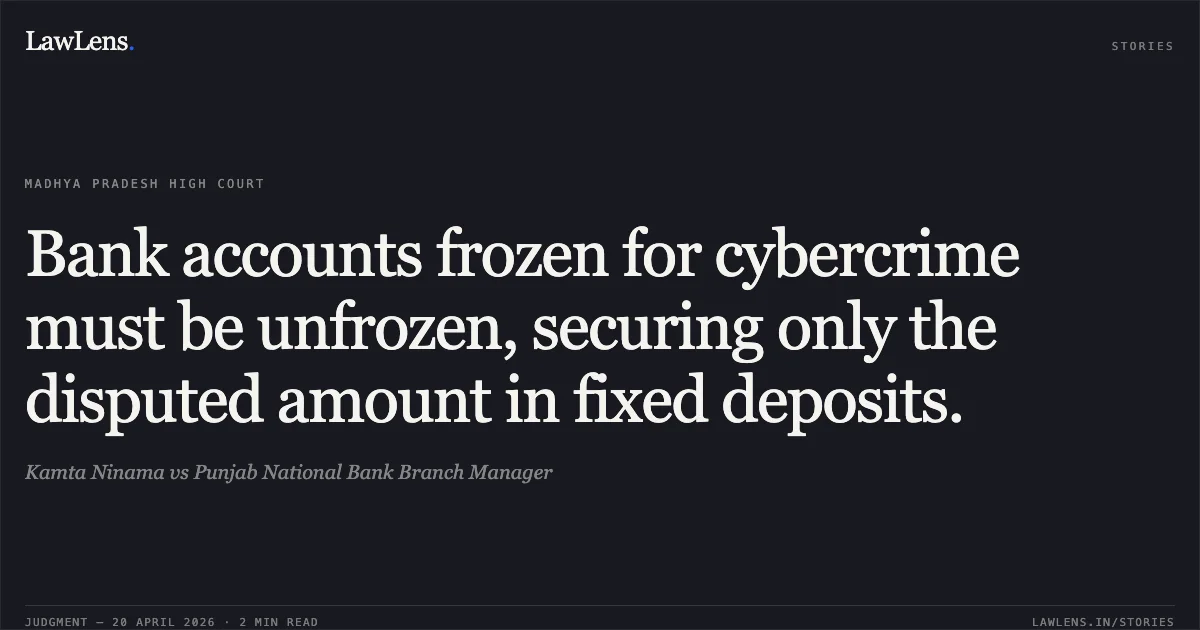
The High Court disposed of the writ petition by directing the respondent bank to unfreeze the petitioner’s account
The bank was specifically directed to keep the disputed amount (₹9,645/-) in a fixed deposit, which can only be liquidated upon orders from a competent Judicial Magistrate within three months
Source reference: para. 5If the police agency fails to proceed under the BNSS or relevant laws within this three-month period, the petitioner is permitted to withdraw the FD amount under intimation to the agency
Source reference: para. 5Acts & Sections Cited
1 provisions across 1 statute referred to in this judgment. Each provision opens on LawLens.
Code of Criminal Procedure, 19731
Original Court PDF
Kamta NinamavsPunjab National Bank Branch Manager
Click to open original judgment
Original judgment, available to read, download and summarize on LawLens.in