Facts
The petitioner, Akhilesh Solanki, filed a writ petition under Article 226 of the Constitution of India challenging the sudden freezing/holding of his bank account (No. 25030269450) maintained with the Bank of Maharashtra
Source reference: p. 1The account was restricted at the behest of cyber crime agencies investigating alleged cyber fraud transactions
Source reference: para. 3, 5The petitioner sought a direction for the removal of this hold, claiming it was imposed without lawful authority or proper notice to him
Source reference: p. 1, para. 4The petitioner argued his case was identical to the precedent set in Malcolm Murayis & Ors. Vs. State Bank of India and Others (W.P. No. 1100 of 2024)
Source reference: para. 2Issues
1. Whether the unilateral freezing of the petitioner's bank account by investigative agencies without adhering to procedural safeguards is legally sustainable
Source reference: para. 4-52. Whether the petitioner is entitled to operate his account, subject to certain conditions, in light of the directions issued in Malcolm Murayis (supra)
Source reference: para. 2, 4Law Applied
The court primarily applied the legal principles governing the seizure of property and bank accounts by police authorities under Section 102 of the Code of Criminal Procedure (Cr.P.C.)
Source reference: para. 3, 4The court strictly followed the precedent established in Malcolm Murayis & Ors. Vs. State Bank of India and Others (W.P. No. 1100 of 2024), which mandates that investigative agencies must report seizures to the Magistrate and that disputed amounts should be secured in fixed deposits rather than completely freezing an account indefinitely
Source reference: para. 3, 9-10Section 102 Cr.P.C. in the updated legal context refers to relevant provisions of the Bharatiya Nagarik Suraksha Sanhita (BNSS)
Source reference: para. 5Reasoning
The Court observed that the facts of the present case were squarely covered by the Malcolm Murayis decision
Source reference: para. 4In that precedent, the Court critiqued the "poor functioning and irresponsible approach" of cyber crime cells that freeze accounts via email but fail to respond to court inquiries or comply with statutory mandates under Section 102 Cr.P.C.
Source reference: para. 3, 8The High Court determined that the principle of mutatis mutandis applied here
Source reference: para. 4Consequently, rather than maintaining a total freeze, the court reasoned that the specific "disputed amounts" identified by the crime agencies should be isolated into fixed deposits to secure the interests of the investigation, while allowing the petitioner to regain access to the account itself. This ensures procedural compliance with the BNSS/Cr.P.C. while preventing arbitrary deprivation of the petitioner's access to his funds.
Source reference: para. 5Holding
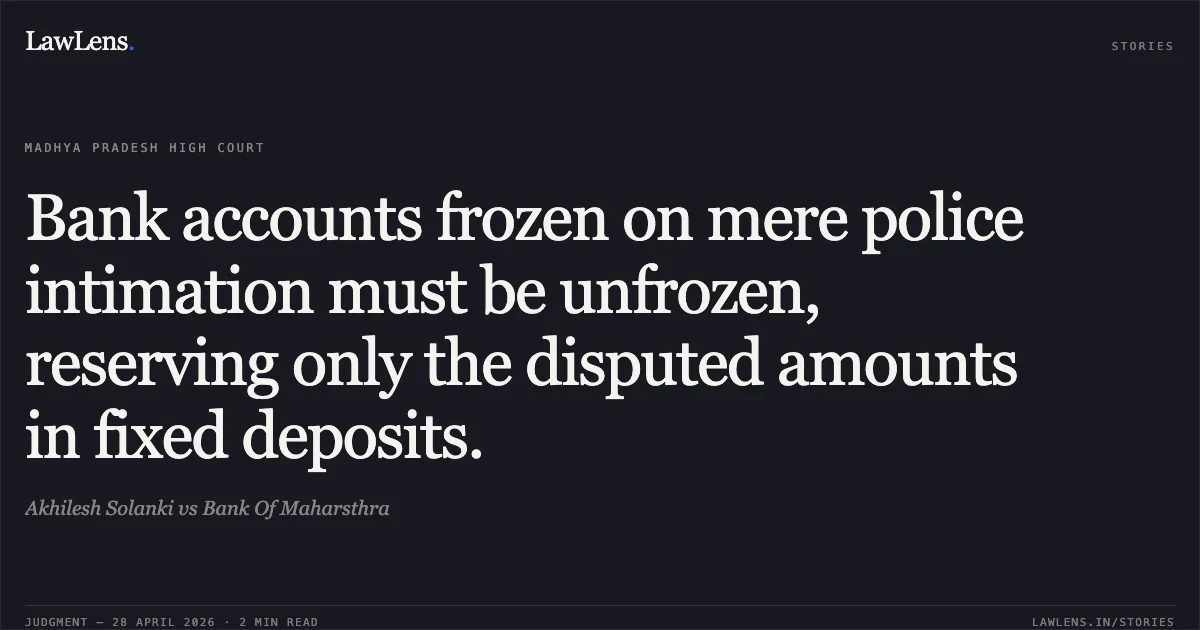
The Court allowed the petition in terms of the Malcolm Murayis precedent and directed the Bank of Maharashtra to unfreeze the petitioner's account
The Bank was ordered to keep the specific disputed amounts in fixed deposits (FDs). These FDs are to be liquidated only upon orders from a competent Judicial Magistrate within three months, provided the police proceed in accordance with the law (BNSS/Cr.P.C.); otherwise, the petitioner is permitted to withdraw the FD amounts under intimation to the agency
Source reference: para. 5The petition was disposed of with these directions
Source reference: para. 6Acts & Sections Cited
2 provisions across 2 statutes referred to in this judgment. Linked provisions open on LawLens.
Code of Criminal Procedure1
Bharatiya Nagarik Suraksha Sanhita, 20231
Original Court PDF
Akhilesh SolankivsBank Of Maharsthra
Click to open original judgment
Original judgment, available to read, download and summarize on LawLens.in