Facts
The petitioner, a private limited company, challenged the freezing of its bank account (No. 60109308262) maintained with the State Bank of India.
Source reference: para. 1The account was frozen following instructions from cyber crime agencies regarding alleged involvement in cyber fraud.
Source reference: para. 3The petitioner sought a writ to de-freeze the account, asserting that the case was squarely covered by a previous coordinate Bench decision involving similar circumstances where bank accounts were frozen without prior notice to the account holders or compliance with statutory reporting requirements to the Magistrate.
Source reference: para. 2, 3Issues
1. Whether the respondent bank can be directed to unfreeze the petitioner’s bank account subject to conditions regarding the disputed amount.
Source reference: para. 4, 52. Whether the principles laid down in Malcolm Murayis Ors. v. State Bank of India and Others apply mutatis mutandis to the present case.
Source reference: para. 4Law Applied
The Court primarily applied the principles governing the seizure of property under Section 102 of the Code of Criminal Procedure (Cr.P.C.), now substituted by corresponding provisions in the Bharatiya Nagarik Suraksha Sanhita (BNSS).
Source reference: para. 3, 5The rule establishes that investigating agencies must inform the concerned Magistrate regarding the seizure/freezing of bank accounts.
Source reference: para. 3, 5The Court relied on the precedent of Malcolm Murayis Ors. v. State Bank of India and Others (W.P. No. 1100/2024), which held that while disputed amounts linked to fraud must be secured, the entirety of an account cannot be indefinitely frozen if the investigating agencies fail to proceed in accordance with law or respond to inquiries.
Source reference: para. 3, 4Reasoning
The Court noted that the petitioner’s situation mirrored the facts in Malcolm Murayis, where accounts were frozen based solely on emails from various cyber cells without the account holders receiving notice of any offence.
Source reference: para. 3The High Court observed a pattern of "irresponsible approach" by cyber crime cells that instruct banks to freeze accounts but fail to respond to judicial or bank communications.
Source reference: para. 3, sub-para. 8Since the petitioner claimed their business was lawful and that any tainted funds might have resulted from third-party transactions without their knowledge, the Court determined that the balance of equities required unfreezing the account while protecting the specific "disputed amount".
Source reference: para. 3, 5The Court reasoned that the investigating agencies must act within a specific timeframe (three months) under the BNSS, failing which the petitioner should regain full access to all funds.
Source reference: para. 5Holding
The Court allowed the petition in part, applying the Malcolm Murayis judgment mutatis mutandis.
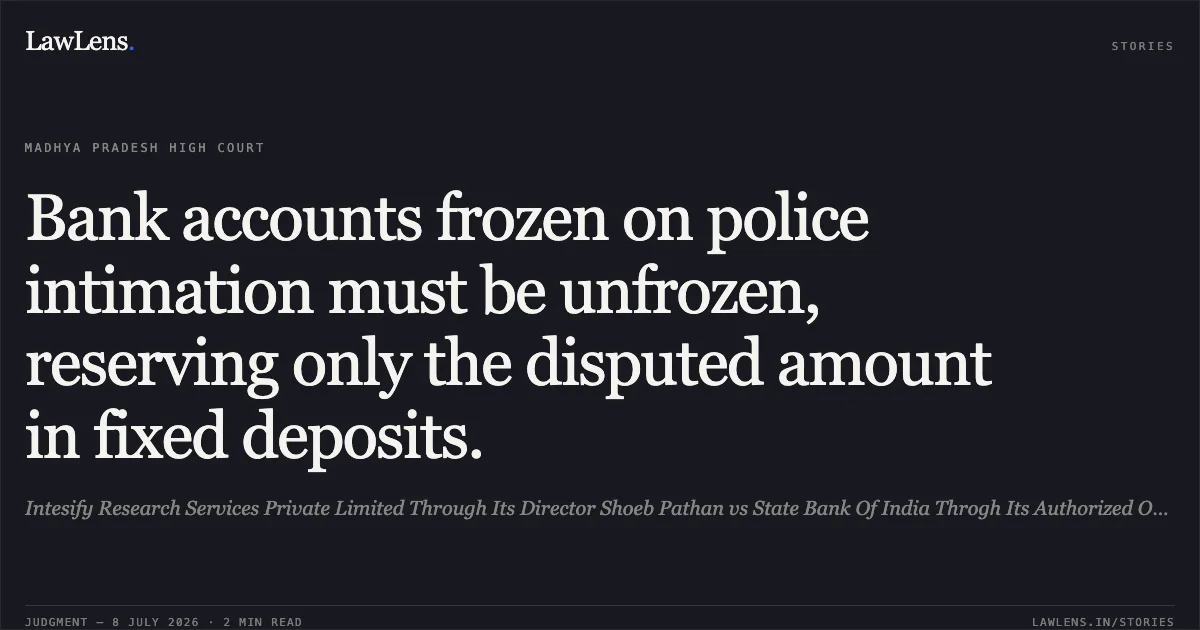
The Court directed the State Bank of India to unfreeze the petitioner's account, ordering the Bank to keep the specific "disputed amount" (as identified by the crime agencies) in a Fixed Deposit (FD) which can only be liquidated upon orders from a competent Judicial Magistrate within three months; if the police agency fails to proceed under the BNSS within this period, the petitioner is permitted to withdraw the FD amount.
Source reference: para. 5Acts & Sections Cited
1 provisions across 1 statute referred to in this judgment. Each provision opens on LawLens.
Code of Criminal Procedure, 19731
Original Court PDF
Intesify Research Services Private Limited Through Its Director Shoeb PathanvsState Bank Of India Throgh Its Authorized Officer/Branch Manger
Click to open original judgment
Original judgment, available to read, download and summarize on LawLens.in