Facts
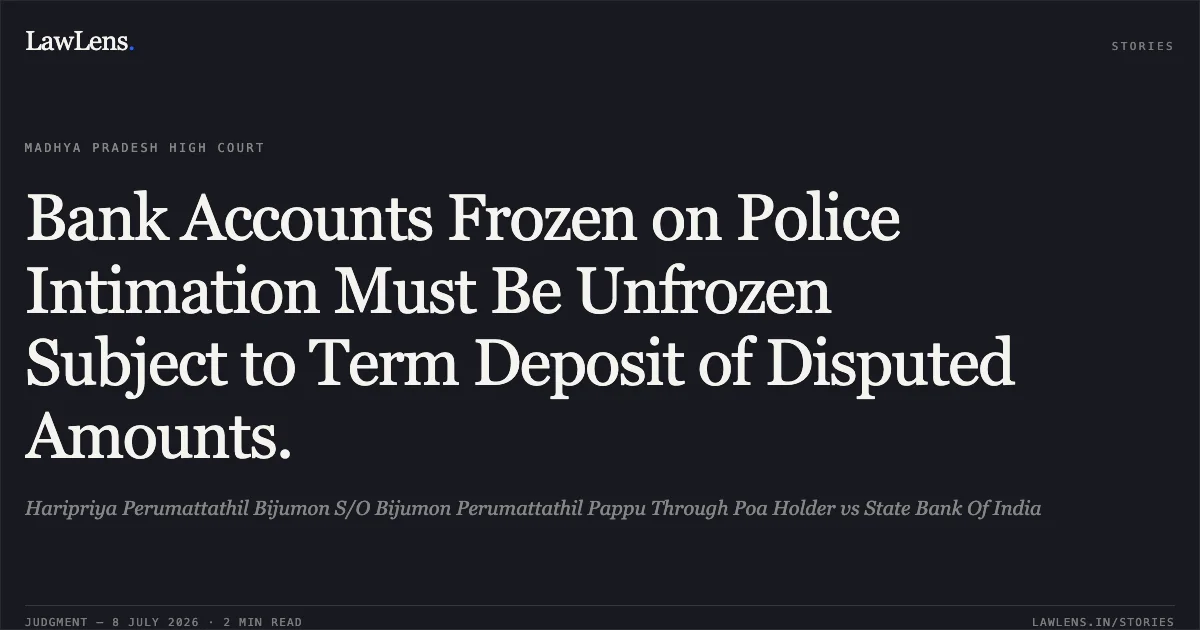
The petitioners, who were engaged in trading crypto and virtual currency, approached the High Court under Article 226 of the Constitution of India challenging the "illegal and arbitrary" freezing of their bank accounts (SBI Account Nos. 43083772517 and 40853337162).
Source reference: para. 1The freeze was imposed by the State Bank of India based on intimations from various cyber cell police stations alleging involvement in cyber fraud.
Source reference: para. 3 - ref. Malcolm MurayisThe petitioners contended that they received no notice of involvement in any offence and that the investigating agencies failed to comply with the mandatory reporting requirements to the Magistrate.
Source reference: para. 3 - ref. Malcolm MurayisIssues
1. Whether the freezing of the petitioners' bank accounts by the bank on the mere instructions of investigating agencies without a formal order or notice was legally sustainable.
Source reference: para. 1-22. Whether the investigating agencies complied with the procedural requirements of Section 102 of the Code of Criminal Procedure (Cr.P.C.) or the corresponding provisions of the Bharatiya Nagarik Suraksha Sanhita (BNSS).
Source reference: para. 3, 5Law Applied
Section 102 of the Cr.P.C. (and the relevant provisions of the BNSS), which empowers police officers to seize property suspected to be stolen or found under circumstances which create suspicion of the commission of any offence, subject to reporting such seizure to the Magistrate.
Source reference: para. 3, 5Precedential ratio from Malcolm Murayis & Ors. Vs. State Bank of India and Others (W.P. No. 1100 of 2024), which established that bank accounts cannot remain frozen indefinitely if the investigating agencies fail to respond or proceed in accordance with the law.
Source reference: para. 2-4Reasoning
The Court observed that the issue was squarely covered by the Malcolm Murayis decision.
Source reference: para. 4In that precedent, the court noted a "poor functioning and irresponsible approach" of cyber crime cells, who requested account freezes but failed to respond to bank inquiries or court notices.
Source reference: para. 3 - Malcolm Murayis para. 8The court reasoned that while the bank acted on police instructions, the petitioners' right to operate their accounts must be balanced against the investigation. Since no clean chit was yet provided, but procedural lapses (non-compliance with reporting to a Magistrate) were evident, the court determined that the disputed amounts should be secured in fixed deposits while allowing the rest of the account to be functional.
Source reference: para. 3, 5This ensures the funds remain available if a crime is proven while preventing indefinite arbitrary freezing.
Source reference: para. 5Holding
The Court allowed the petition and directed the Respondent Bank to unfreeze the petitioners' bank accounts.
The Bank is ordered to keep only the specific "disputed amount" (as identified by the crime agencies) in fixed deposits (FD). These FDs shall only be liquidated upon orders from a competent Judicial Magistrate within three months; should the police agency fail to proceed in accordance with the law (BNSS/Cr.P.C.) within that timeframe, the petitioners are permitted to withdraw the FD amounts under intimation to the agency.
Source reference: para. 5-6Acts & Sections Cited
1 provisions across 1 statute referred to in this judgment. Each provision opens on LawLens.
Code of Criminal Procedure, 19731
Original Court PDF
Haripriya Perumattathil Bijumon S/O Bijumon Perumattathil Pappu Through Poa HoldervsState Bank Of India
Click to open original judgment
Original judgment, available to read, download and summarize on LawLens.in