Facts
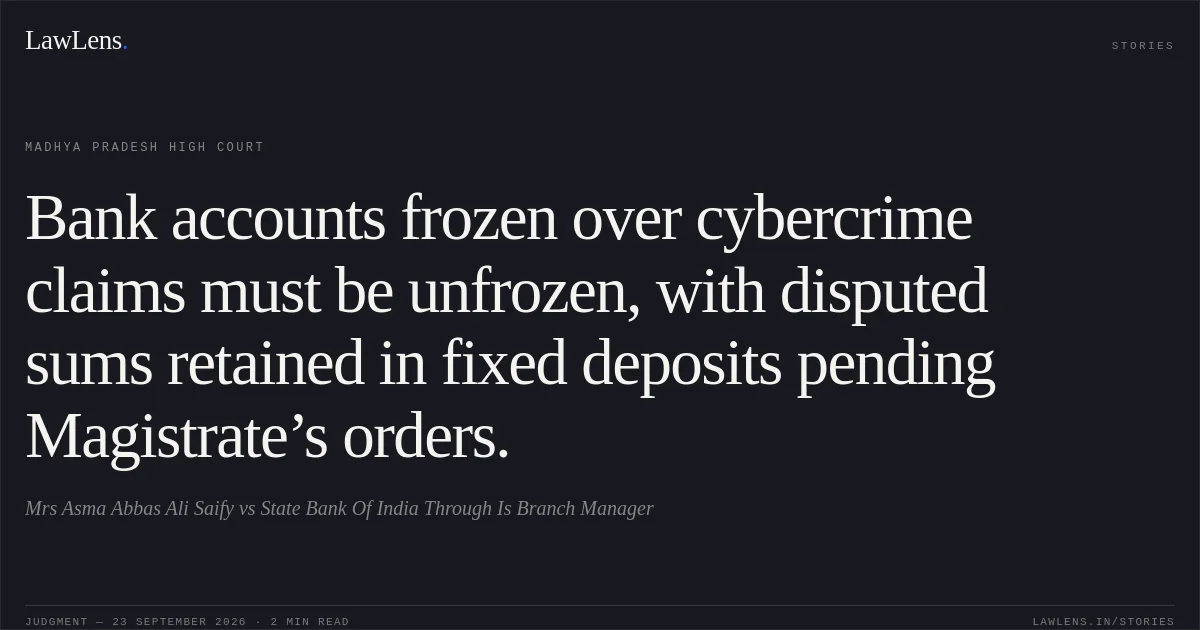
The petitioner’s bank account No. 63038825250 maintained with the State Bank of India was frozen pursuant to communications from cyber-crime/police authorities concerning alleged disputed transactions of ₹21,000 and ₹22,300, totalling ₹43,300.
Source reference: p.1, para.1The petitioner approached the High Court under Article 226 of the Constitution seeking removal of the freeze, or alternatively restriction of the freeze to the disputed amounts, together with disclosure of the underlying complaints/FIRs and directions for expeditious investigation.
Source reference: p.1, para.1Relying on Malcolm Murayis & Ors. v. State Bank of India & Ors., W.P. No. 1100 of 2024, decided on 26 April 2024, the petitioner contended that the account should be operationalised while the disputed amount could be separately secured.
Source reference: p.2, paras.2–3Issues
Whether the petitioner’s bank account should remain fully frozen merely on the basis of cyber-crime authorities’ communications concerning identified disputed amounts, or whether the freeze should be confined to those amounts.
Source reference: p.1, para.1; p.3, paras.4–5Whether the disputed sum of ₹43,300 should be segregated in fixed deposits pending action by the competent Judicial Magistrate under the applicable law.
Source reference: p.3, para.5Law Applied
The Court applied Article 226 of the Constitution to examine the legality of the account freeze.
Source reference: p.2, paras.3–4The Court followed the precedent in Malcolm Murayis & Ors. v. State Bank of India & Ors., under which the bank is directed to preserve only the amount identified by cyber-crime agencies as disputed in fixed deposits, while the account is unfrozen; liquidation of the fixed deposit is subject to orders of the competent Judicial Magistrate within the prescribed period.
Source reference: p.2, paras.3–4The precedent further recognised the requirement that investigating agencies proceed in accordance with Section 102 of the Code of Criminal Procedure, or the corresponding applicable provisions of the Bharatiya Nagarik Suraksha Sanhita, 2023 (“BNSS”), concerning seizure/freezing of property during investigation.
Source reference: p.2, para.3; p.3, para.5Reasoning
The Court found the present case materially covered by Malcolm Murayis and applied that decision mutatis mutandis.
Source reference: p.3, para.4Since the alleged cyber-fraud related to specifically ascertainable amounts of ₹21,000 and ₹22,300, maintaining a complete freeze on the petitioner’s account was not considered necessary.
Source reference: p.3, para.5Consistently with the earlier precedent, the Court balanced the petitioner’s need to operate the account against the investigating agency’s interest in preserving the allegedly tainted funds by directing that ₹43,300 be placed in fixed deposits.
Source reference: p.3, para.5The police agency was expected to approach the competent Judicial Magistrate under the relevant provisions of the BNSS or other applicable law within three months; failing such action, the fixed-deposit amount could be released to the petitioner after intimation to the police agency.
Source reference: p.3, para.5Holding
The petition was disposed of.
The State Bank of India was directed to unfreeze the petitioner’s bank account, while retaining ₹43,300—the aggregate of the disputed amounts—in fixed deposits.
Source reference: p.3, paras.5–6The fixed deposits could be liquidated only pursuant to orders of the competent Judicial Magistrate within three months.
Source reference: p.3, paras.5–6If the police agency failed to proceed in accordance with law within that period, the amount could also be withdrawn by the petitioner upon intimation to the police agency.
Source reference: p.3, paras.5–6Acts & Sections Cited
1 provisions across 1 statute referred to in this judgment. Each provision opens on LawLens.
Code of Criminal Procedure, 19731
Original Court PDF
Mrs Asma Abbas Ali SaifyvsState Bank Of India Through Is Branch Manager
Click to open original judgment
Original judgment, available to read, download and summarize on LawLens.in