Facts
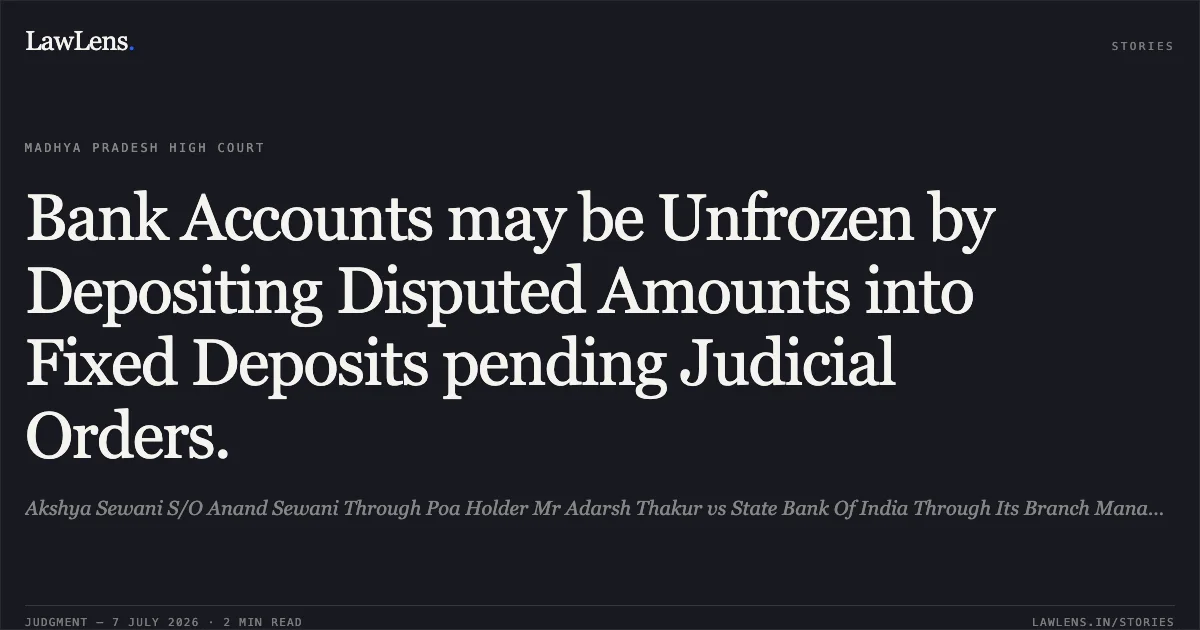
The petitioner, Akshya Sewani (through a Power of Attorney holder), filed a writ petition under Article 226 of the Constitution of India challenging the "illegal and arbitrary" freezing of his bank account (SBI Account No. 35656301048).
Source reference: para. 1The account had been placed on hold/freeze without a specific lawful order or prior notice to the petitioner, purportedly due to investigations into cyber crimes by police agencies.
Source reference: para. 1, 3The petitioner sought a direction to the bank to unfreeze the account, asserting that the action was taken without following due legal procedure.
Source reference: para. 1Issues
1. Whether the respondent bank can maintain a permanent freeze on the petitioner's bank account solely based on police intimations without the investigating agencies following statutory procedural requirements?
Source reference: para. 1-32. Whether the petitioner is entitled to the same relief granted by the High Court in previous similar matters involving crypto-trading and cyber-cell-directed account freezes?
Source reference: para. 2, 4Law Applied
The court primarily applied the principles governing the seizure of property under Section 102 of the Code of Criminal Procedure (Cr.P.C.) and the corresponding relevant provisions of the Bharatiya Nagarik Suraksha Sanhita (BNSS).
Source reference: para. 4 of Malcolm Murayis; para. 5Under Section 102 Cr.P.C., investigating officers must report seizures (including account freezes) to the concerned Magistrate.
Source reference: para. 4 of Malcolm MurayisThe court also relied on the precedent set in Malcolm Murayis Ors. Vs. State Bank of India and Others (W.P. No. 1100/2024), which established that disputed amounts linked to alleged fraud should be segregated into fixed deposits to balance the interests of the investigation and the account holder’s right to regular funds.
Source reference: para. 3, 9 of Malcolm MurayisReasoning
The Court observed that the issue was squarely covered by the decision in Malcolm Murayis.
Source reference: para. 4In that case, the Court noted a "poor functioning and irresponsible approach" by cyber crime cells, who directed banks to freeze accounts via email but failed to respond to court inquiries or comply with Section 102 Cr.P.C.
Source reference: para. 8 of Malcolm MurayisBy applying this reasoning mutatis mutandis to the present case, the Court found that while the police have the power to investigate, they cannot indefinitely freeze an entire account without proceeding in accordance with the law.
Source reference: para. 5The Court determined that the investigator's failure to provide a "clean chit" or engage in proper legal follow-up necessitated a time-bound direction for the bank to protect the disputed amount while allowing the petitioner access to the remaining funds.
Source reference: para. 5, 9 of Malcolm MurayisHolding
The High Court allowed the petition in part, directing the respondent bank to unfreeze the petitioner's SBI account (No. 35656301048).
The bank was ordered to keep only the specific "disputed amount" (as informed by the crime agencies) in a fixed deposit, which may only be liquidated per the orders of a competent Judicial Magistrate; the police agencies were directed to proceed according to BNSS/Cr.P.C. within three months, otherwise the petitioner may withdraw the amount. The petition was disposed of with no order as to costs.
Source reference: para. 5, 6Acts & Sections Cited
1 provisions across 1 statute referred to in this judgment. Each provision opens on LawLens.
Code of Criminal Procedure, 19731
Original Court PDF
Akshya Sewani S/O Anand Sewani Through Poa Holder Mr Adarsh ThakurvsState Bank Of India Through Its Branch Manager
Click to open original judgment
Original judgment, available to read, download and summarize on LawLens.in