Facts
The Petitioner, Mr. Ramhet, filed a writ petition under Article 226 of the Constitution of India challenging the freezing of his bank account (No. 20403449982) maintained with the State Bank of India, Indore Branch.
Source reference: para. 1The account was frozen by Law Enforcement Agencies (LEA) in relation to alleged cyber-crime transactions.
Source reference: para. 1The Petitioner contended that the freezing was done without complying with the procedural mandates of Sections 106(3) and 107 of the Bharatiya Nagarik Suraksha Sanhita (BNSS), 2023, and sought the de-freezing of the account, suggesting that the disputed amount be converted into a Fixed Deposit Receipt (FDR).
Source reference: para. 1The Petitioner relied on a similar precedent set by the same Court in Malcolm Murayis & Ors. v. State Bank of India and Others (W.P. No. 1100 of 2024).
Source reference: para. 2Issues
Whether the complete freezing of the Petitioner's bank account by Law Enforcement Agencies without procedural compliance under the BNSS is constitutional and legally sustainable.
Source reference: para. 1Whether the Court can direct the isolation of the disputed amount into a Fixed Deposit while unfreezing the remainder of the account to balance investigative needs with the Petitioner's rights.
Source reference: para. 3 & 5Law Applied
The Court primarily applied the principles of procedural fairness under Articles 14, 19, 21, and 300A of the Constitution of India.
Source reference: para. 1It relied on the statutory provisions of Sections 106(3) and 107 of the Bharatiya Nagarik Suraksha Sanhita (BNSS), 2023 (the successor to Section 102 of the Cr.P.C.), which govern the power of police officers to seize property and the subsequent duty to inform the Magistrate.
Source reference: para. 1 & 3Furthermore, the Court applied the doctrine of mutatis mutandis regarding its own precedent in Malcolm Murayis & Ors. v. State Bank of India and Others, which established that disputed amounts in cyber-fraud cases should be kept in fixed deposits rather than freezing entire accounts indefinitely.
Source reference: para. 3-4Reasoning
The Court observed that the Petitioner’s case was squarely covered by the decision in Malcolm Murayis.
Source reference: para. 4In that precedent, the Court noted that cyber crime cells often request banks to freeze accounts without following the mandatory reporting requirements to the Magistrate under Section 102 of the Cr.P.C. (now BNSS) and often fail to respond to judicial inquiries.
Source reference: para. 3The Court reasoned that an indefinite and total freeze on a bank account causes undue hardship to the account holder.
Source reference: para. 3By applying the Malcolm Murayis ratio to the present facts, the Court determined that the interests of justice would be served by isolating only the specific "disputed amount" into a fixed deposit. This ensures that the allegedly tainted funds remain secured for the investigation while allowing the Petitioner to operate the rest of the account, thereby upholding the Petitioner’s right to property and trade.
Source reference: para. 3 & 5Holding
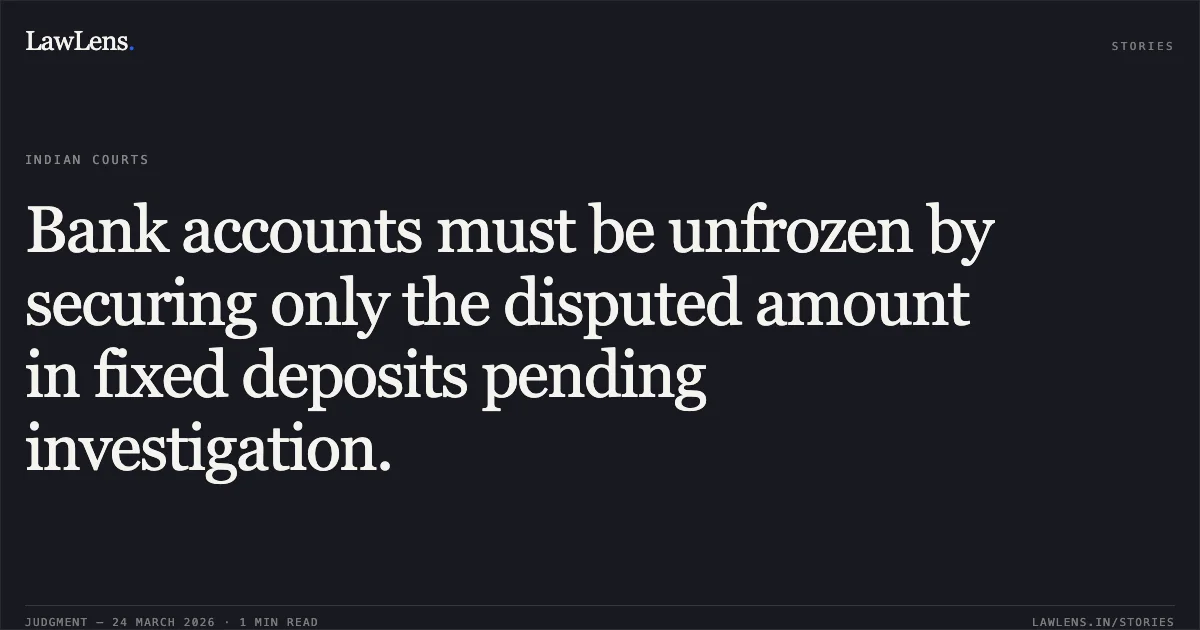
The Respondent Bank is directed to unfreeze the Petitioner’s bank account.
The disputed amount, as informed by the crime agencies, shall be kept in a Fixed Deposit.
Source reference: para. 5This FDR shall not be liquidated without an order from a competent Judicial Magistrate.
Source reference: para. 5The Police agency is expected to proceed under the relevant provisions of the BNSS within three months; if they fail to do so, the Petitioner may be allowed to withdraw the amount kept in the FD under intimation to the agency.
Source reference: para. 5Acts & Sections Cited
2 provisions across 1 statute referred to in this judgment. Each provision opens on LawLens.
Bharatiya Nagarik Suraksha Sanhita, 20232
Original Court PDF
Mr. RamhetvsThe State Bank Of India
Click to open original judgment
Original judgment, available to read, download and summarize on LawLens.in


