Facts
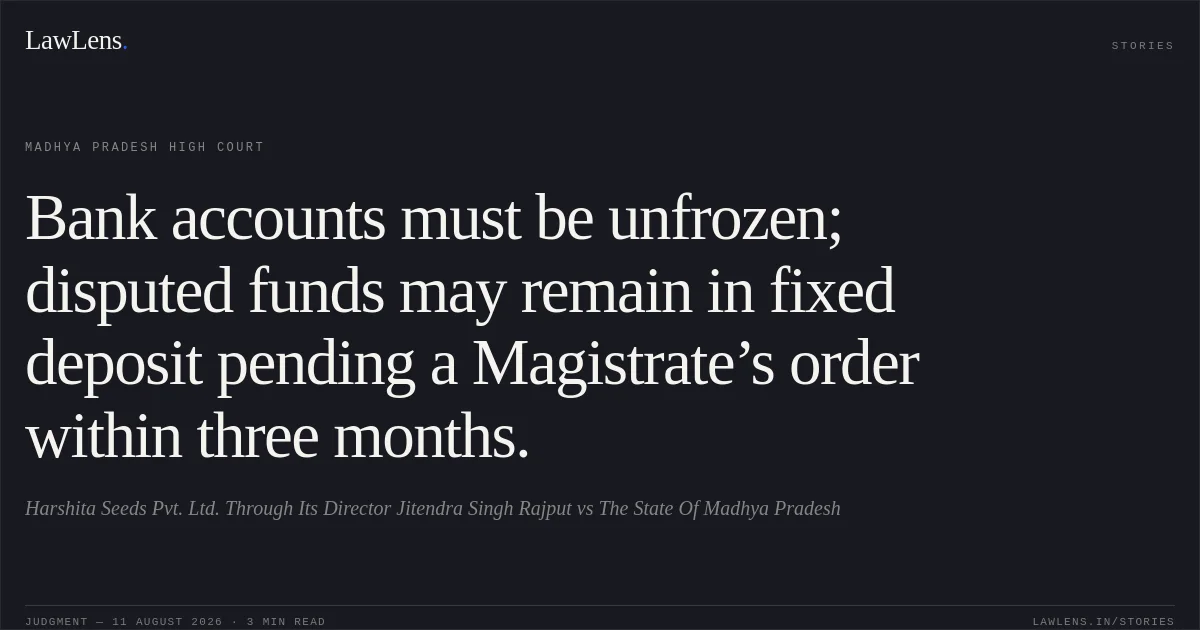
The petitioner, Harshita Seeds Pvt. Ltd., through its Director, challenged the freezing of its current account no. 030005006042 maintained with ICICI Bank, Ujjain, and sought a writ of mandamus directing the bank to permit operation of the account.
Source reference: para. 1The account had been frozen pursuant to information or directions received from cyber-crime authorities alleging that a particular amount in the account was connected with cyber crime.
Source reference: no citationThe disputed amount identified by the authorities was Rs. 24,300.
Source reference: para. 5The petitioner relied on the Madhya Pradesh High Court’s earlier decision in Malcolm Murayis & Others v. State Bank of India & Others, W.P. No. 1100 of 2024, decided on 26 April 2024, in which similar bank-account freezes had been considered.
Source reference: paras. 2–3Issues
Whether the petitioner’s bank account, frozen pursuant to cyber-crime authorities’ directions, could continue to remain wholly frozen when only Rs. 24,300 was identified as the disputed amount
Source reference: paras. 1, 5–6Whether the disputed amount should be secured in a fixed deposit pending orders of the competent Judicial Magistrate, while the remaining balance in the account should be released to the petitioner
Source reference: paras. 3–6Law Applied
The High Court exercised its jurisdiction under Article 226 of the Constitution of India to regulate the freezing of the petitioner’s bank account.
Source reference: para. 1It applied the principle laid down in Malcolm Murayis & Others v. State Bank of India & Others, namely that where a bank account is frozen on the basis of cyber-crime allegations, the disputed amount may be retained in a fixed deposit and should be liquidated only pursuant to an order of the competent Judicial Magistrate; the investigating agency is expected to proceed in accordance with Section 102 of the Code of Criminal Procedure, 1973, or the applicable successor law, within the prescribed period.
Source reference: para. 3, quoting Malcolm Murayis, para. 9The Court further applied the corresponding requirement under the BNSS or other applicable law, and held that amounts not shown to be connected with the alleged offence need not remain frozen.
Source reference: paras. 5–6Reasoning
The Court found that the petitioner’s case was squarely covered by the ratio in Malcolm Murayis and that the earlier decision applied mutatis mutandis.
Source reference: para. 4Since the cyber-crime agencies had identified only Rs. 24,300 as the disputed amount, a complete freeze of the petitioner’s account was considered unnecessary.
Source reference: no citationThe Court therefore adopted the protective mechanism from the precedent: the disputed sum would remain secured in a fixed deposit until the competent Judicial Magistrate passed appropriate orders, while the investigating agency was required to take lawful steps within three months.
Source reference: para. 5The balance, not alleged to be connected with the cyber offence, was directed to be released because it was not necessary to keep the entire account frozen.
Source reference: para. 6Holding
The petition was disposed of.
The concerned bank was directed to unfreeze the petitioner’s account, retain Rs. 24,300 in a fixed deposit, and permit its liquidation only pursuant to an order of the competent Judicial Magistrate within three months.
Source reference: paras. 5–7If no such order was passed within that period, the fixed-deposit amount could also be withdrawn by the petitioner under intimation to the police agency.
Source reference: paras. 5–7Any remaining amount in the account was directed to be defreezed and made available to the petitioner.
Source reference: paras. 5–7Acts & Sections Cited
1 provisions across 1 statute referred to in this judgment. Each provision opens on LawLens.
Code of Criminal Procedure, 19731
Original Court PDF
Harshita Seeds Pvt. Ltd. Through Its Director Jitendra Singh RajputvsThe State Of Madhya Pradesh
Click to open original judgment
Original judgment, available to read, download and summarize on LawLens.in