01Facts
The petitioner approached the Madhya Pradesh High Court under Article 226 of the Constitution challenging the freezing of his savings bank account bearing No. 1021000296106 and seeking restoration of its operation, a declaration that the freezing was arbitrary and unconstitutional, and disclosure of the complaints or orders forming its basis.
¶ 1The petitioner contended that the matter was covered by Malcolm Murayis & Others v. State Bank of India & Others, W.P. No. 1100 of 2024, decided on 26 April 2024.
¶ 2In Malcolm Murayis, the Court had dealt with bank-account freezes imposed pursuant to communications from cyber-crime police authorities alleging that the accounts were linked to cyber fraud, and had directed preservation of the disputed amounts while permitting operation of the accounts.
¶ 302Issues
i.1. Whether the freezing of the petitioner’s bank account pursuant to information or directions from police/cyber-crime agencies could continue without the disputed amount being separately secured and without proceedings before the competent Judicial Magistrate under the applicable law.
¶ 3–5ii.2. Whether the petitioner’s bank account should be unfrozen, subject to preservation of the amount allegedly connected with the cyber offence.
¶ 503Law Applied
The Court applied the principles governing seizure or freezing of property connected with an alleged offence under Section 102 of the Code of Criminal Procedure, as reflected in Malcolm Murayis & Others v. State Bank of India & Others.
¶ 3Under that principle, the investigating agency must proceed in accordance with law and place the seizure or restraint before the competent Magistrate.
The Court also relied on its earlier direction that the disputed amount may be retained in a fixed deposit and liquidated only pursuant to orders of the competent Judicial Magistrate.
In the present case, the Court referred to the corresponding provisions of the Bharatiya Nagarik Suraksha Sanhita, 2023, or any other applicable law.
¶ 5The governing procedural rule was therefore that the entire bank account should not remain frozen indefinitely merely on the basis of a police communication; the allegedly tainted amount may instead be secured pending lawful judicial orders.
Provisions in the judgment · 1 · Linked ones open on LawLens
Code of Criminal Procedure, 1973 Section 102
04Reasoning
The Court found the petitioner’s case to be materially covered by Malcolm Murayis, where account holders engaged in cryptocurrency or virtual-currency trading had challenged freezes imposed on the basis of cyber-crime communications.
¶ 2–4Following that precedent, the Court balanced the investigative interest in preserving allegedly fraudulent funds against the petitioner’s right to operate his bank account.
It directed that only the disputed amount communicated by the crime agencies be placed in a fixed deposit, rather than continuing a blanket freeze over the entire account.
¶ 5The fixed deposit was to remain subject to orders of the competent Judicial Magistrate, thereby preserving the evidentiary or restitutionary interests of the investigation while preventing indefinite deprivation of access to the petitioner’s account.
¶ 505Holding
The petition was disposed of.
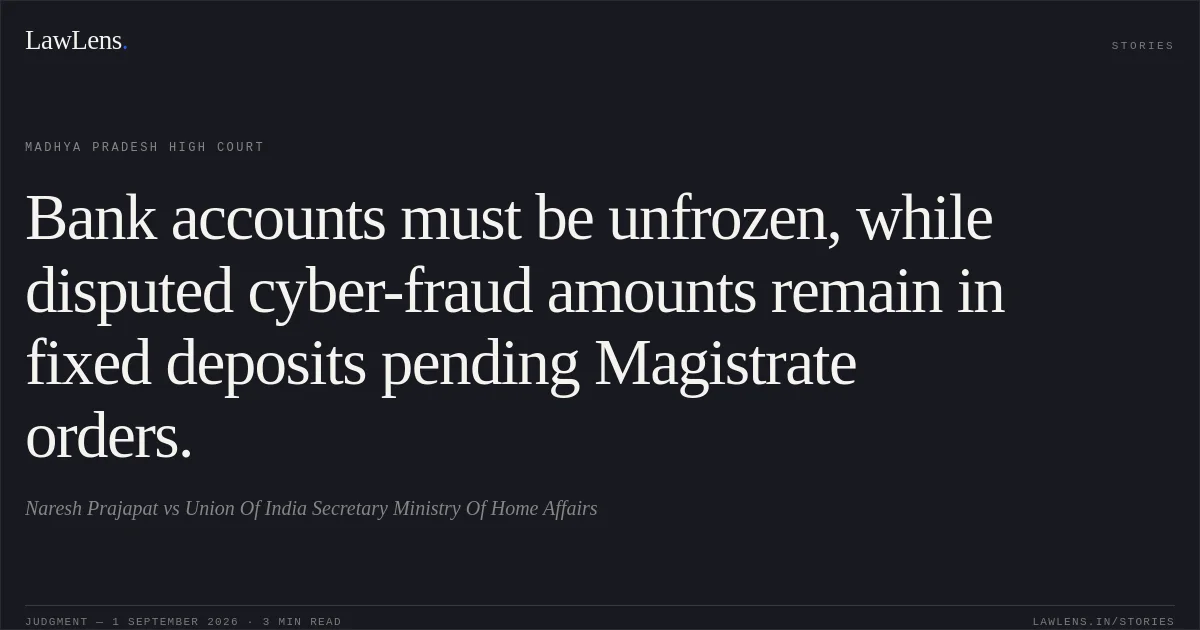
¶ 5The respondent bank was directed to unfreeze the petitioner’s bank account, while placing the disputed amount identified by the crime agencies in a fixed deposit.
¶ 5The fixed deposit could be liquidated only pursuant to an order of the competent Judicial Magistrate, which the police agency was expected to obtain within three months under the applicable provisions of the BNSS or other relevant law.
¶ 5If the agency failed to proceed accordingly within that period, the petitioner would be permitted to withdraw the amount kept in fixed deposit, under intimation to the police agency.
¶ 5–6Original Court PDF
Naresh PrajapatvsUnion Of India Secretary Ministry Of Home Affairs
Click to open original judgment
Original judgment, available to read, download and summarize on LawLens.in