01Facts
The petitioner invoked Article 226 of the Constitution seeking directions to the respondents to defreeze his bank account bearing No. 431100050600576 maintained with respondent No. 2, along with costs and other appropriate reliefs.
¶ 1The petitioner relied on Malcolm Murayis & Others v. State Bank of India & Others, W.P. No. 1100 of 2024, decided on 26 April 2024, in which the High Court had directed that the disputed amount connected with alleged cyber fraud be kept in fixed deposit while permitting operation of the bank account.
¶ 2In the present case, the amount allegedly connected with the cyber-crime reports was Rs. 14,000.
¶ 502Issues
i.Whether the petitioner’s bank account, which had been frozen pursuant to information or directions from crime/cyber agencies, should be defrozen subject to safeguarding the disputed amount of Rs. 14,000.
¶ 2–5ii.Whether the disputed amount should be retained in a fixed deposit pending orders of the competent Judicial Magistrate under the applicable law, including the relevant provisions of the BNSS.
¶ 5iii.Whether, in the absence of timely action by the police agency before the competent Magistrate, the disputed amount could subsequently be released to the petitioner.
¶ 503Law Applied
The Court applied the principle laid down in Malcolm Murayis & Others v. State Bank of India & Others, that a bank account should not remain wholly frozen merely on the basis of communications from investigating or cyber-crime agencies when the disputed amount can be separately secured; the bank may place the disputed amount in a fixed deposit and permit operation of the remaining account.
¶ 3–5The Court relied on the statutory procedure governing seizure or attachment of property connected with an offence, referring in the precedent to Section 102 of the Code of Criminal Procedure and, in the present matter, to the relevant provisions of the Bharatiya Nagarik Suraksha Sanhita, 2023, or any other applicable law.
¶ 5The competent Judicial Magistrate must determine the further treatment of the disputed amount within the prescribed period.
¶ 5Provisions in the judgment · 1 · Linked ones open on LawLens
Code of Criminal Procedure, 1973 Section 102
04Reasoning
The Court found that the decision in Malcolm Murayis applied mutatis mutandis to the petitioner’s case.
¶ 4Applying that principle, it balanced the interests of the investigation and the petitioner: the alleged tainted amount of Rs. 14,000 would remain secured in a fixed deposit, while the petitioner’s bank account would not continue to be under a blanket freeze.
¶ 5The police agency was expected to take the disputed amount before the competent Judicial Magistrate and obtain appropriate orders under the BNSS or other applicable law within three months.
¶ 5If it failed to do so, continued retention of the amount would not be justified, subject to withdrawal by the petitioner after intimation to the police agency.
¶ 505Holding
The petition was disposed of.
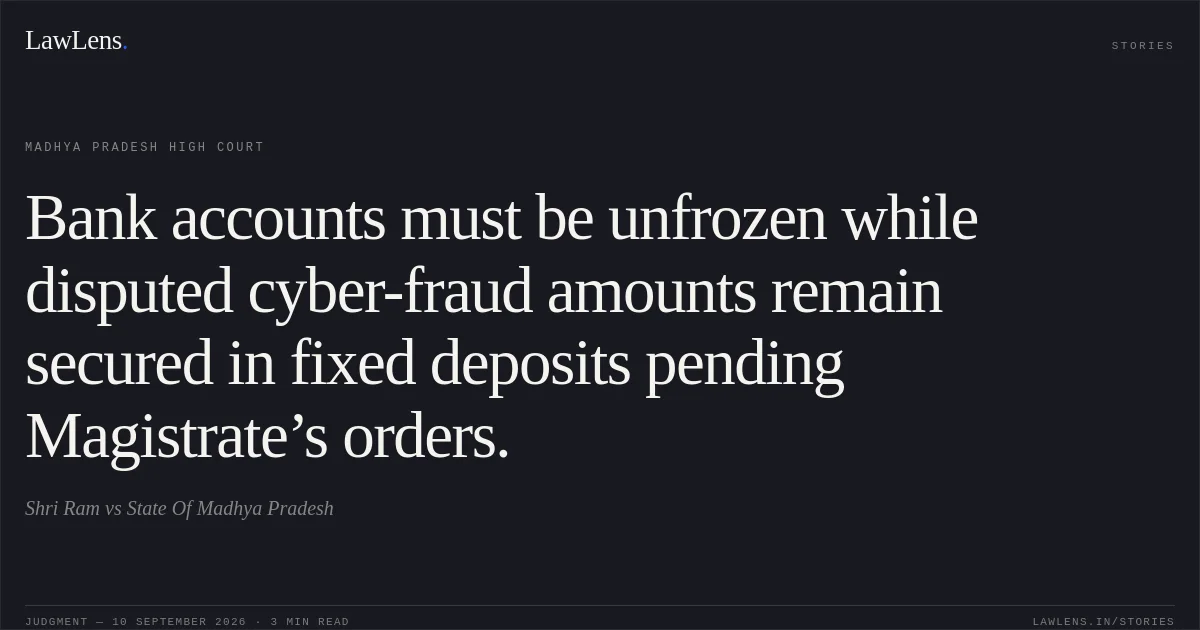
¶ 5The bank was directed to defreeze the petitioner’s account, while keeping Rs. 14,000—the disputed amount identified by the crime agencies—in a fixed deposit.
¶ 5The fixed deposit could be liquidated only pursuant to an order of the competent Judicial Magistrate passed within three months.
¶ 5If the police agency failed to proceed in accordance with law within that period, the amount could also be released to the petitioner upon intimation to the police agency.
¶ 5–6Original Court PDF
Shri RamvsState Of Madhya Pradesh
Click to open original judgment
Original judgment, available to read, download and summarize on LawLens.in