01Facts
The petitioner claimed ownership of Survey No. 6, inherited from his father and recorded in the names of the legal heirs through Succession Entry No. 1165 dated 2 May 2000.
¶ 2.1In 2017, negotiations allegedly took place for sale of the land, after which a Satakhat/Memorandum of Understanding and related documents were prepared.
¶ 2.1The petitioner alleged that a forged Satakhat and power of attorney were subsequently used to execute a registered sale deed dated 7 October 2017 in favour of respondent No. 14 for ₹2.75 crore.
¶ 2.1–2.3An FIR was registered on 26 July 2018, investigation was completed, and a chargesheet was filed; the criminal case remained pending for trial.
¶ 2.4The petitioner also instituted civil suits seeking cancellation of the sale deed, while the purchaser filed proceedings seeking a declaration of its validity. Interim protection was granted in favour of the petitioner in the civil proceedings.
¶ 2.5The petitioner thereafter filed a complaint under the Gujarat Land Grabbing (Prohibition) Act, 2020 before the Collector-led Committee. The Committee found that no offence under the Act was made out because the civil suits were pending. The Special Court confirmed that decision, leading to the present petition under Articles 226 and 227 of the Constitution and Section 528 of the Bharatiya Nagarik Suraksha Sanhita, 2023.
¶ 1, 2.502Issues
i.Whether the allegations and circumstances disclosed “land grabbing” or established the respondents as “land grabbers” under Sections 2(d) and 2(e) of the Gujarat Land Grabbing (Prohibition) Act?
¶ 6, 8–9ii.Whether the Special Court erred in confirming the Committee’s decision rejecting the land-grabbing inquiry, particularly when criminal and civil proceedings concerning the disputed sale deed were already pending?
¶ 1, 2.5, 5, 903Law Applied
The Court applied Sections 2(d) and 2(e) of the Gujarat Land Grabbing (Prohibition) Act, which define “land grabber” and “land grabbing.”
¶ 6Land grabbing requires unauthorised, forcible, violent, unscrupulous, unfair or greedy possession of land, without lawful entitlement, coupled with the requisite intention to illegally take possession, create illegal tenancy/lease/licence arrangements, construct unauthorised structures, or otherwise commercially exploit the land.
¶ 8The Court relied on Konda Lakshmana Bapuji v. Government of Andhra Pradesh, (2002) 3 SCC 258, which holds that the ingredients of land grabbing include both the factual act of unauthorised acquisition or possession and the requisite mens rea or intention; however, for taking cognizance, an allegation may suffice, whereas a finding that a person is a land grabber requires proof of the statutory ingredients.
¶ 7The petition was considered under Articles 226 and 227 of the Constitution read with Section 528 of the Bharatiya Nagarik Suraksha Sanhita, 2023.
¶ 1Provisions in the judgment · 2 · Linked ones open on LawLens
Bharatiya Nagarik Suraksha Sanhita, 2023 Section 528
Gujarat Land Grabbing (Prohibition) Act, 2020. Section 2
04Reasoning
The Court noted that the petitioner remained in possession of the subject land and had obtained protection from the competent Civil Court.
¶ 5, 9It further observed that the alleged fraudulent sale deed and related conduct were already the subject of a pending FIR, criminal trial and civil suits.
¶ 2.4–2.5, 9Applying Sections 2(d) and 2(e) and the test in Konda Lakshmana Bapuji, the Court held that the material did not establish that the respondents had, without lawful entitlement, forcibly or otherwise unlawfully taken possession of the petitioner’s land.
¶ 9Since the essential factual element of unauthorised possession was absent, the statutory ingredients of land grabbing were not satisfied, notwithstanding the allegations of forgery and the pending proceedings concerning the sale deed.
¶ 905Holding
The Court answered the issues against the petitioner.
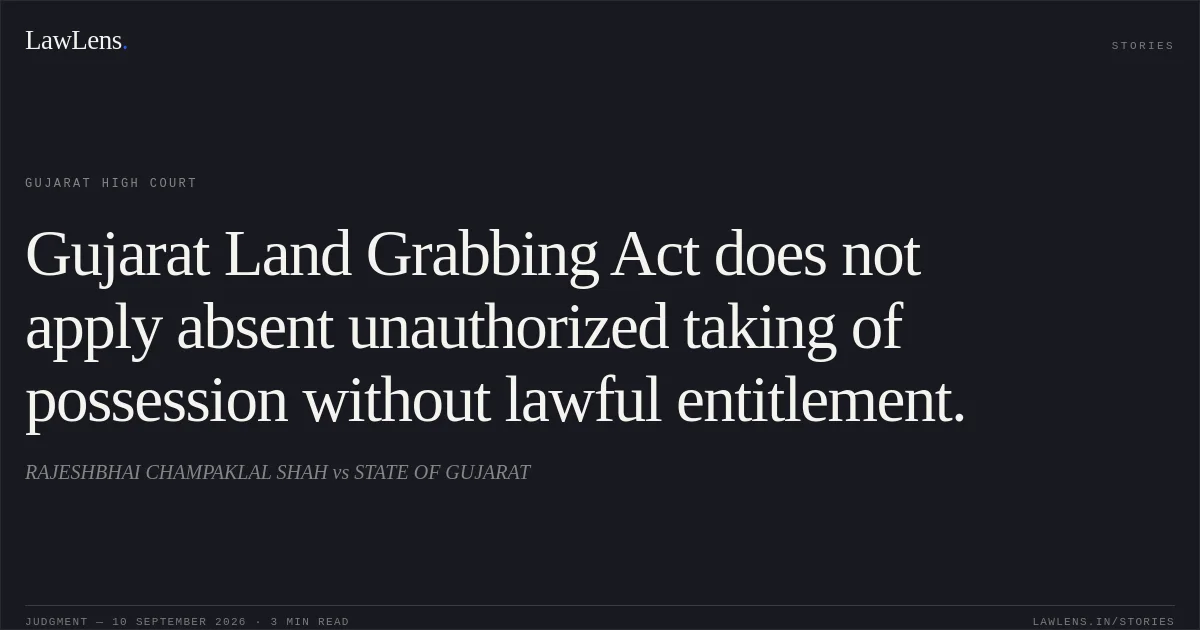
¶ 9It held that the essential ingredients of “land grabbing” and “land grabber” under the Gujarat Land Grabbing (Prohibition) Act were not made out because the petitioner was in possession and protected by the Civil Court, while the disputed transaction was already being adjudicated in criminal and civil proceedings.
¶ 9The Court found no error in the Special Court’s order confirming the Committee’s decision to reject the inquiry and accordingly rejected the petition.
¶ 10Original Court PDF
RAJESHBHAI CHAMPAKLAL SHAHvsSTATE OF GUJARAT
Click to open original judgment
Original judgment, available to read, download and summarize on LawLens.in