01Facts
The petitioner, appointed as a Peon in 1985 and later promoted to Clerk and Head Cashier, was suspended on 20.12.2013 and subsequently proceeded against in a departmental enquiry concerning alleged cash irregularities/attempted embezzlement, misbehaviour with customers, and conduct prejudicial to the Bank.
pp. 2–5The charge-sheet was issued on 26.05.2014 after a prior show-cause notice and reply from the petitioner.
pp. 2–5The petitioner challenged the enquiry on grounds including delay in issuing the charge-sheet, vagueness of charges, non-supply of documents and witnesses, change of the Presenting Officer, denial of natural justice, bias, non-examination of complainants, and improper appreciation of evidence.
pp. 2–4The Disciplinary Authority dismissed him from service on 07.08.2015; his appeal and mercy appeal were rejected on 17.03.2016 and 27.07.2016 respectively.
pp. 3, 22–23The petitioner also sought payment of provident fund, leave encashment, settlement arrears and other service dues.
p. 5During the proceedings, the Bank stated that the admissible post-retiral dues had been released pursuant to the Court’s order dated 21.11.2017.
p. 602Issues
i.1. Whether the departmental enquiry and the consequential orders were vitiated by violation of the principles of natural justice, the applicable Memorandum of Settlement, bias, non-supply of documents, or denial of a reasonable opportunity of defence?
pp. 17–22 · ¶ 13–16ii.2. Whether the findings of misconduct were based on no evidence, were perverse, or were liable to be interfered with under Article 226 of the Constitution?
pp. 7–18 · ¶ 5–13iii.3. Whether the penalty of dismissal was disproportionate and warranted interference by the High Court?
pp. 12–13, 19–23 · ¶ 10, 13, 17iv.4. Whether the petitioner was entitled to directions for payment of the claimed retiral and service dues?
pp. 5–6, 22–23 · ¶ 3, 17–1803Law Applied
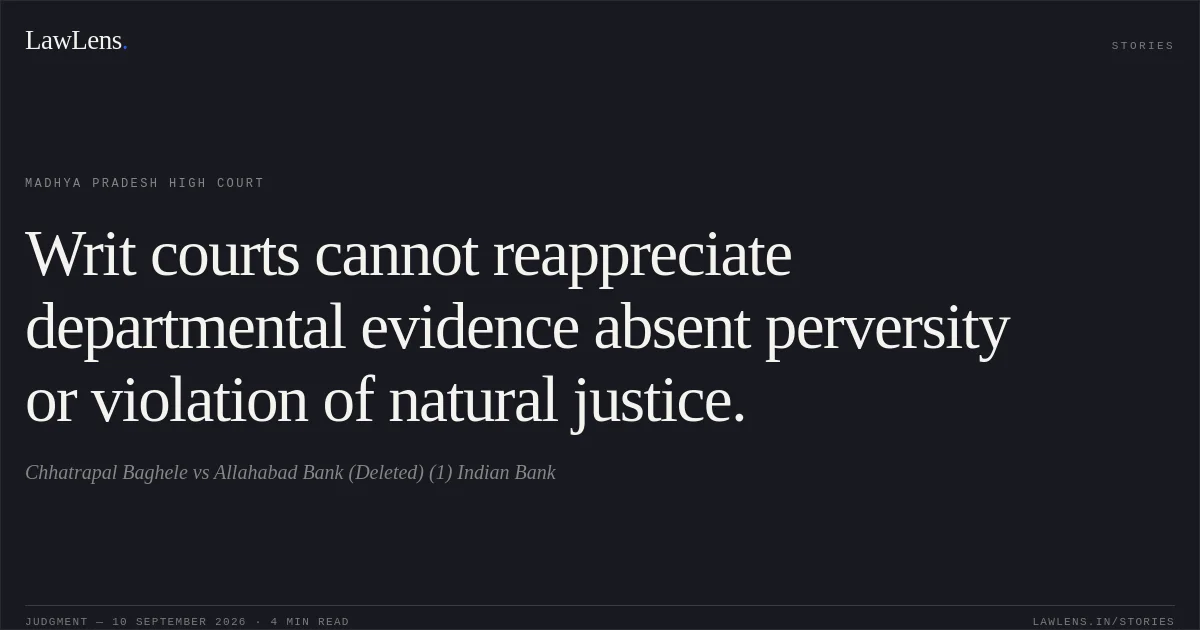
The Court applied the limited scope of judicial review under Article 226, holding that a writ court is not an appellate authority and cannot reappreciate evidence in departmental proceedings.
pp. 7–18 · ¶ 5–12Relying principally on State of Karnataka v. N. Gangaraj, State of A.P. v. S. Sree Rama Rao, B.C. Chaturvedi v. Union of India, High Court of Bombay v. Shashikant S. Patil, State Bank of Bikaner Jaipur v. Nemi Chand Nalwaya, Union of India v. P. Gunasekaran, and State Bank of India v. Ramesh Dinkar Punde, the Court held that interference is permissible only where the enquiry violates natural justice or statutory procedure, is mala fide or arbitrary, is based on no evidence, is perverse, or results in manifest miscarriage of justice.
pp. 7–18 · ¶ 5–12Findings supported by some legal evidence cannot be reassessed merely because another view is possible, and the adequacy or reliability of evidence is ordinarily outside writ jurisdiction.
pp. 7–12 · ¶ 6, 9–12The Court also applied the principle that departmental proceedings are governed by the preponderance-of-probabilities standard and that bank employees are subject to heightened requirements of honesty, integrity, diligence and protection of the Bank’s interests.
pp. 14–17 · ¶ 7, 12The applicable Memorandum of Settlement dated 10.04.2002 and the relevant Bipartite Settlement provisions governed the disciplinary procedure.
pp. 2, 4, 20–2104Reasoning
The Court found that the petitioner had received a show-cause notice, submitted a reply, participated in the enquiry, and was supplied the relevant documents and witness list before the regular enquiry commenced.
pp. 19–20 · ¶ 13The change of the Presenting Officer was attributed to administrative reasons, and the petitioner failed to demonstrate actual prejudice or bias.
pp. 4–5, 19–20 · ¶ 13The alleged non-production of certain pre-cash scrolls and non-examination of some complainants did not establish denial of natural justice, particularly in the absence of proof that the petitioner suffered specific prejudice.
pp. 20–22 · ¶ 13–15The allegations of mala fides based on trade-union activities were unsupported, and the concerned officer was not impleaded by name.
p. 19 · ¶ 13Since the disciplinary authorities relied on material available in the enquiry and the findings were not shown to be based on no evidence or to be perverse, the Court declined to reassess the evidence or substitute its own conclusions.
pp. 17–20 · ¶ 8–13The petitioner’s long service and absence of prior punishment did not outweigh the seriousness of misconduct involving cash transactions, customer misbehaviour and the functioning of a bank; the dismissal penalty was not considered shocking to the Court’s conscience.
pp. 19–23 · ¶ 13, 17The claim regarding unpaid post-retiral dues no longer survived because the Bank had released the admissible dues pursuant to the Court’s earlier direction.
p. 6 · ¶ 305Holding
The High Court held that the petitioner failed to establish violation of natural justice, breach of the applicable disciplinary procedure, mala fides, perversity, absence of evidence, or disproportionate punishment.
pp. 19–23 · ¶ 13–17The orders of dismissal dated 07.08.2015, appellate rejection dated 17.03.2016, and mercy appeal rejection dated 27.07.2016 were upheld.
p. 23 · ¶ 18The claim for retiral dues was treated as substantially addressed through the Bank’s payment of admissible amounts.
p. 23 · ¶ 18The writ petition was accordingly dismissed, with no interference under Article 226.
p. 23 · ¶ 18Original Court PDF
Chhatrapal BaghelevsAllahabad Bank (Deleted) (1) Indian Bank
Click to open original judgment
Original judgment, available to read, download and summarize on LawLens.in