Facts
The petitioner filed a writ petition under Article 226 of the Constitution of India challenging the freezing of her savings bank account (A/c No. 30653750184) and a linked Fixed Deposit (A/c No. 42256201045) maintained at the State Bank of India, Pithampur Branch.
Source reference: para. 1The accounts were frozen following instructions from cyber authorities/police agencies regarding alleged cyber fraud.
Source reference: para. 1, 3The petitioner sought a writ of mandamus to defreeze the accounts, arguing that she was neither an accused nor a suspect and that the indefinite freezing without statutory backing was arbitrary.
Source reference: para. 1The petitioner relied on the precedent set in Malcolm Murayis & Ors. v. State Bank of India and Others (W.P. No. 1100/2024).
Source reference: para. 2Issues
1. Whether the indefinite freezing of the petitioner’s bank account based on police instructions, without the petitioner being formally charged, is legally sustainable?
Source reference: para. 1(iv), 32. Whether the directions issued by the Court in Malcolm Murayis v. SBI regarding the treatment of disputed funds and account operation apply to the present case?
Source reference: para. 4Law Applied
Article 226 of the Constitution of India regarding the High Court's power to issue directions for the protection of rights.
Source reference: para. 1Procedural requirements of Section 102 of the Code of Criminal Procedure (Cr.P.C.), and its successor provisions under the Bharatiya Nagarik Suraksha Sanhita (BNSS), which mandate that police must inform the concerned Magistrate regarding the seizure of property/accounts.
Source reference: para. 3(4), 5Precedent of Malcolm Murayis & Ors. v. State Bank of India and Others (2024), which established a balanced approach between investigative needs and the account holder's right to subsistence.
Source reference: para. 3, 4Reasoning
The Court observed that the case was squarely covered by the decision in Malcolm Murayis.
Source reference: para. 4In that precedent, the Court noted a pattern of "poor functioning and irresponsible approach" by cyber crime cells, who frequently ordered freezes via email but failed to respond to judicial inquiries or comply with the mandatory reporting requirements under Section 102 Cr.P.C.
Source reference: para. 3(8)The Court reasoned that an account holder should not face indefinite financial hardship due to investigative delays.
Source reference: para. 3(9)Consequently, the Court found that instead of an absolute freeze on the entire account, only the specific "disputed amount" flagged by the agencies should be secured in a Fixed Deposit (FD), while the remainder of the account should be accessible to the petitioner.
Source reference: para. 5This ensures the funds are preserved for potential legal proceedings while restoring the petitioner’s right to utilize her legitimate assets.
Source reference: para. 5Holding
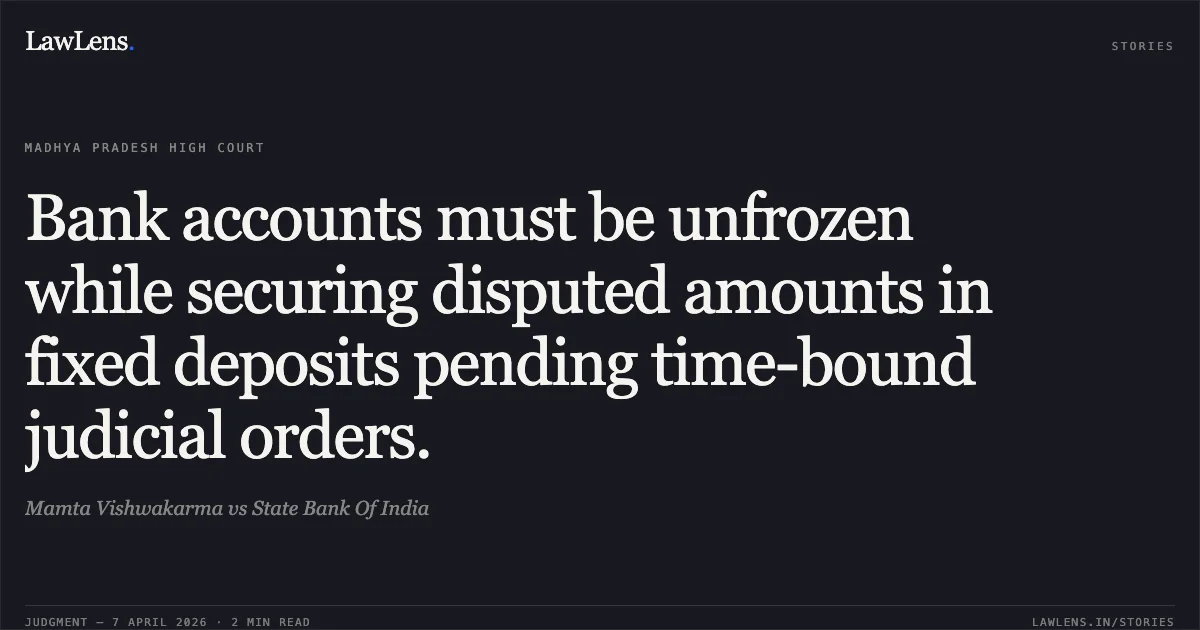
The Court disposed of the petition and ordered the State Bank of India to unfreeze the petitioner’s bank account.
The Bank was directed to keep the disputed amount—as specified by the crime agencies—in a Fixed Deposit.
Source reference: para. 5This FD is only to be liquidated upon orders from a competent Judicial Magistrate within a three-month period.
Source reference: para. 5The Court held that if the police agency fails to proceed in accordance with the law (BNSS/Cr.P.C.) within these three months, the petitioner shall be permitted to withdraw the amount kept in the FD under intimation to the police.
Source reference: para. 5Acts & Sections Cited
1 provisions across 1 statute referred to in this judgment. Each provision opens on LawLens.
Code of Criminal Procedure, 19731
Original Court PDF
Mamta VishwakarmavsState Bank Of India
Click to open original judgment
Original judgment, available to read, download and summarize on LawLens.in


