Facts
The petitioner’s daughter, the proforma respondent, held an add-on credit card issued by Axis Bank (Respondent No. 2).
Source reference: para. 2On October 20, 2024, while in Dublin, Ireland, her card was stolen, and two unauthorized transactions of 1,000 Euros each were executed at 22:48 and 22:49 IST
Source reference: para. 2She lodged a police complaint the same day, and the petitioner reported the fraud to the bank within 24 hours on October 21, 2024
Source reference: para. 2Respondent No. 2 rejected the claim, alleging the transactions occurred because the holder divulged the card and PIN numbers
Source reference: para. 3The petitioner appealed to the RBI Ombudsman (Respondent No. 1), who closed the complaint under Clause 16(2)(a) of the RBI Integrated Ombudsman Scheme, 2021, without providing reasons
Source reference: para. 1, 4The petitioner challenged these decisions via a writ petition
Source reference: para. 1Issues
1. Whether the decisions of the RBI Ombudsman and the respondent bank to reject the petitioner's complaint were legally sustainable under the applicable RBI guidelines
Source reference: para. 162. Whether the petitioner or his daughter was negligent in a manner that shifts the liability of the unauthorized transactions onto the customer
Source reference: para. 7, 13Law Applied
The court primarily applied the Reserve Bank of India Circular dated July 6, 2017, regarding "Customer Protection – Limiting Liability of Customers in Unauthorised Electronic Banking Transactions"
Source reference: para. 19Specifically, it relied on Clause 6, which establishes "Zero Liability" for customers in cases of third-party breaches reported within three working days, and Clause 12, which mandates that the burden of proving customer liability lies solely on the bank
Source reference: para. 19, 25The court also considered Clause 9 regarding the timeline for reversal of funds
Source reference: para. 21Clause 16(2)(a) of the Reserve Bank of India-Integrated Ombudsman Scheme, 2021
Source reference: para. 1The court further cited the precedent of State Bank of India v. Pallabh Bhowmick (2024 SCC OnLine Gau 1519), affirming that banks cannot absolve themselves of liability based on perceived negligence without concrete proof
Source reference: para. 10, 21Reasoning
The court found that the petitioner reported the unauthorized transactions within 24 hours, fulfilling the criteria for "Zero Liability" under the 2017 RBI Circular
Source reference: para. 20, 24It observed that the bank failed to produce any evidence proving negligence or that the cardholder had shared credentials; the bank's mere assertion that a card without PIN/OTP requires "extra caution" was insufficient to meet the burden of proof under Clause 12
Source reference: para. 23, 25The court noted that since the card was stolen and immediate police and bank reports were made, the incident fell under "third-party breach" where the deficiency lies elsewhere in the system
Source reference: para. 23-24Furthermore, the RBI Ombudsman’s order was found to be arbitrary as it closed the complaint without assigning reasons or addressing the petitioner's rejoinder
Source reference: para. 5, 26The court determined that the bank had a duty to exercise reasonable care and reverse the unauthorized charges once reported within the prescribed timeframe
Source reference: para. 9, 21Holding
The court allowed the writ petition and set aside the impugned orders of the RBI Ombudsman (dated January 29, 2025) and Axis Bank (dated December 7, 2024)
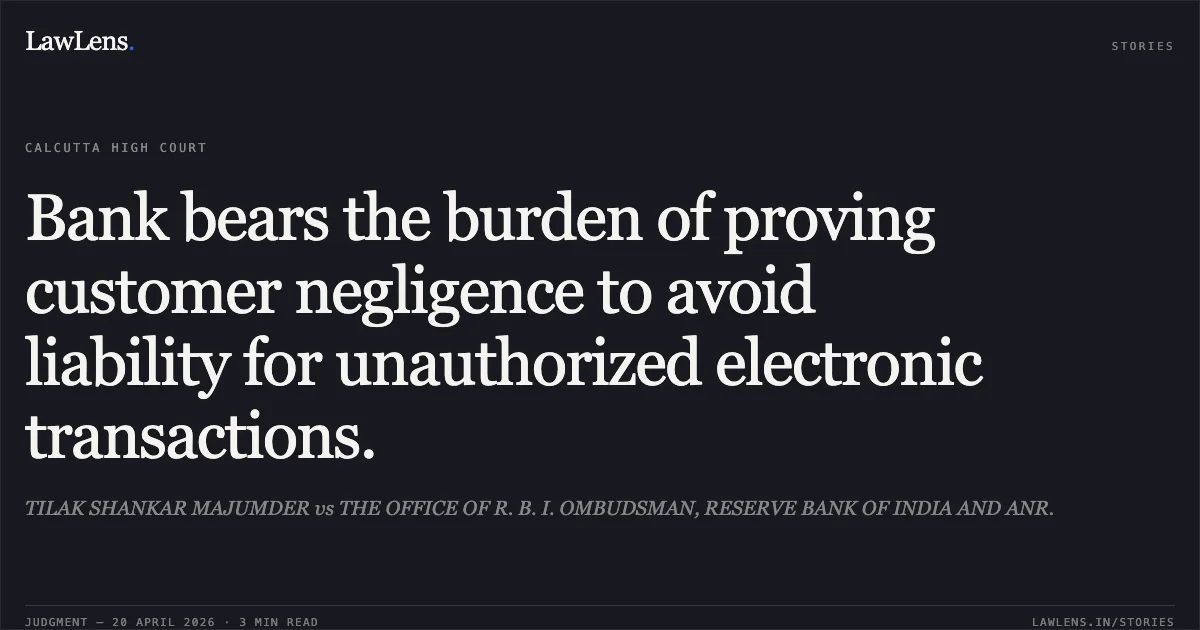
It held that the bank failed to establish customer negligence and disregarded the mandatory "Zero Liability" protections afforded by the RBI Circular
Source reference: para. 27Respondent No. 2 (Axis Bank) was directed to forthwith refund the amount of the fraudulent electronic transactions dated October 20, 2024, along with any associated charges, to the petitioner’s account
Source reference: para. 28Original Court PDF
TILAK SHANKAR MAJUMDERvsTHE OFFICE OF R. B. I. OMBUDSMAN, RESERVE BANK OF INDIA AND ANR.
Click to open original judgment
Original judgment, available to read, download and summarize on LawLens.in