Facts
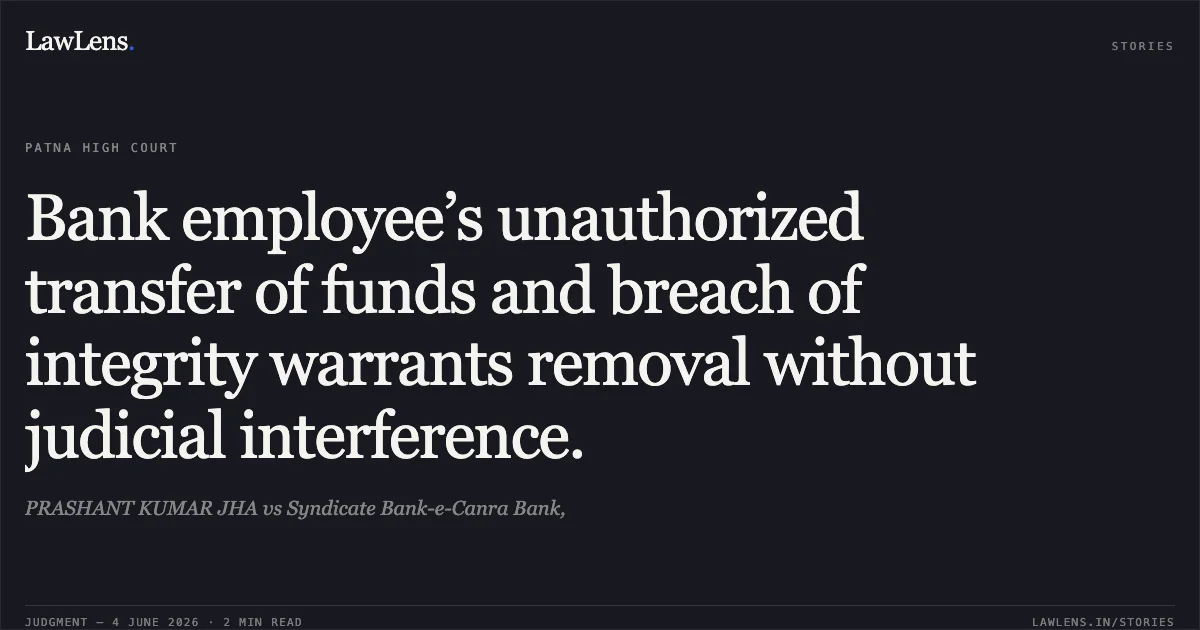
The petitioner, a Probationary Officer (later Assistant Manager) at Syndicate Bank, was served a charge memo on 17.04.2015 alleging he unauthorizedly debited Rs. 3.00 lakhs from the Bank’s General Ledger (GL) account using his and other officers' passwords and credited it to a joint account with his wife.
Source reference: paras. 3, 12An enquiry report dated 10.03.2016 found him guilty.
Source reference: para. 5Consequently, the Disciplinary Authority removed him from service on 31.05.2016, noting it would not disqualify him for future employment.
Source reference: para. 6His subsequent appeal and review were rejected on 23.12.2016 and 24.12.2019, respectively.
Source reference: para. 7The petitioner challenged these orders on grounds of procedural irregularity and disproportionate punishment.
Source reference: para. 9Issues
1. Whether the disciplinary proceedings violated the principles of natural justice due to the alleged non-provision of the list of witnesses and documents.
Source reference: para. 92. Whether the punishment of removal from service was disproportionate to the misconduct of unauthorized fund transfer.
Source reference: para. 93. Whether the High Court, under Article 226, can re-appreciate evidence or interfere with the findings of a domestic enquiry.
Source reference: paras. 10, 22Law Applied
The court primarily applied Regulations 3(1) and 24 of the Syndicate Bank Officer Employees (Conduct) Regulations, 1976, regarding integrity, devotion to duty, and conduct unbecoming of an officer.
Source reference: paras. 12, 17It relied on the doctrine of judicial review as established in Union of India v. P. Gunasekaran (2015), which restricts the High Court from re-appreciating evidence or correcting factual errors unless the findings are perverse or based on no evidence.
Source reference: para. 22It also referenced Asstt. General Manager, SBI v. Thomas Jose (2000), emphasizing that misappropriation of public money in banks must be treated with severity.
Source reference: para. 20Reasoning
The Court found no merit in the petitioner’s claim of procedural unfairness, noting that the Bank had provided the list of documents and witnesses well in advance via a letter dated 28.09.2015, and the petitioner had extensively cross-examined the lead vigilance witness.
Source reference: para. 19The Court observed that the petitioner effectively admitted to the charges by claiming he took the money due to a "financial crisis" and lack of training.
Source reference: para. 21Applying the P. Gunasekaran principles, the Court held it could not act as an appellate body to reassess the adequacy of evidence since the enquiry followed statutory rules and natural justice.
Source reference: para. 22Regarding proportionality, the Court reasoned that since the petitioner held a position of trust involving public money, his conduct was a grave breach of integrity.
Source reference: para. 20The punishment of removal without future disqualification was deemed reasonable and not "shocking to the conscience".
Source reference: paras. 10, 23Holding
The Court answered the issues in the negative, holding that the disciplinary proceedings were valid and the punishment was not disproportionate.
The Court held that the petitioner failed to prove any legal error or perversity in the enquiry findings.
Source reference: para. 24The writ application was dismissed, upholding the order of removal from service dated 31.05.2016 and the appellate order dated 23.12.2016.
Source reference: para. 25Acts & Sections Cited
1 provisions across 1 statute referred to in this judgment. Linked provisions open on LawLens.
Indian Evidence Act, 18721
Original Court PDF
PRASHANT KUMAR JHAvsSyndicate Bank-e-Canra Bank,
Click to open original judgment
Original judgment, available to read, download and summarize on LawLens.in