Facts
The Petitioner, a Senior Officer/Manager at the Central Bank of India, was served a charge-sheet on 31.10.2007 containing eight charges.
Source reference: para. 14Following a departmental inquiry, all eight charges were proved.
Source reference: para. 3Charge Nos. 1, 3, and 5 formed the basis for the major penalty of dismissal: Charge 1 involved discounting cheques for personal gain on 14 occasions, which were initially returned unpaid; Charge 3 related to unpaid credit card dues; and Charge 5 pertained to the misutilization of a Leave Fare Concession (LFC) advance of ₹90,000/- which was not returned for three years.
Source reference: paras. 5, 8, 11, 18The Petitioner challenged the dismissal, arguing that no financial loss was caused to the Bank as all amounts were eventually recovered and that his past service record was unblemished.
Source reference: para. 6Issues
1. Whether the punishment of dismissal from service is disproportionate to the misconduct when no actual financial loss was caused to the Bank.
Source reference: para. 192. Whether the Bank was required to mitigate the punishment based on the Petitioner's past unblemished service record.
Source reference: paras. 6-7Law Applied
The Court applied the principle that bank officers are held to a higher standard of honesty and integrity as they handle public funds in a fiduciary capacity.
Source reference: para. 20The Court relied on Chairman and Managing Director, United Commercial Bank v. P.C. Kakkar, which establishes that acting without authority or in a manner unbecoming of a bank officer is a serious breach of discipline, regardless of whether a loss occurred.
Source reference: paras. 20, 24It further cited Disciplinary Authority-cum-Regional Manager v. Nikunja Bihari Patnaik, holding that "acting beyond authority" is itself misconduct and proof of loss is not necessary.
Source reference: para. 21Under State Bank of India v. Ramesh Dinkar Punde, the Court emphasized that judicial review is restricted to the decision-making process, and "sympathy or generosity" is impermissible where there is a loss of confidence.
Source reference: para. 22Reasoning
The Court rejected the Petitioner's argument that the recovery of funds neutralized the misconduct. Dealing with the 14 instances of cheque discounting (Charge 1) and the retention of LFC advances for three years (Charge 5), the Court found these were not isolated "errors of judgment" but a consistent course of conduct unbecoming of a manager.
Source reference: paras. 15, 18, 21The Court reasoned that the integrity and discipline of a financial institution depend on officers staying within their allotted spheres.
Source reference: para. 24Since the Petitioner held a position of trust, any act of dishonesty or lack of devotion to duty constitutes serious misconduct.
Source reference: paras. 23-24The Court determined that the decision-making process was not deficient and the punishment did not "shock the conscience" of the Court, thereby limiting the scope for judicial interference.
Source reference: para. 25Holding
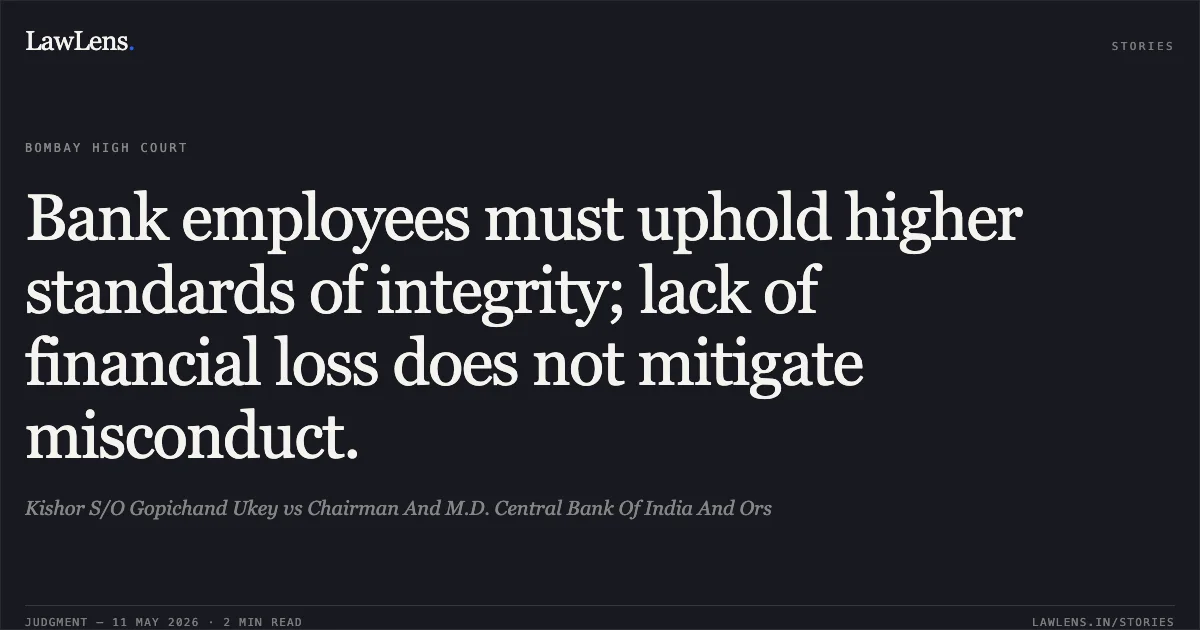
The Court answered the issues in the negative, holding that a bank officer's lack of integrity is sufficient ground for dismissal regardless of actual financial loss.
The final holding sustained the major penalty of dismissal imposed by the Disciplinary Authority. The Writ Petition was dismissed, and the rule was discharged with no order as to costs.
Source reference: paras. 26-27Original Court PDF
Kishor S/O Gopichand UkeyvsChairman And M.D. Central Bank Of India And Ors
Click to open original judgment
Original judgment, available to read, download and summarize on LawLens.in