01Facts
The petitioner held a savings bank account (No. 20373429231) with the third respondent, SBI Valandur Branch, since 11.07.2016
¶ 2 · p. 2In April 2026 he learned the account had been blocked on a police communication from the second respondent (Jhagrakhand PS, Chhattisgarh) concerning a cybercrime complaint over a UPI transaction of Rs.3,000 dated 14.03.2026
¶ 2 · p. 2The petitioner denied involvement, sought restriction limited to Rs.3,000, and complained to the bank's customer care and the Banking Ombudsman without effective redress
¶ 2–3 · pp. 2–3The bank later relied on jewel loan renewal transactions and classified the account as a suspected money mule account without furnishing supporting material
¶ 3 · p. 3The bank's counter-affidavit stated that only Rs.3,000 was placed on hold, that an intimation email was sent on 06.04.2026, and that enhanced due diligence under the SOP was conducted on 25.03.2026
¶ 5 · pp. 4–5The petitioner relied on this Court's order in W.P.No.25631 of 2024 dated 10.09.2024
¶ 4 · p. 302Issues
i.1. Whether the complete freezing of a savings account can be sustained merely on the basis of a cybercrime complaint involving Rs.3,000
¶ 8 · p. 5ii.2. Whether the bank's independent suspicion and money mule classification must be reviewed, justified, and communicated to the account holder under the applicable regulatory framework
¶ 8 · p. 5 · ¶ 9(ii), (v) · pp. 5–6iii.3. Whether the restriction on the account affects the investigating agency's latitude to continue its investigation
¶ 7 · pp. 4–5 · ¶ 9(vi) · p. 603Law Applied
The Court's reasoning rests on its writ jurisdiction under Article 226 of the Constitution, invoked by way of mandamus
p. 1It recognises the investigating agency's latitude to investigate cyber-enabled financial fraud, trace suspected proceeds of crime, and seek banking records
¶ 7 · p. 4It applies the principle that a restriction on an account should not extend beyond what is legally necessary for the investigation
¶ 7 · pp. 4–5It further holds that a bank's independent suspicion must be examined under the "applicable regulatory frame work," including RBI guidelines and banking regulations, and cannot justify indefinite deprivation of access to the whole account without further justification
¶ 8 · p. 5 · ¶ 9(iv) · p. 6The order refers to "statutory confidentiality requirements" but does not identify any specific statute, and it relies on the earlier decision in W.P.No.25631 of 2024 as persuasive on the freezing of accounts pursuant to police communications
¶ 4 · p. 304Reasoning
The Court separated two questions: the police hold, which is the investigating agency's domain, and the bank's wider restriction, which must be justified
¶ 8 · p. 5Because the disputed sum was only Rs.3,000, the Court held that a freeze on the entire account could not be sustained on the cybercrime complaint alone
¶ 8 · p. 5It also treated the bank's money mule classification as a distinct, internal determination that needed to be examined under the regulatory framework and disclosed to the customer
¶ 8 · p. 5To avoid an open-ended restriction, the Court set a sequenced process: the bank was to review its classification and identify the transactions needing clarification within two weeks; the petitioner was to explain them, including the jewel loan renewals, within two weeks; and the bank was to decide within a further two weeks
¶ 9(ii)–(iv) · pp. 5–6Any restriction beyond Rs.3,000 had to rest on a disclosed legal or regulatory basis and could not rest on internal classification alone
¶ 9(v) · p. 6The police were left free to pursue the disputed amount and any connected funds in accordance with law
¶ 9(vi) · p. 6The Court expressly made no finding on whether the transactions were genuine or whether the account was used for money mule activity
¶ 10 · p. 705Holding
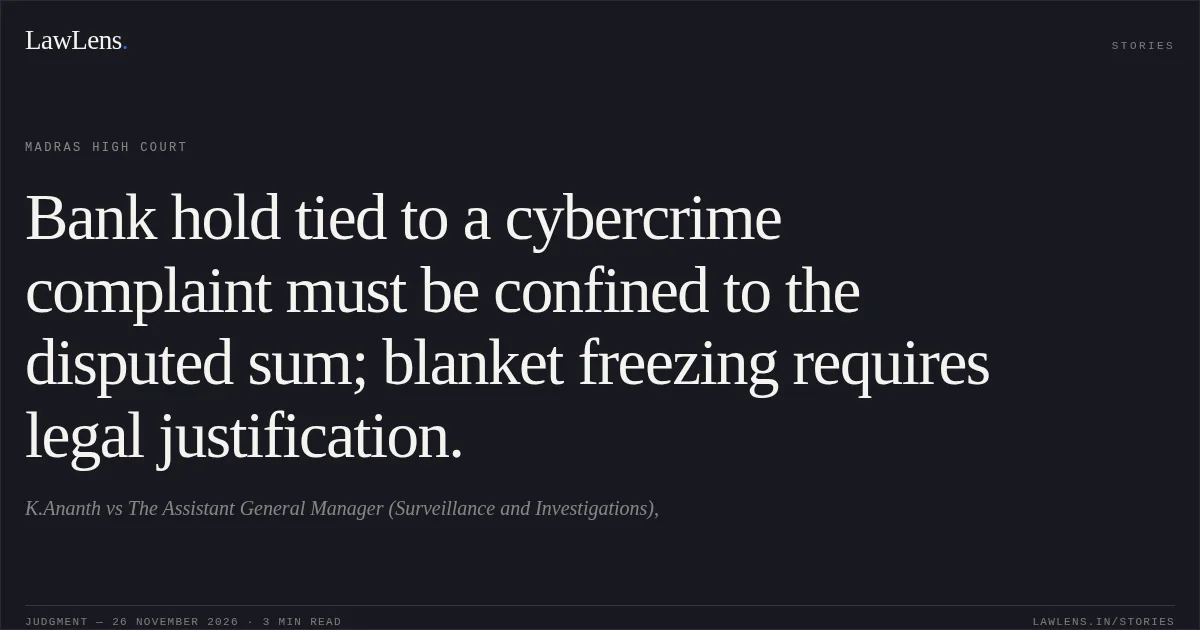
The Court held that continued complete freezing of the account could not be sustained on a Rs.3,000 cybercrime complaint alone and that an internal money mule classification could not justify indefinite restriction without legal justification
¶ 8 · p. 5The writ petition was disposed of with directions that the bank confine the hold to Rs.3,000 and permit operation of the remaining balance
¶ 9(i) · p. 5The bank review its classification within two weeks and specify the transactions requiring clarification
¶ 9(ii) · pp. 5–6The petitioner furnish explanations and documents within two weeks of receiving that communication
¶ 9(iii) · p. 6The bank decide on the explanation within a further two weeks under RBI guidelines
¶ 9(iv) · p. 6Any restriction beyond Rs.3,000 be supported by a disclosed legal basis
¶ 9(v) · p. 6The police proceed with the investigation in accordance with law
¶ 9(vi) · p. 6The bank comply and permit normal operations on the balance, subject to any independent lawful restriction
¶ 9(vii) · pp. 6–7No costs
¶ 10 · p. 7Original Court PDF
K.AnanthvsThe Assistant General Manager (Surveillance and Investigations),
Click to open original judgment
Original judgment, available to read, download and summarize on LawLens.in