Facts
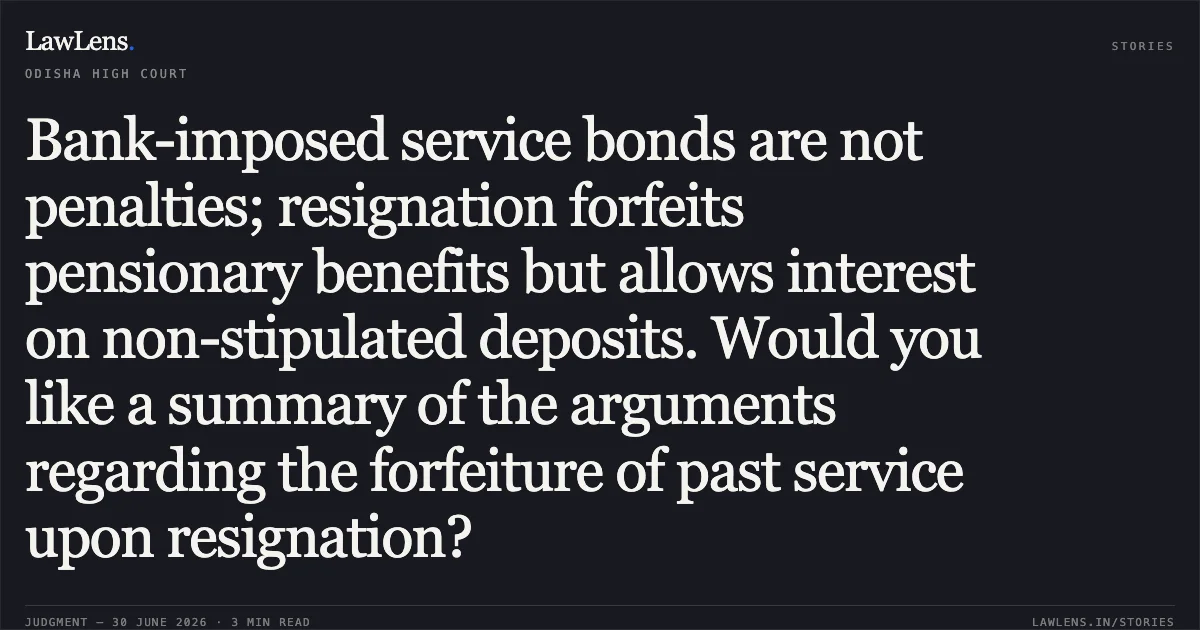
The deceased petitioner, an Executive Scale-IV officer of UCO Bank, was posted to the Singapore branch in 2004 under a contract requiring a 5-year post-repatriation service or payment of a Rs. 10 lakh bond as liquidated damages
Source reference: p.2Due to family health issues, she submitted her resignation on September 6, 2007, along with 9372.30 SGD (three months' salary) in lieu of notice
Source reference: p.3, 14The Bank refused the resignation and initiated disciplinary proceedings for "abandonment of service" and prior loan irregularities
Source reference: p.4, 15The petitioner returned to India and subsequently passed away; her legal representatives continued the suit
Source reference: p.1The Bank eventually accepted the resignation in 2014 but sought to recover the Rs. 10 lakh bond money and service charges from her terminal benefits, while denying pension and certain leave encashments
Source reference: p.5-7, 28Issues
1. Whether the Bank's recovery of Rs. 10 lakh bond money as "liquidated damages" via a disciplinary penalty was legally sustainable
Source reference: p.21 / para. 152. Whether an employee who resigns is entitled to pensionary benefits or the employer’s contribution to the Provident Fund under the UCO Bank (Employees’) Pension Regulations, 1995
Source reference: p.30 / para. 193. Whether the petitioner was entitled to interest on the 9372.30 SGD deposited in 2007 and reimbursement of Singapore income tax
Source reference: p.24, 28 / para. 16, 184. Whether the petitioner was entitled to encashment of Privilege Leave (PL) accumulated during the overseas tenure
Source reference: p.25 / para. 17Law Applied
Regulation 22(1) of the UCO Bank (Employees’) Pension Regulations, 1995, which stipulates that resignation entails forfeiture of past service, disqualifying the employee from pension
Source reference: p.30-31Supreme Court precedent UCO Bank v. Sanwar Mal (2004), which held that resignation and retirement are distinct, and a self-financing pension scheme can validly exclude those who resign
Source reference: p.31-33Section 74 of the Indian Contract Act, 1872, noting that liquidated damages must be a reasonable estimate of loss and not a penalty
Source reference: p.21UCO Bank Officer Employees’ (Conduct) Regulations, 1976, and the Provident Fund Rules
Source reference: p.35-37Reasoning
The Court reasoned that while the Bank has a general right to enforce service bonds to recoup costs, such recovery cannot be imposed as a "penalty" under disciplinary regulations as it is a civil liability
Source reference: p.22-23In this case, since the petitioner deposited three months' salary and sought repatriation due to hardship, the court found the Rs. 10 lakh demand "unconscionable" and unsupported by proof of actual loss
Source reference: p.41-43Regarding pension, the Court followed Sanwar Mal, concluding that the petitioner’s resignation triggered the forfeiture clause in Regulation 22(1), making her ineligible for both pension and the Bank’s contribution to the PF
Source reference: p.38-39On tax reimbursement, the claim was rejected as the Bank proved the Singapore authorities returned the cheque, meaning no tax was actually encashed
Source reference: p.24-25The Court found that the Bank's retention of the SGD deposit for seven years without a regulatory basis for such a deposit was unjustified, necessitating a refund with interest
Source reference: p.29, 43Holding
The Bank cannot recover the Rs. 10 lakh bond money or interest thereon, as the penalty was legally untenable and unconscionable
The petitioner is not entitled to pension or the Bank's contribution to the PF due to her resignation
Source reference: p.42The Bank must refund the 9372.30 SGD deposit with 6% annual interest from 2007
Source reference: p.43The Bank must re-evaluate the claim for 100 days of overseas PL encashment based on foreign service rules. The Bank was directed to disburse the dues within six weeks
Source reference: p.43-44Acts & Sections Cited
5 provisions across 3 statutes referred to in this judgment. Each provision opens on LawLens.
Indian Contract Act, 18723
Indian Stamp Act, 18991
Limitation Act, 19631
Original Court PDF
MEENAKSHI PANDAvsUCO BANK
Click to open original judgment
Original judgment, available to read, download and summarize on LawLens.in