01Facts
The petitioner, a Regional Rural Bank, challenged four Show Cause Notices (SCNs) issued in December 2023
¶ 3.3These notices sought to levy Goods and Services Tax (GST) on commissions paid to "pigmy agents" (deposit collectors) for the financial years 2018-19, 2019-20, and 2021-22
¶ 3.2The Revenue Department conducted an inspection under Section 67 of the CGST Act and alleged that pigmy agents act as "business facilitators," making the bank liable to pay GST under the Reverse Charge Mechanism (RCM)
¶ 3.1, 5The petitioner contended that pigmy agents are "employees" and their services are exempt from GST under Schedule III of the CGST Act
¶ 402Issues
i.Whether the petitioner is liable to discharge Goods and Services Tax on the services rendered and commission paid to the pigmy agents?
¶ 603Law Applied
The court primarily applied Section 7(2)(a) read with Entry 1 of Schedule III of the CGST Act, 2017, which stipulates that services by an employee to the employer in the course of employment are treated neither as a supply of goods nor services
¶ 8It relied on the precedent Indian Bank’s Association v. Workmen of Syndicate Bank (2001) 3 SCC 36, which established that deposit collectors are "workmen" and their commission constitutes "wages" under the Industrial Disputes Act
¶ 7Furthermore, the court applied the "control and supervision" test from Dharangadhara Chemical Works Ltd. v. State of Saurashtra [para 10.1] and the "economic reality/integration" tests from Sushilaben Indravadan Gandhi v. New India Assurance Co. Ltd. to determine the existence of a master-servant relationship
¶ 10.3It also examined Notification No. 13/2017-Central Tax (Rate) regarding "business facilitators"
¶ 12Provisions in the judgment · 13 · Linked ones open on LawLens
Central Goods and Services Tax Act, 2017 10 provisions
Section 2Section 7Section 9Section 11Section 50Section 67Section 73Section 107Section 122Section 168KARNATAKA GOODS AND SERVICES TAX ACT, 2017 Section 73Section 168
Integrated Goods and Services Tax Act, 2017 Section 2
04Reasoning
The court analyzed the nature of engagement of pigmy agents by examining the Memorandum of Agreement, which revealed the bank’s pervasive control, requirement of security deposits, and provision of benefits like gratuity
¶ 9Applying the tests from Indian Bank’s Association, the court determined that pigmy agents are not detached contractors but operate under a master-servant nexus, where their remuneration—though termed "commission"—is substantively "wages"
¶ 7, 11Regarding the Revenue's claim that agents are "business facilitators," the court noted that the RBI’s definition requires such facilitators to be intermediaries appointed under specific regulatory models for functions like loan processing
¶ 12-13The court found that pigmy agents, whose role is confined to daily deposit collection, do not meet this definition and are instead integrated into the bank's core business as employees
¶ 13-14Consequently, the court held that their services fall squarely within the exemption under Entry 1, Schedule III of the CGST Act, rendering them outside the taxable net
¶ 11, 1405Holding
The court allowed the writ petition and quashed the impugned Show Cause Notices
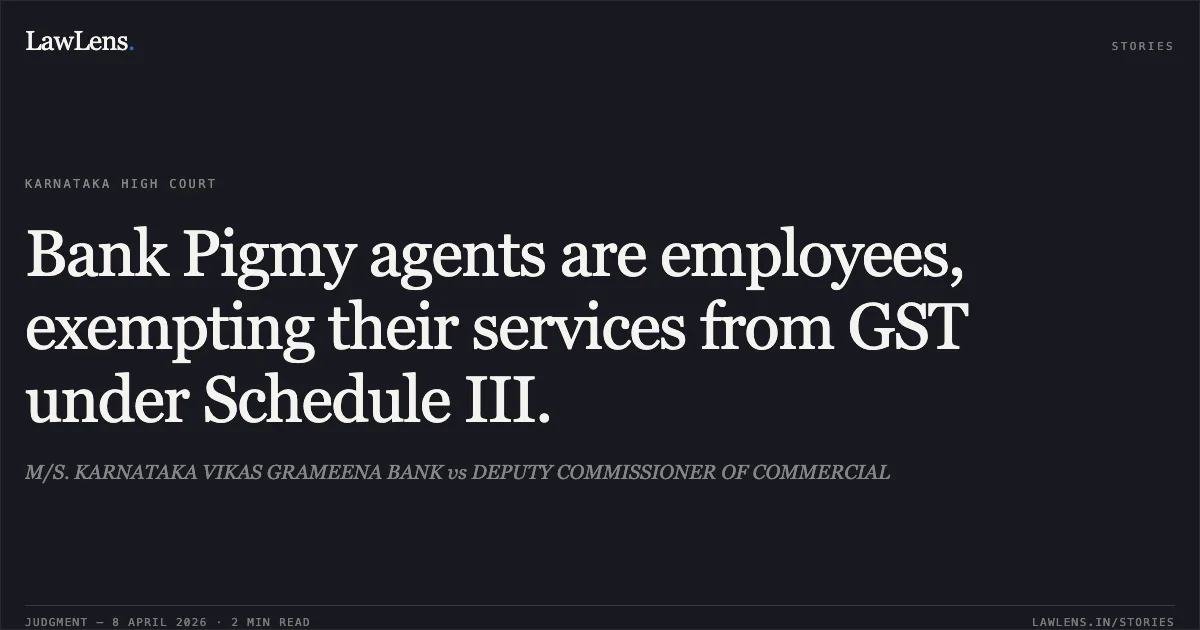
¶ 16It held that pigmy agents are employees of the bank, and therefore, the services rendered by them in the course of employment are exempt from GST under Schedule III of the CGST/KGST Acts
¶ 14-15The court declined to rule on the validity of notifications extending the time limit for SCNs, as the underlying tax demand itself was found unsustainable
¶ 15The petitioner was granted all consequential benefits following the quashment
¶ 16Original Court PDF
M/S. KARNATAKA VIKAS GRAMEENA BANKvsDEPUTY COMMISSIONER OF COMMERCIAL
Click to open original judgment
Original judgment, available to read, download and summarize on LawLens.in