Facts
The petitioner, a sole proprietor of “Sanjeev Vyapaar,” maintained Current Account No. 43061577012 with the State Bank of India (“SBI”). On 19 March 2026, SBI partially froze the account, preventing its normal operation, allegedly pursuant to an identification by the Proactive Risk Management Cell, Patna, of the account as a suspected “mule account”.
Source reference: para. 2, 4SBI subsequently conducted physical verification of the petitioner’s office and godown and alleged that the petitioner’s actual business differed from the activities reflected in his trade licences and GST records.
Source reference: paras. 3, 6–8The bank further relied upon a request from Ninja Ferro Tec Private Limited claiming that ₹10,00,000 had been erroneously transferred to the petitioner’s account and seeking reversal of that amount. The bank stated that the account balance on the date of freezing was ₹10,01,509.14, including the disputed ₹10,00,000.
Source reference: paras. 9–11The petitioner sought restoration of the account and disclosure of the reasons for the freeze, but SBI declined to provide complete details, citing statutory restrictions relating to suspicious transaction reporting.
Source reference: paras. 4–5, 9The petitioner therefore approached the High Court under Article 226 of the Constitution.
Source reference: no citationIssues
Whether SBI was justified in partially freezing the petitioner’s bank account on the basis of a suspicion that it was being operated as a “mule account,” without establishing any fraudulent or illegal transaction and without prior notice to the petitioner?
Source reference: paras. 13–18Whether Clause 59 of the RBI Master Direction dated 25 February 2016 authorises a bank to freeze a customer’s account merely upon suspicion of mule-account activity?
Source reference: paras. 12, 15–16Whether the disputed sum of ₹10,00,000 could be protected by retaining it under lien while permitting the petitioner to operate the remaining account balance?
Source reference: para. 19Law Applied
The Court applied Clause 59 of the RBI’s Master Direction DBR.AML.BC. No.81/14.01.001/2015-16 dated 25 February 2016, which requires banks to undertake due diligence and meticulous monitoring to identify accounts operated as “money mules” and to take appropriate action, including filing Suspicious Transaction Reports (“STRs”) with the Financial Intelligence Unit–India.
Source reference: para. 12The Court held that although the provision permits diligence, monitoring and reporting of suspicious transactions, it does not expressly authorise the freezing of a bank account merely on suspicion.
Source reference: para. 15The Court also applied the principles of procedural fairness and non-arbitrariness, holding that adverse action affecting the operation of a bank account must be supported by material establishing the alleged wrongdoing and cannot be sustained solely on an unsubstantiated suspicion.
Source reference: paras. 14–18Reasoning
The Court found that SBI had frozen the account on 19 March 2026, before conducting its physical verification, and without giving the petitioner prior notice.
Source reference: para. 16Although the bank alleged that the petitioner’s actual business differed from his trade licences and GST records, that discrepancy did not establish that the account had been used for fraud, money laundering, or any illegal transaction.
Source reference: paras. 13–16The Court further noted that there was no report from SBI or any investigating agency identifying a fraudulent transaction in the petitioner’s account, and that the bank had not produced evidence establishing that the petitioner operated a mule account.
Source reference: paras. 14, 18The alleged erroneous transfer of ₹10,00,000 justified safeguarding that specific amount, but SBI had not independently corresponded with or heard the petitioner to determine whether the transfer was genuinely erroneous or arose from a legitimate business transaction.
Source reference: paras. 17–18Consequently, the broader partial freeze was disproportionate and unsupported by Clause 59, though the disputed sum could reasonably remain protected pending determination of the competing claims.
Source reference: para. 19Holding
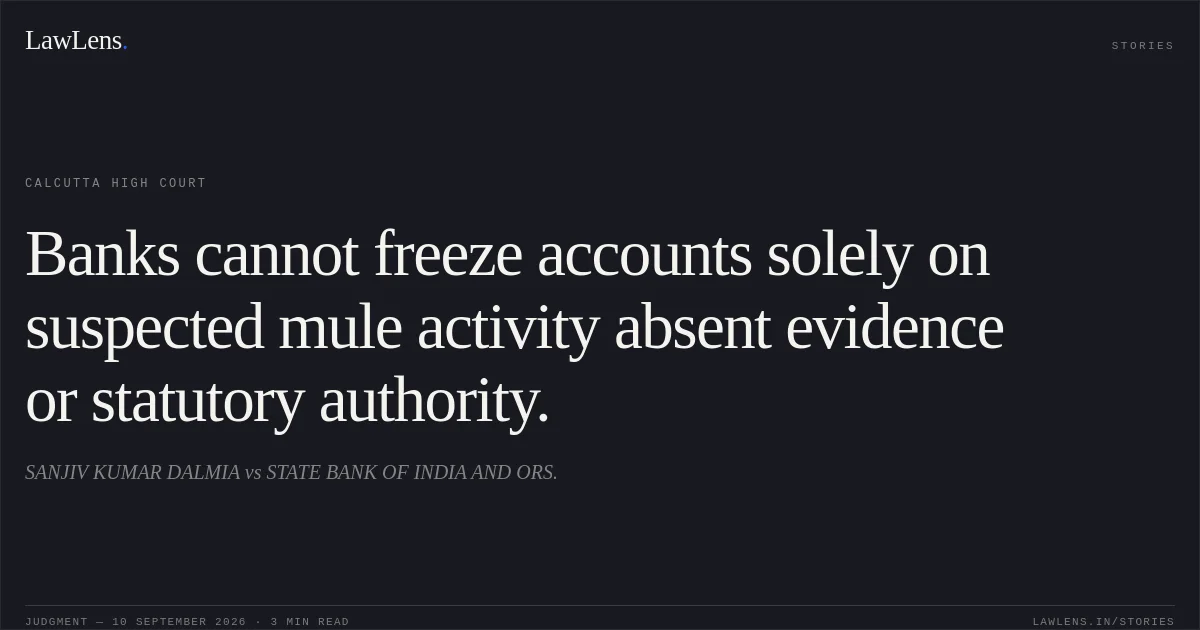
The Court held that SBI was not justified in partially freezing the petitioner’s account merely on the allegation that it was a mule account, in the absence of evidence of fraud or an illegal transaction and in the absence of prior notice.
SBI was directed to immediately defreeze the account and permit the petitioner to operate it, while retaining ₹10,00,000 under lien.
Source reference: para. 19SBI was further directed to decide the entitlement to that amount after giving an opportunity of hearing to both the petitioner and Ninja Ferro Tec Private Limited, within six weeks from receipt of the order.
Source reference: paras. 19–20The writ petition was accordingly disposed of.
Source reference: paras. 19–20Original Court PDF
SANJIV KUMAR DALMIAvsSTATE BANK OF INDIA AND ORS.
Click to open original judgment
Original judgment, available to read, download and summarize on LawLens.in