Facts
The petitioner, an MSME-registered enterprise, provided operation, maintenance, electrical and technical services to the respondent under a service agreement dated 18 January 2017, subsequently extended until 31 January 2020.
Source reference: paras. 3–6It claimed unpaid invoices amounting to ₹64,84,061 and initiated proceedings before the West Bengal Micro Small Enterprises Facilitation Council (“WBMSEFC”) under Section 18 of the Micro, Small and Medium Enterprises Development Act, 2006 (“MSMED Act”) through the Samadhaan portal.
Source reference: paras. 3–6Conciliation failed on 15 February 2023, following which the dispute was referred to arbitration under Section 18(3) of the MSMED Act.
Source reference: paras. 3–6The WBMSEFC passed an award dated 18 September 2025, allowing substantial portions of the petitioner’s claim.
Source reference: paras. 3–6The petitioner thereafter filed the present application under Section 29A of the Arbitration and Conciliation Act, 1996 (“Arbitration Act”), seeking a post-award extension of the arbitral mandate.
Source reference: paras. 3–6The respondent opposed the application on the ground that the parties’ agreement conferred exclusive jurisdiction on the courts at New Delhi and that a Section 34 challenge to the same award was already pending there.
Source reference: paras. 11–14Issues
Whether the Calcutta High Court was the “Court” under Section 2(1)(e) of the Arbitration Act competent to entertain the Section 29A application merely because the statutory arbitration was conducted by the WBMSEFC at Kolkata, notwithstanding the contractual exclusive-jurisdiction clause in favour of the courts at New Delhi?
Source reference: para. 16If the Court had territorial jurisdiction, whether an extension of the arbitral mandate under Section 29A of the Arbitration Act was required in respect of the proceedings conducted under Section 18 of the MSMED Act.
Source reference: para. 16Law Applied
Section 18(1), 18(3), 18(4) and 24 of the MSMED Act confer statutory jurisdiction on the Facilitation Council where the supplier is located and override inconsistent contractual provisions concerning the constitution and conduct of the statutory arbitration; this principle was recognised in Gujarat State Civil Supplies Corporation Ltd. v. Mahakali Foods Pvt. Ltd., (2023) 6 SCC 401, and reiterated in Harcharan Dass Gupta v. Union of India, 2025 SCC OnLine SC 1111.
Source reference: paras. 17–21However, Section 18(3) of the MSMED Act makes the Arbitration Act applicable to the dispute as though the arbitration arose from an agreement under Section 7.
Source reference: paras. 17–21Accordingly, the location of the Facilitation Council does not, by itself, determine the court having jurisdiction over post-award proceedings.
Source reference: paras. 17–21Relying on Gammon Engineers & Contractors (P) Ltd. v. Sahay Industries, 2023 SCC OnLine Bom 750, Odisha Power Generation Corporation Ltd. v. Techniche Consulting Service, 2024 SCC OnLine Cal 10386, Swastik Gases Pvt. Ltd. v. Indian Oil Corporation Ltd., (2013) 9 SCC 32, and Indus Mobile Distribution Pvt. Ltd. v. Datawind Innovations Pvt. Ltd., (2017) 7 SCC 678, the Court held that a valid and unambiguous exclusive-jurisdiction clause continues to govern proceedings arising from the award.
Source reference: paras. 17–21Reasoning
The Court distinguished between the WBMSEFC’s statutory jurisdiction to conduct the MSME arbitration and the jurisdiction of a court over proceedings arising from the resulting award.
Source reference: paras. 18–26Although Section 18 of the MSMED Act authorised the WBMSEFC at Kolkata to conduct the reference, Section 18(3) subjected the arbitration and post-award proceedings to the Arbitration Act.
Source reference: paras. 18–26The Council’s location therefore constituted, at most, the venue of the statutory proceedings and did not automatically make the Calcutta High Court the competent court under Section 2(1)(e).
Source reference: paras. 18–26The parties had expressly agreed that the courts at New Delhi would have exclusive jurisdiction, and there was no material showing that this arrangement had been altered or that Kolkata had been designated as the juridical seat of arbitration.
Source reference: paras. 18–26The respondent’s pending Section 34 challenge before the New Delhi courts further supported the conclusion that New Delhi was the agreed forum, although such pendency could not independently confer jurisdiction.
Source reference: paras. 18–26Consequently, the Section 29A application was held to be territorially incompetent.
Source reference: paras. 18–26Holding
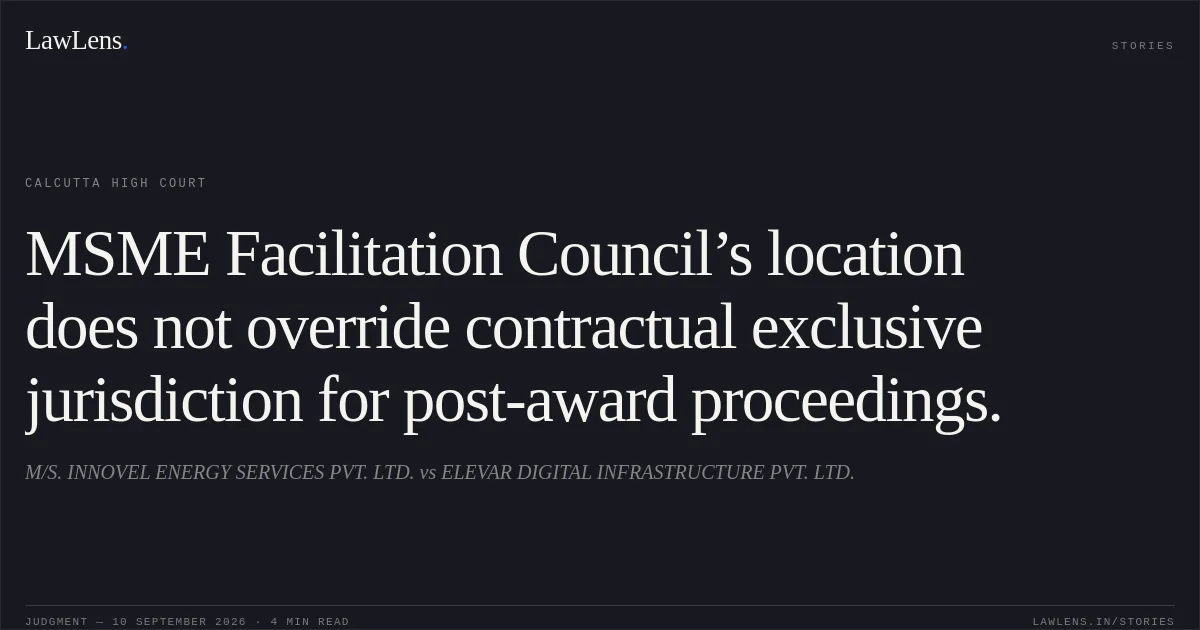
The Calcutta High Court held that the WBMSEFC’s location at Kolkata did not confer territorial jurisdiction on it over post-award proceedings under the Arbitration Act.
The contractual exclusive-jurisdiction clause in favour of the courts at New Delhi continued to govern the Section 29A application.
Source reference: paras. 26–28The petition was therefore dismissed as not maintainable for want of territorial jurisdiction, with liberty to the petitioner to pursue any remedy available before the competent court in accordance with law.
Source reference: paras. 26–28Since the Court lacked jurisdiction, it expressly declined to decide whether Section 29A applied to the MSMED arbitration or whether a post-award extension of the arbitral mandate could be granted.
Source reference: paras. 26–28Acts & Sections Cited
5 provisions across 2 statutes referred to in this judgment. Each provision opens on LawLens.
Arbitration and Conciliation Act, 19963
Micro, Small and Medium Enterprises Development Act, 20062
Original Court PDF
M/S. INNOVEL ENERGY SERVICES PVT. LTD.vsELEVAR DIGITAL INFRASTRUCTURE PVT. LTD.
Click to open original judgment
Original judgment, available to read, download and summarize on LawLens.in