Facts
The petitioner, Secretary of Millat Committee, Golakpur Kabristan (Waqf Estate No. 2153), alleged that he was attacked by criminals while pursuing removal of encroachments from the Waqf property, resulting in Pirbahore P.S. Case No. 291 of 2014 under Sections 341, 323 and 307 IPC.
Source reference: p.2 / para. 3Claiming a continuing threat to his life, he applied on 21 November 2014 for an N.P. bore revolver/pistol licence.
Source reference: p.2 / para. 3After the application remained undecided, he approached the High Court, which directed the licensing authority to decide it within three months.
Source reference: p.2 / paras. 3–4During contempt proceedings, the District Magistrate rejected the application by order dated 14 July 2017 in Arms Case No. 9-726/14, allegedly without properly considering the favourable police recommendation.
Source reference: p.2 / paras. 3–4The petitioner preferred Arms Appeal No. 17 of 2018 before the Divisional Commissioner.
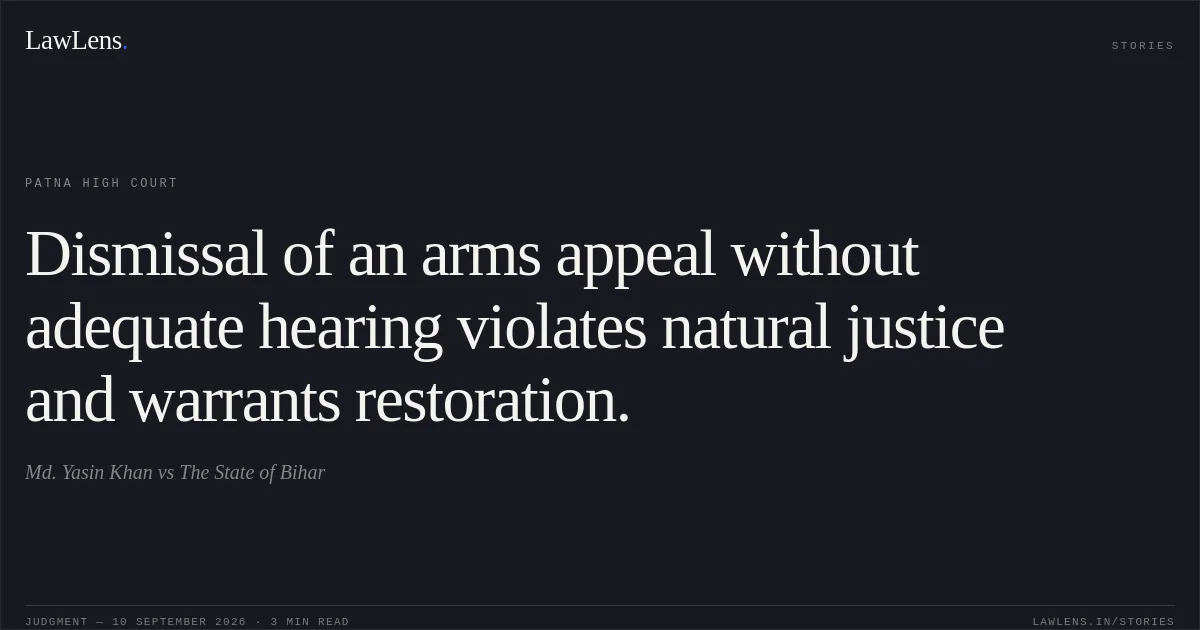
Source reference: p.3 / para. 5The appeal was dismissed by order dated 5 October 2023, allegedly for non-appearance and without an adequate opportunity of hearing.
Source reference: p.3 / para. 5The State contended that the petitioner had been given notice and heard before the District Magistrate, and that he had remained absent on three dates before the appellate authority.
Source reference: p.4–5 / paras. 6–7Issues
Whether the Divisional Commissioner’s order dated 5 October 2023 dismissing the petitioner’s arms appeal was vitiated by denial of a reasonable opportunity of hearing and breach of the audi alteram partem rule.
Source reference: p.6–7 / paras. 8–10Whether the District Magistrate’s order dated 14 July 2017 rejecting the arms-licence application reflected proper application of mind to the police reports, the petitioner’s claimed threat perception, and the requirements of Sections 13 and 14 of the Arms Act, 1959.
Source reference: p.3–5 / paras. 4 and 6The High Court ultimately remitted the matter on the ground of violation of natural justice and did not finally adjudicate the merits of the licence application.
Source reference: p.4–7 / paras. 6, 9–10Law Applied
The Court applied Sections 13(3)(b) and 14(1)(b)(i)–(ii) of the Arms Act, 1959, under which the grant or refusal of an arms licence is a statutory matter and may be refused where the authority considers the applicant unsuitable or the grant prejudicial to public peace or safety.
Source reference: p.4–5 / para. 6Although there is no fundamental right to bear arms and an arms licence is a statutorily regulated privilege, the discretion of licensing and appellate authorities is not unfettered; orders under Sections 13 and 14 must disclose due application of mind to relevant material, including police verification and recommendation reports, and cannot be based on vague apprehension or unsupported assumptions.
Source reference: p.5–6 / para. 8The Court further applied the audi alteram partem principle, holding that an administrative or quasi-judicial decision affecting a person’s rights cannot be sustained where the affected party has not received a fair and adequate opportunity of hearing.
Source reference: p.6 / paras. 8–9Reasoning
The Court found that the appellate order dated 5 October 2023 did not demonstrate that the petitioner had been afforded an adequate opportunity to present his case.
Source reference: p.3 / para. 5The State’s assertion that the petitioner had been absent on three dates did not, in the Court’s view, cure the alleged denial of a fair hearing, particularly where the appeal had remained pending for several years and the petitioner attributed the delay to the functioning of the appellate forum and the COVID-19 period.
Source reference: p.3 / para. 5Since the appellate authority dismissed the appeal without sufficiently ensuring effective participation by the petitioner, the order violated the audi alteram partem rule and was legally unsustainable.
Source reference: p.6 / para. 9The Court therefore considered it appropriate to restore the appeal rather than determine, in writ jurisdiction, whether the petitioner substantively satisfied the statutory requirements for grant of an arms licence.
Source reference: p.4–7 / paras. 6, 9–10The merits of the District Magistrate’s decision, including the competing police reports and the petitioner’s stated need for protection, were left open for fresh consideration by the appellate authority.
Source reference: p.4–7 / paras. 6, 9–10Holding
The High Court held that the appellate order dated 5 October 2023 was vitiated by violation of natural justice and set it aside.
Arms Appeal No. 17 of 2018 was restored to its original file before the Divisional Commissioner, Patna Division, with a direction to decide it afresh in accordance with law after giving due opportunity of hearing to the petitioner and the respondents, preferably within twelve weeks from receipt or production of the order.
Source reference: p.7 / para. 10The writ petition was accordingly disposed of; no arms licence was directly granted by the High Court.
Source reference: p.7 / para. 11Acts & Sections Cited
5 provisions across 2 statutes referred to in this judgment. Each provision opens on LawLens.
Indian Penal Code, 18603
Arms Act, 19592
Original Court PDF
Md. Yasin KhanvsThe State of Bihar
Click to open original judgment
Original judgment, available to read, download and summarize on LawLens.in