Facts
The petitioner was appointed as a Revenue Karamchari on 14 July 1992 and served in various revenue circles in Gaya district.
Source reference: pp. 2–3He was suspended on 7 December 2007 and proceeded against departmentally. Although the first Enquiry Officer exonerated him, the disciplinary authority ordered a fresh enquiry, pursuant to which a report recommending severe punishment was submitted.
Source reference: pp. 3–4The petitioner was dismissed from service on 25 July 2008. His statutory appeal was initially allowed by the Divisional Commissioner on 7 May 2009, but the Member, Board of Revenue subsequently restored the dismissal order in Service Appeal No. 30 of 2009.
Source reference: p. 4The petitioner challenged that decision in CWJC No. 2982 of 2010. By order dated 7 October 2010, the High Court set aside the Board’s order and directed reconsideration, including whether the petitioner should be treated similarly to the Circle Inspector and Circle Officer and granted full salary.
Source reference: pp. 5, 10–11Subsequent proceedings resulted in orders setting aside the petitioner’s compulsory retirement and remanding the matter for fresh consideration under Article 14.
Source reference: pp. 5–7, 10–11Ultimately, by order dated 22 April 2019 in Service Appeal (Revision) Case No. 18 of 2018, the Member, Board of Revenue set aside the dismissal order, holding that the petitioner had been wrongly dismissed on the basis of a perverse enquiry report and had wrongly remained out of service since 25 July 2008.
Source reference: pp. 7–8, 11–12The petitioner rejoined on 24 April 2019 and later retired on 28 February 2023. His representation for regularisation of the intervening period, payment of salary, consequential benefits and Second MACP was not decided, leading to the present writ petition.
Source reference: p. 8Issues
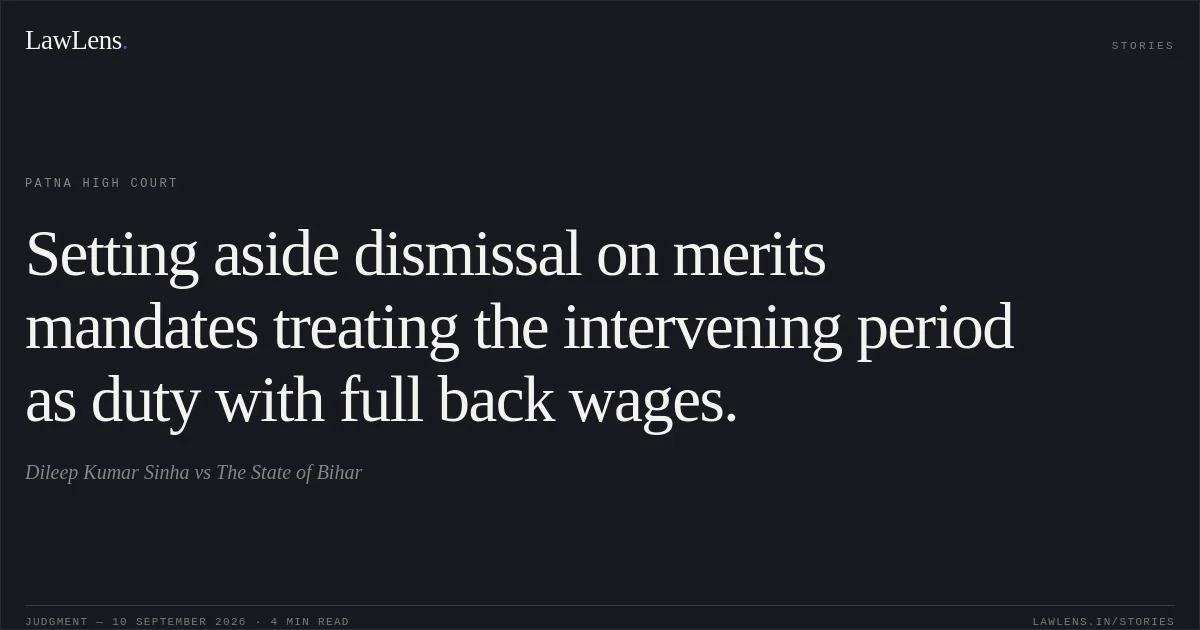
Whether the period from 25 July 2008 to 23 April 2019 was required to be treated as duty for all purposes after the petitioner’s dismissal was set aside?
Source reference: paras. 14–15, 18Whether the petitioner was entitled to full salary and allowances for the period of his absence, after adjustment of subsistence allowance, notwithstanding the State’s reliance on the principle of “no work, no pay”?
Source reference: paras. 11, 15–18Whether the petitioner was entitled to consequential service benefits, including the Second MACP, on account of the setting aside of the dismissal order?
Source reference: paras. 2, 18–19Law Applied
The Court applied Rule 13(3) of the Bihar Government Servants (Classification, Control & Appeal) Rules, 2005, which provides that where dismissal, removal or compulsory retirement is set aside on merits, or solely for procedural non-compliance without any further enquiry being proposed, the intervening period must be treated as duty for all purposes and the employee is entitled to full pay and allowances as if the adverse order had not been passed.
Source reference: para. 15The Court also relied on the principles stated in Deepali Gundu Surwase v. Kranti Junior Adhyapak Mahavidyalaya (D.Ed.), (2013) 10 SCC 324, that reinstatement following an illegal termination ordinarily carries the right to restoration to the position the employee would have occupied but for the illegal action, including back wages; denial of back wages is justified only where the employer specifically pleads and proves gainful employment during the intervening period.
Source reference: paras. 16–17The Court further considered the earlier High Court directions concerning parity under Article 14 and the finding that the petitioner had been wrongly dismissed.
Source reference: paras. 13–14Reasoning
The Board of Revenue’s final order dated 22 April 2019 set aside the petitioner’s dismissal and expressly found that he had been wrongly removed from service on the basis of a perverse enquiry report.
Source reference: paras. 8, 14Since the dismissal was not sustained on merits and no further disciplinary enquiry was shown to have been initiated, Rule 13(3) required the intervening period to be treated as duty, thereby excluding the State’s general “no work, no pay” objection.
Source reference: paras. 11, 15, 18The Court also found that the petitioner had undergone prolonged litigation because of the respondents’ erroneous disciplinary action and that the principles governing restoration after illegal termination supported payment of consequential monetary benefits.
Source reference: paras. 16–18Accordingly, the petitioner was entitled to regular service treatment from 25 July 2008 to 23 April 2019, salary for the claimed period after adjustment of subsistence allowance, and consequential benefits including the Second MACP.
Source reference: para. 18Holding
The writ petition was allowed.
The Court directed the Collector, Gaya, to calculate and pay the petitioner’s arrears, treating him as being in regular service from 25 July 2008 to 23 April 2019.
Source reference: paras. 18–20The petitioner was held entitled to salary from 7 December 2007 to 23 April 2019, subject to deduction of subsistence allowance, along with all consequential service benefits, including the Second MACP.
Source reference: paras. 18–20The arrears were directed to be calculated and paid within four months from production of the judgment.
Source reference: para. 19Original Court PDF
Dileep Kumar SinhavsThe State of Bihar
Click to open original judgment
Original judgment, available to read, download and summarize on LawLens.in