Facts
The petitioner, mother of the detenue Nikhila C., challenged the preventive-detention order dated 29 August 2025 issued under Section 3(1) of the Prevention of Illicit Traffic in Narcotic Drugs and Psychotropic Substances Act, 1988 (“PITNDPS Act”), and the confirmation order dated 14 November 2025 issued under Sections 9(f) and 11 of that Act.
Source reference: paras. 1–2The detention was based on two criminal cases, including Crime No. 4 of 2025 of the Excise Range Office, Payyannur, registered under Section 22(b) of the Narcotic Drugs and Psychotropic Substances Act, 1985.
Source reference: para. 2The petitioner had previously challenged the detention order in W.P.(Crl.) No. 1632 of 2025 and W.P.(Crl.) No. 301 of 2026, both of which were dismissed.
Source reference: paras. 3–4She thereafter submitted a representation dated 7 March 2026, which was initially rejected on 25 April 2026.
Source reference: para. 5Upon reconsideration, the Government obtained a Medical Board opinion and rejected the representation by order dated 27 June 2026, finding no medical emergency requiring release of the detenue.
Source reference: paras. 6, 17Issues
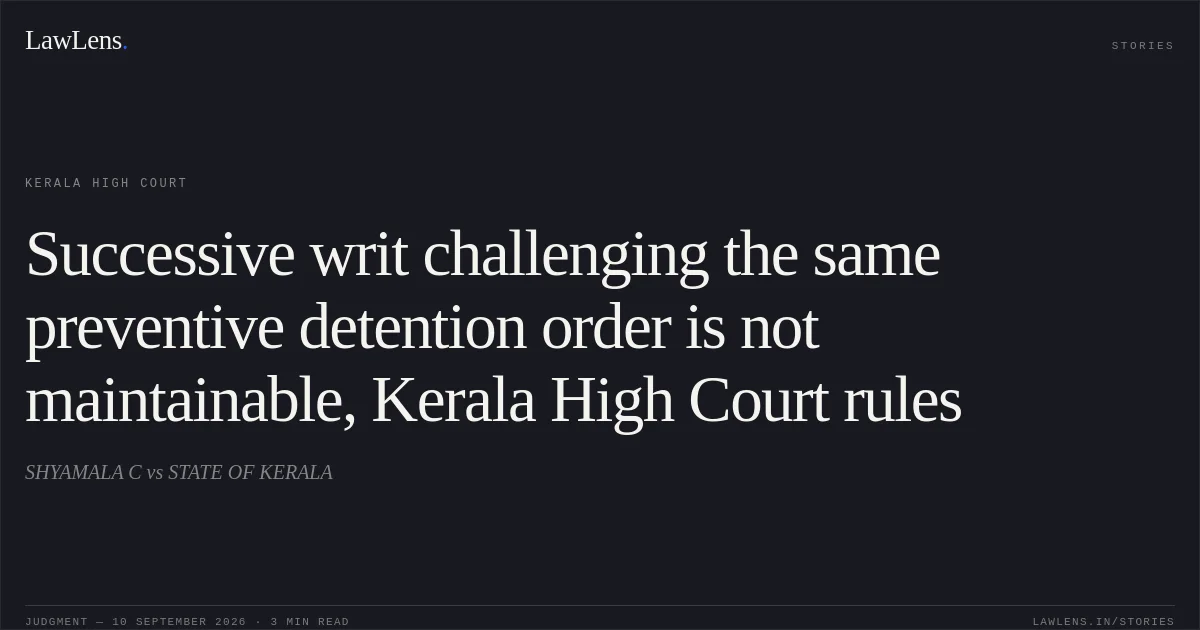
Whether a successive writ petition challenging the same preventive-detention order is maintainable when it raises a new ground that was not urged in the earlier proceedings, namely, delay in considering the representation?
Source reference: paras. 12, 16–19Whether the delay in considering the petitioner’s representation was unreasonable and unexplained so as to vitiate the detention order?
Source reference: paras. 9, 13–18Whether the petitioner was entitled to quashing of the detention and confirmation orders, or to release of the detenue, on the basis of the alleged medical condition and the representation?
Source reference: paras. 17–19Law Applied
The Court applied Article 226 of the Constitution and Sections 3(1), 3(2), 9(b), 9(f), 11, 12 and 13 of the PITNDPS Act governing preventive detention, communication of detention, Advisory Board review, confirmation and representations.
Source reference: paras. 1–2.2, 17It relied on Lallubhai Jogibhai Patel v. Union of India, holding that constructive res judicata does not bar a subsequent habeas corpus petition based on fresh grounds not raised earlier.
Source reference: para. 12However, relying on Ramseena S. v. State of Kerala, the Court held that a successive writ challenging the very same detention order is generally not maintainable where the substantial challenge to that order has already attained finality, even though a fresh ground may in principle support a successive habeas petition.
Source reference: para. 16Under Harish Pahwa v. State of U.P. and Piara Singh v. State of Punjab, a representation by a preventive detainee must be considered with utmost expedition, and unexplained or inordinate delay may invalidate the detention.
Source reference: paras. 13–14At the same time, K.M. Abdulla Kunhi v. Union of India establishes that the time imperative is not absolute; the Government must act as early as possible, subject to the procedural circumstances, including proceedings before the Advisory Board.
Source reference: para. 15Reasoning
The Court accepted that a successive habeas corpus petition may, in an appropriate case, be founded on a genuinely new ground.
Source reference: paras. 17–19However, the present petition sought not merely habeas corpus but also quashing of the original detention and confirmation orders, which had already been directly challenged and upheld in the earlier proceedings.
Source reference: paras. 17–19In any event, the alleged delay did not establish a constitutional violation.
Source reference: paras. 17–18The representation dated 7 March 2026 had initially been considered and rejected on 25 April 2026; after that order was set aside, it was reconsidered pursuant to the Court’s direction, including examination of the detenue by a specialised Medical Board on 20 June 2026, and was finally rejected on 27 June 2026.
Source reference: paras. 17–18The Court found no unreasonable or unexplained delay comparable to the delays condemned in Harish Pahwa and Piara Singh.
Source reference: paras. 17–18The Medical Board, comprising specialists, found no present medical emergency, and the petitioner’s other grounds had already been considered in the previous litigation.
Source reference: para. 17Since the present proceedings substantially reopened the validity of detention orders that had attained finality, and since the alleged delay was not proved, the petition could not succeed.
Source reference: paras. 18–19Holding
The Court held that although a successive habeas corpus petition may be maintainable on a genuinely new ground, the present petition was not maintainable insofar as it again sought quashing of the same detention and confirmation orders already adjudicated in the earlier proceedings.
It further held that there was no unreasonable or unexplained delay in the Government’s consideration of the representation, particularly in view of the reconsideration process and the Medical Board’s report.
Source reference: para. 18The writ petition was accordingly dismissed, with no order directing release of the detenue.
Source reference: para. 19Acts & Sections Cited
7 provisions across 3 statutes referred to in this judgment. Each provision opens on LawLens.
Prevention of Illicit Traffic in Narcotic Drugs and Psychotropic Substances Act, 19885
Narcotic Drugs and Psychotropic Substances Act, 19851
Conservation of Foreign Exchange and Prevention of Smuggling Activities Act, 19741
Original Court PDF
SHYAMALA CvsSTATE OF KERALA
Click to open original judgment
Original judgment, available to read, download and summarize on LawLens.in