Facts
The Petitioner, a sole proprietorship engaged in the fisheries machinery business, maintained a current account with the Indian Overseas Bank (Respondent Bank).
Source reference: para. 3On January 16, 2026, ₹23 lakhs was credited to the account via RTGS from a Mrs. Anita for a business transaction, and the Petitioner withdrew ₹5 lakhs.
Source reference: para. 4On January 20, 2026, the Bank orally informed the Petitioner that the account was frozen due to "suspicious transactions," citing that the credit amount exceeded the Petitioner’s declared annual income.
Source reference: para. 4, 8The Bank later claimed the freeze was based on an email from the Bank of Maharashtra alleging "suspicious activity" in Mrs. Anita’s account, though no police complaint, FIR, or court order existed.
Source reference: para. 9, 14, 15The Petitioner sought a writ for de-freezing the account.
Source reference: para. 2Issues
1. Whether a bank has the legal authority to unilaterally freeze a customer's account solely on the suspicion that the credited amount exceeds the declared annual income or based on informal queries from other banks.
Source reference: para. 11, 142. Whether Section 12(2) or Section 12AA of the Prevention of Money Laundering Act (PMLA), 2002 empowers a reporting entity to freeze a bank account on its own volition.
Source reference: para. 12, 183. Whether the Bank’s action violated the Petitioner’s fundamental rights under Articles 19(1)(g) and 21 of the Constitution of India.
Source reference: para. 23, 26Law Applied
The Court applied Section 12 and 12AA of the PMLA, 2002, noting that these provisions mandate record-keeping and "enhanced due diligence" but do not authorize banks to freeze accounts; such power resides with competent authorities under Section 17 of the PMLA.
Source reference: para. 16-18It relied on the RBI Circular dated July 2, 2012, which explicitly instructs banks not to restrict operations in accounts even where Suspicious Transaction Reports (STR) are filed.
Source reference: para. 21The Court followed the precedent in OPTO Circuits (India) Ltd. v. Axis Bank (2021) 6 SCC 707, holding that freezing accounts cannot be done casually.
Source reference: para. 23Khalsa Medical Store v. RBI (2026), established that police/authorities must follow strict procedural safeguards under Section 106 of the BNSS before freezing accounts.
Source reference: para. 30Section 171 of the Contract Act, 1872, stating a bank can only freeze an account on its own volition if it exercises a valid lien.
Source reference: para. 31Reasoning
The Court observed that the Respondent Bank acted as an "Investigating agency" rather than a trustee of the depositor's funds.
Source reference: para. 2, 29It found the "suspicion" regarding declared income versus actual credit to be legally baseless, as no regulation bars credits exceeding declared income.
Source reference: para. 11The Bank's reliance on Section 12(2) of the PMLA was deemed "misconceived" and "illegal," as that section pertains to confidentiality of records, not account freezing.
Source reference: para. 16The Court further noted that even if the Bank suspected money laundering, Section 12AA only allows for aborting a "specified transaction," not a blanket freeze of the entire account.
Source reference: para. 18-19Crucially, the Court highlighted the Bank's mala fides: the Bank of Maharashtra (the source bank) had not even frozen the account of the alleged fraudster, Mrs. Anita, yet the Respondent Bank froze the Petitioner's account without any FIR or judicial order.
Source reference: para. 14-15This unilateral action was held to be a "serious breach of trust" and a violation of the right to livelihood.
Source reference: para. 2, 26Holding
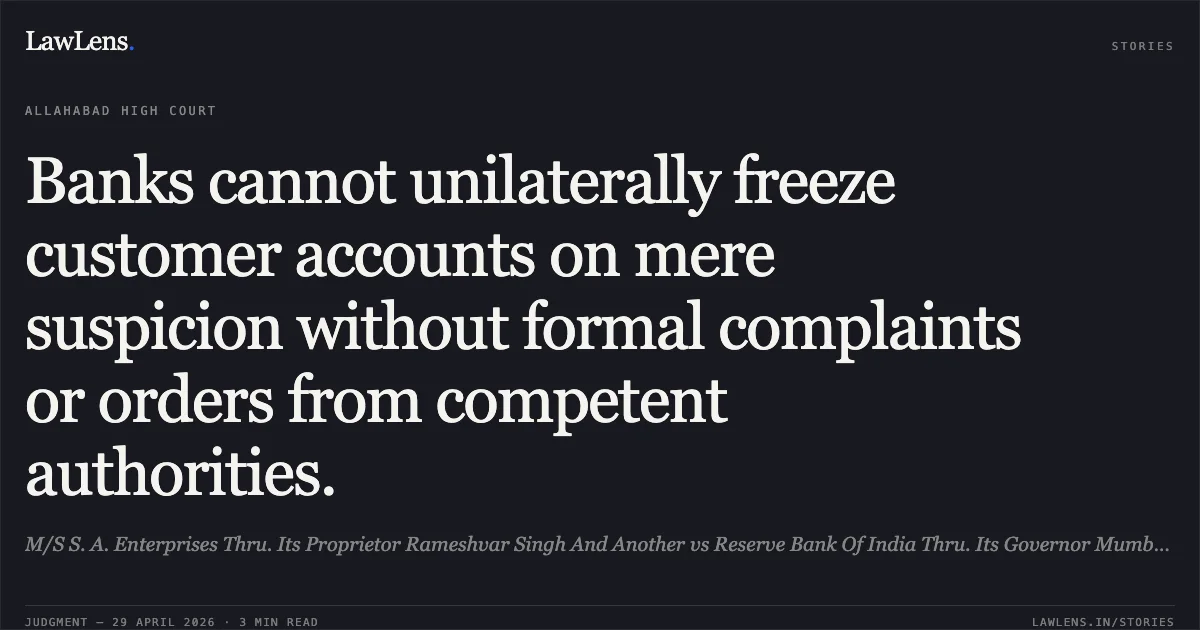
The Court held that a bank cannot transform into an investigative agency and has no authority to freeze an account without a complaint, an order from a competent authority, or a specific statutory lien.
The Court allowed the writ petition and issued a Mandamus directing the Respondent Bank to de-freeze the Petitioner’s account forthwith.
Source reference: para. 28, 32Finding the Bank’s action "vexatious and actuated with mala fides," the Court imposed a cost of ₹50,000/- on the Indian Overseas Bank to be paid to the Petitioner as compensation for financial and reputational damage.
Source reference: para. 27, 33Acts & Sections Cited
6 provisions across 4 statutes referred to in this judgment. Each provision opens on LawLens.
Prevention of Money-Laundering Act, 20022
Bharatiya Nagarik Suraksha Sanhita, 20232
Code of Criminal Procedure, 19731
Indian Contract Act, 18721
Original Court PDF
M/S S. A. Enterprises Thru. Its Proprietor Rameshvar Singh And AnothervsReserve Bank Of India Thru. Its Governor Mumbai And 2 Others
Click to open original judgment
Original judgment, available to read, download and summarize on LawLens.in


